
 By
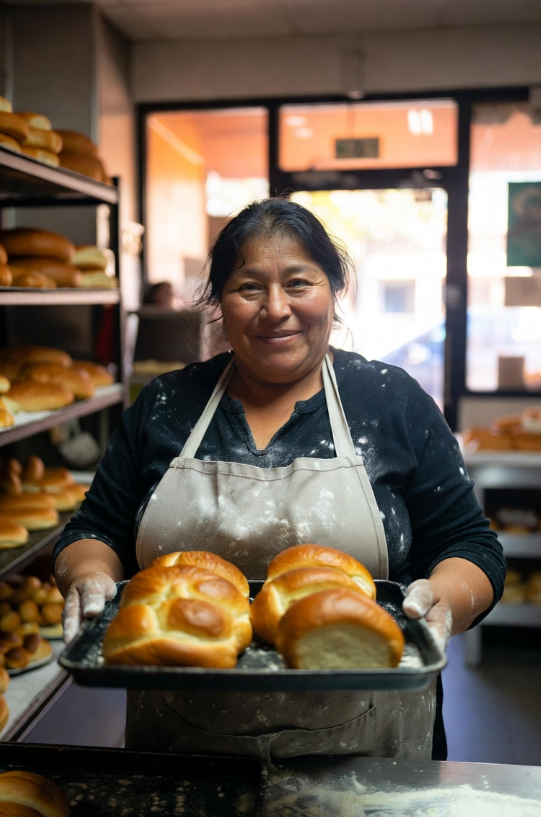
By Christmas week. The bakery is a machine. We are producing at a level that would have seemed impossible a year ago — five hundred conchas a day, plus the holiday items, plus the tamale orders that are still coming in even though I said the deadline was Friday and people seem to think "deadline" means "suggestion." I am sleeping four hours a night. My hands are raw. My back is a topographical map of pain. I have never been happier in my work, which makes no sense and perfect sense, because this is what I was built for — to make food for people at the time of year when food matters most.
Luis Jr. came to the bakery every day this week. No school — Christmas break — and he worked from 5 AM to 2 PM without complaint, without his phone, without the sullen resistance that usually accompanies a sixteen-year-old doing anything his mother asks. He worked because it was needed and because he is becoming the kind of man who does what is needed without being asked why. I watched him carrying trays from the oven to the cooling rack, his arms steady, his face focused, and I thought: when he joins the Army — because I have accepted that he will, the way I accept weather, which is to say reluctantly but completely — when he joins the Army, they will get a man who already knows how to work. I taught him that. Rosa taught me that. The line holds.
Sofia sold her Mexican hot chocolate conchas. The recipe she developed — chocolate-cinnamon dough with dark chocolate shell — went on the menu this week, and they sold out every day. Every single day. The customers love them. Sofia priced them herself, calculated the margin herself, and when I asked her how she learned to calculate margins she said, "YouTube," which is apparently where eleven-year-olds learn everything now, and I don't understand YouTube but I respect its results.
Nochebuena preparations. The tamales are made. The buñuelos are bagged. The ponche de frutas is simmering — the warm fruit punch with guava and tejocotes and sugar cane and cinnamon that Rosa started brewing three days before Christmas and that filled the house in Anapra with a smell so sweet and warm that it felt like the house itself was cooking. I am making it in my kitchen now, and the smell is the same, and the kitchen is different, and Rosa is not here, and the ponche doesn't know. The ponche simmers the same. The cinnamon sticks turn the same slow circles. The guava softens the same way. The recipe does not grieve. The recipe just is.
Alejandro is coming for Christmas. He crosses the bridge on Saturday. Carmen will pick him up. He will stay through New Year's. This will be the first time he has been in our house for Christmas, because Rosa always insisted on Christmas in Anapra, in the house Alejandro built, and we always went there, and now the house has no Rosa in it and Alejandro has no reason to insist and every reason to come to the side of the bridge where his children are, where his grandchildren are, where the tamales are Rosa's recipe even if Rosa's hands didn't make them.
I made rosca de reyes dough this week — started it early because the dough needs to proof and the candied fruit needs to be prepared and the small plastic baby Jesus figurines need to be hidden inside before baking. Rosca de reyes is for January 6, Three Kings Day, but you start in December because good bread requires planning and good planning requires Rosa's voice in your head saying, "Start early, mija. The dough doesn't care about your schedule."
I am ready for Christmas. I am ready for the first Christmas without Rosa. I am ready the way soldiers are ready for battle — not because I want it but because it is coming and readiness is the only option. The tamales are made. The buñuelos are crisp. The ponche is simmering. The tree is up (Diego wired the lights — 4.5 inches apart). The presents are wrapped (Diego's are hand-built and weigh more than they should). And somewhere in heaven — or in Anapra, or in the steam rising from the ponche, or in the flour on Sofia's hands — Rosa is watching, and I hope she is proud, and I think she is, and thinking she is will have to be enough because knowing she is would require her to be alive, and she is not, and that is the one ingredient I cannot add to any recipe, no matter how hard I try.
This year, I needed something simpler alongside the tamales and buñuelos—something that could just sit there, quiet and warm, filling the house with the kind of smell that makes grief feel less like a wall and more like a door. Apple cider in the crockpot is the opposite of everything that requires Rosa’s voice in your head; it asks almost nothing of you, and it gives back a house that smells like you’re ready for something good. Here’s how I made it.
Crockpot Apple Cider
Prep Time: 10 minutes | Cook Time: 2–3 hours | Total Time: 3 hours 10 minutes | Servings: 10
Ingredients
- 1 gallon fresh apple cider
- 3 cinnamon sticks
- 1 teaspoon whole cloves
- 1 teaspoon whole allspice berries
- 1 orange, sliced into rounds
- 1 apple, cored and sliced
- 1/4 cup brown sugar (adjust to taste)
- 1/4 teaspoon ground nutmeg
- Optional: 1 star anise pod
Instructions
- Combine. Pour the apple cider into a 6-quart slow cooker. Add the cinnamon sticks, cloves, allspice, and star anise if using.
- Add fruit and sweetener. Lay the orange and apple slices over the top. Stir in the brown sugar and ground nutmeg.
- Slow cook. Cover and cook on LOW for 2 to 3 hours, until the cider is fragrant and steaming and the spices have fully bloomed. Do not boil.
- Strain and serve. Use a ladle to serve directly from the slow cooker, straining out whole spices as needed. Leave the cinnamon sticks in — they will keep turning their slow circles as long as the pot is warm.
- Keep warm. Switch the slow cooker to the WARM setting for serving throughout the evening. The cider holds beautifully for up to 4 hours.
Nutrition (per serving)
Calories: 130 | Protein: 0g | Fat: 0g | Carbs: 32g | Fiber: 1g | Sodium: 20mg