
 By
By The liminal week. Between Christmas and New Year's. Miya at Brian's for New Year's Eve (the calendar). I am alone with the ozoni components and the apartment and the decision that has been forming for months: I am going to go off the medication. In January. After the holidays. I will tell my therapist. I will work with my doctor. I will do it gradually, responsibly, with supervision. But I am going to do it. After twenty-four years. I want to know who I am without it.
The decision feels brave and terrifying in equal measure, the way all important decisions feel: the bravery and the terror are the same coin, and the coin is in my hand, and I am about to flip it. The flip will determine: either the practice (yoga, cooking, writing, therapy) is strong enough to hold me without the medication, or it is not. The either is the experiment. The experiment is the risk. The risk is the living.
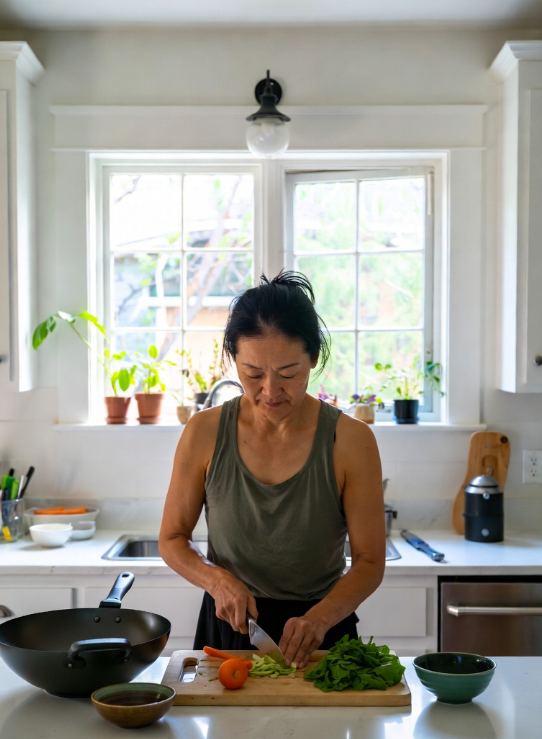
I made ozoni. The eleventh year. The soup from memory, from muscle, from the body that has made this soup so many times that the soup is the body and the body is the soup. The dashi was deep. The miso dissolved perfectly. The mochi puffed. The taste was correct. The correctness was not a surprise. The correctness was the expectation met. The expectation is the practice. The practice meets the expectation every time. The every-time is the confidence. The confidence is the foundation on which I am basing the decision to remove one of the four pillars and see if the building stands.
At midnight, alone in the kitchen: "Happy New Year, Fumiko. I am going to try something brave. I hope you would approve. I think you would say: 'Be careful.' I will be careful. I will be careful the way you were careful with dashi — with attention, with precision, with the understanding that the margin for error is thin and the consequences of error are real. I will be careful. I will also be brave. The careful and the brave are the same thing. They have always been the same thing."
After the ozoni was done and the dashi pot was clean and the mochi wrappers were in the recycling, I needed something to do with my hands — something that required the same quality of attention, the same margin-for-error awareness, but that belonged to the rest of the night rather than to the ritual. A cranberry apple pie felt right: tart and sweet in the same bite, two things that seem opposite until you taste them together, which is exactly the kind of thing I needed to be reminded of at midnight on the last night of the year. This is the pie I make when I need the kitchen to hold me.
Cranberry Apple Pie
Prep Time: 30 min | Cook Time: 55 min | Total Time: 1 hr 25 min | Servings: 8
Ingredients
- 1 double pie crust (homemade or store-bought), divided
- 3 medium apples (such as Granny Smith or Honeycrisp), peeled, cored, and thinly sliced
- 1 1/2 cups fresh or frozen cranberries
- 3/4 cup granulated sugar
- 2 tablespoons brown sugar
- 3 tablespoons cornstarch
- 1 teaspoon ground cinnamon
- 1/4 teaspoon ground nutmeg
- 1/4 teaspoon fine salt
- 1 tablespoon fresh lemon juice
- 1 teaspoon pure vanilla extract
- 2 tablespoons unsalted butter, cut into small pieces
- 1 egg, beaten (for egg wash)
- 1 tablespoon coarse sugar (for topping)
Instructions
- Preheat and prep. Preheat your oven to 400°F (205°C). Roll out one half of your pie crust and fit it into a 9-inch pie pan, letting the edges overhang by about 1 inch. Refrigerate while you prepare the filling.
- Make the filling. In a large bowl, combine the sliced apples, cranberries, granulated sugar, brown sugar, cornstarch, cinnamon, nutmeg, and salt. Add the lemon juice and vanilla extract and toss everything together until the fruit is evenly coated. Let sit for 5 minutes so the juices begin to release.
- Fill the crust. Pour the filling into the chilled pie shell, mounding it slightly in the center. Dot the top of the filling evenly with the small pieces of butter.
- Top the pie. Roll out the second half of the crust. Lay it over the filling and trim the edges to a 1-inch overhang. Fold the top and bottom crusts together and crimp firmly to seal. Cut 5 or 6 small slits in the top crust to allow steam to escape.
- Egg wash and sugar. Brush the top crust evenly with the beaten egg, then sprinkle with coarse sugar for a golden, crackled finish.
- Bake. Place the pie on a rimmed baking sheet to catch any drips. Bake at 400°F for 20 minutes, then reduce the heat to 375°F and bake for an additional 30–35 minutes, until the crust is deep golden brown and the filling is bubbling through the vents. If the crust edges brown too quickly, cover them loosely with foil.
- Cool before slicing. Transfer the pie to a wire rack and let it cool for at least 2 hours before cutting. The filling needs this time to set — this is the part that requires patience.
Nutrition (per serving)
Calories: 370 | Protein: 3g | Fat: 14g | Carbs: 59g | Fiber: 3g | Sodium: 210mg