
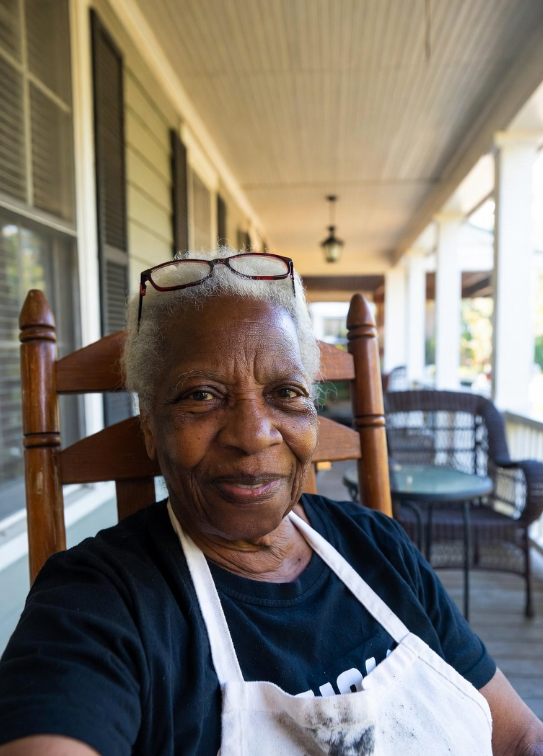
 By
By I went to the Port of Savannah this week to see Andre at work. Denise arranged it — a visitor's pass, a parking spot, an escort through the gates. The port is enormous. Container ships the size of apartment buildings. Cranes that look like mechanical dinosaurs. Trucks moving in lines that stretch to the horizon. And somewhere in this organized chaos, my grandson — Denise's boy, the one who graduated from Georgia Southern seven months ago — sits at a desk and manages the flow of goods from one side of the world to the other.
Andre met us at the visitor center. He was wearing khakis and a polo shirt with the port logo, and he looked like a man who has found his place, which is the thing every grandmother wants to see — not success, not money, not titles, but a person who fits where they are. He walked us to the overlook where you can see the container yard, and I stood there looking at the cranes and the ships and the water and I thought about Daddy.
James Williams. My father. The longshoreman. The man who worked these docks — not these exact docks, the old ones, before the port was modernized and expanded and turned into the fourth-largest container port in the country — but this water. This same Savannah River. He loaded cargo with his hands until his back gave out when I was twelve. He came home smelling like salt and diesel and exhaustion, and Hattie Pearl fed him supper and he ate it standing up sometimes because his back hurt too much to sit, and he never complained because complaining was not in his vocabulary. He just worked. He just showed up.
Andre said, "Granny, want to see my office?" I said, "Yes." He took me to a room with a window that overlooked the river. He had a computer and a phone and a coffee mug that said "Georgia Southern Alumni" and a framed photo on his desk of the whole family at his graduation. I looked out the window at the water — the same water, the same river, the same Savannah that has been moving cargo and lives and dreams since before any of us were here — and I said, "Andre, your great-grandfather James would be proud. He would stand in this office and he wouldn't say anything because James Williams was not a man who used words when silence said it better. But he would be proud."
Made Frogmore stew tonight. For Daddy. For James Williams. For the man who worked the docks. The shrimp came from the same water his ships came from. The food is the bridge between the docks he worked and the office his great-grandson works in. The food crosses the years the way the ships cross the water. Everything connects. Everything returns.
Now go on and feed somebody.
Standing at that overlook with Andre, watching the same Savannah River water that James Williams worked beside for decades, I knew the only thing to bring to the table that night had to come from the sea. I’d already told you about the Frogmore stew I made for Daddy’s memory — but later in the week, when the family gathered to hear the full story of Andre’s office and that view and that framed photograph, I made these Crab Rangoon as a starter, because crab comes from the same coastal waters the shrimp do, the same water those ships have always moved through, and there is something right about pulling the sea to your table when the sea is where your people made their lives.
Crab Rangoon
Prep Time: 20 min | Cook Time: 15 min | Total Time: 35 min | Servings: 6 (about 4 pieces each)
Ingredients
- 8 oz cream cheese, softened to room temperature
- 6 oz lump crab meat, well drained and picked over
- 3 green onions, finely chopped
- 1 tsp Worcestershire sauce
- 1 tsp soy sauce
- 1/2 tsp garlic powder
- 1/4 tsp black pepper
- 24 square wonton wrappers
- 1 small bowl of water (for sealing)
- Vegetable oil, for frying (about 3 cups)
- Sweet and sour sauce or duck sauce, for serving
Instructions
- Make the filling. In a medium bowl, combine softened cream cheese, drained crab meat, green onions, Worcestershire sauce, soy sauce, garlic powder, and black pepper. Mix until thoroughly combined and smooth.
- Fill the wontons. Lay a wonton wrapper flat on a clean surface. Place 1 heaping teaspoon of the crab filling in the center. Dip your fingertip in water and lightly dampen all four edges of the wrapper.
- Seal the wontons. Fold the wrapper diagonally to form a triangle, pressing firmly to seal the edges and push out any air pockets around the filling. You can also bring all four corners up to the center and pinch to form a purse shape — either works.
- Heat the oil. Pour vegetable oil into a deep skillet or medium saucepan to a depth of about 2 inches. Heat over medium-high heat until the oil reaches 350°F. Use a thermometer if you have one; if not, a small piece of wonton wrapper should sizzle and float immediately when dropped in.
- Fry in batches. Add 6–8 rangoons at a time, being careful not to crowd the pan. Fry for 2 to 3 minutes, turning once, until golden brown and crisp on all sides. Adjust heat as needed to maintain temperature.
- Drain and rest. Remove with a slotted spoon or spider and transfer to a plate lined with paper towels. Let drain for 1 minute before serving.
- Serve warm. Arrange on a platter and serve immediately with sweet and sour sauce or duck sauce on the side for dipping.
Nutrition (per serving)
Calories: 225 | Protein: 9g | Fat: 13g | Carbs: 18g | Fiber: 1g | Sodium: 390mg