
 By
By One hundred and twelve degrees on Tuesday. One hundred and twelve. The sidewalk outside Station 19 could fry an egg, and I know this because Ruiz actually tried it during a slow stretch and the egg cooked in four minutes. We documented it photographically. This is what firefighters do when we're not saving lives — we conduct unnecessary food experiments and text the evidence to our wives.
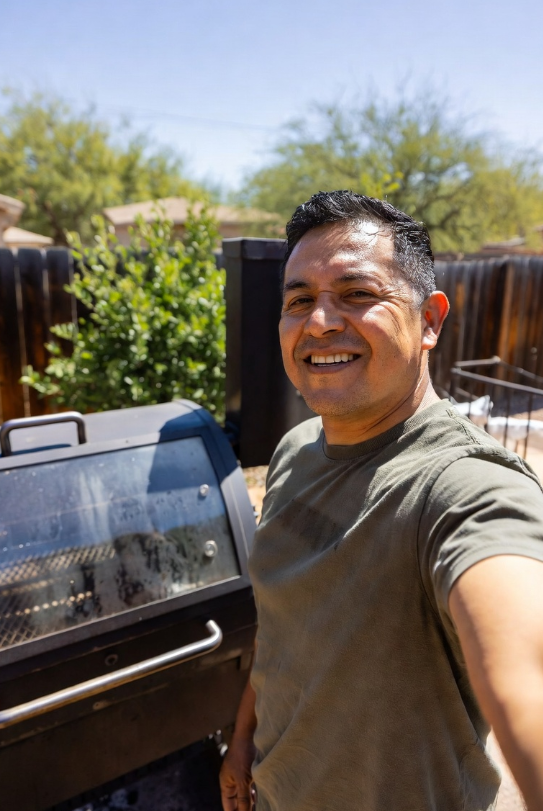
Summer in Phoenix is a test of character. The rest of the country complains about their heat waves — "oh no, it's 95 in New York" — and I want to reach through the screen and explain that 95 is a pleasant autumn day here. In Phoenix, summer means you don't touch your steering wheel without oven mitts. Your car's AC takes twenty minutes to do anything useful. Dogs refuse to walk on the pavement. And yet we grill. We grill through it. Because what else are you going to do, go inside? I'm not going inside. The smoker is outside. Therefore I am outside. This is logic.
I did a practice brisket this weekend — the competition prep I've been planning. Bought a fourteen-pound packer from Costco, trimmed it down to about twelve, rubbed it with just salt and coarse black pepper. Started at 3 AM to beat the worst of the heat. By the time the sun was really cranking at 10 AM, the brisket was through the stall and wrapped in butcher paper. I spritzed it with apple cider vinegar every hour. Pulled it at 5 PM. Let it rest in a cooler for ninety minutes.
The flat was good — tender, even, with a solid smoke ring. The point was great — unctuous, beefy, the fat rendered perfectly. The bark was the best I've ever gotten: a deep, mahogany crust that cracked when you bent the slice. But the seasoning was one-note. Salt and pepper is classic, but for competition I need more depth. I'm thinking about adding a tiny amount of garlic powder and onion powder to the rub — heresy to the Texas purists, but I'm not from Texas, I'm from Phoenix, and in Phoenix we improvise.
Jessica tasted it and said "this is the best thing you've ever made" which is what she says about every brisket because she's loyal, not discerning. My dad tasted it and said nothing for a full thirty seconds, then said "the point is better than the flat." He's right. I need to work on the flat. Back to the drawing board. Back to 3 AM. Back to the grill. This is the process and I love it.
My dad’s thirty-second silence told me everything I needed to know—this cook was close, but not there yet, and that gap is exactly what keeps me coming back to the pit at 3 AM. So here’s the recipe as it stands right now: the best bark I’ve ever produced, a point that made a quiet man pause, and a flat I’m still chasing. Think of it as a snapshot of a work in progress—cook it, eat it, and maybe you’ll have ideas I haven’t thought of yet.
Competition-Style Salt and Pepper Brisket
Prep Time: 45 min (plus overnight trim) | Cook Time: 14–16 hours | Total Time: ~17 hours | Servings: 18–20
Ingredients
- 1 whole packer brisket (14 lb), trimmed to approximately 12 lb with 1/4-inch fat cap
- 3 tablespoons coarse kosher salt
- 3 tablespoons coarse black pepper (16-mesh or freshly cracked coarse)
- 1 teaspoon garlic powder
- 1/2 teaspoon onion powder
- Apple cider vinegar in a clean spray bottle, for spritzing
- Butcher paper (uncoated), for wrapping
- Post oak or hickory wood chunks, enough for 8–10 hours of smoke
Instructions
- Trim the brisket. The night before your cook, trim the cold brisket on a sturdy cutting board. Remove hard fat deposits from the point, thin out any paper-thin meat edges that will burn, and bring the fat cap down to an even 1/4 inch across the flat. Cold fat trims cleanly —this step is easier straight from the fridge. Pat the brisket completely dry with paper towels.
- Apply the rub. Combine salt, pepper, garlic powder, and onion powder in a small bowl and stir to distribute evenly. Season the brisket aggressively on all sides —you want visible crust coverage, not a light dusting. Let the rubbed brisket sit uncovered in the refrigerator overnight, or at minimum one hour at room temperature before cooking.
- Fire the smoker. Start your smoker at 3 AM if cooking in summer heat —you want the long middle hours of the cook finished before peak afternoon temperatures. Bring your smoker to a stable 250°F with clean smoke rolling. Add wood chunks to establish your smoke base before the meat goes on.
- Start the smoke. Place the brisket fat-side up (or down depending on your smoker’s heat source —fat toward the heat). Do not open the lid for the first 3 hours. Let the bark begin to set undisturbed.
- Spritz every hour. Beginning at the 3-hour mark, spritz the brisket lightly with apple cider vinegar every 60 minutes. This keeps the surface from drying out, encourages bark development, and adds a mild acidity that balances the rub. Do not over-spritz —a light mist, not a soak.
- Monitor the stall. Around 160–170°F internal temperature, the brisket will stall as evaporative cooling plateaus the temp. Do not panic. Do not raise the heat. This is normal and can last 2–4 hours.
- Wrap in butcher paper. Once the bark is deep mahogany and set firm to the touch (typically at the stall, around 165–170°F), pull the brisket and wrap tightly in two layers of uncoated butcher paper. Return to the smoker at 250°F.
- Cook to temperature, not time. Continue cooking until the thickest part of the flat probes between 200–205°F and the probe slides in with no resistance —like pushing into warm butter. The point will probe even softer. Total cook time is typically 14–16 hours depending on your smoker and the specific brisket.
- Rest in a cooler. Remove the wrapped brisket from the smoker and place it directly into a dry cooler (no ice). Close the lid and rest for a minimum of 90 minutes, up to 3 hours. This step is not optional —resting allows the juices to redistribute and the collagen to finish converting. Skipping it is the fastest way to a dry flat.
- Slice and evaluate. Unwrap on a cutting board and separate the flat from the point along the fat seam. Slice the flat against the grain into 1/4-inch slices. Slice the point into thicker chunks. Evaluate your bark, your smoke ring, your moisture level, and your seasoning balance. Take notes. Adjust your rub ratios for the next cook. This is the process.
Nutrition (per serving, approximately 6 oz cooked brisket)
Calories: 390 | Protein: 42g | Fat: 24g | Carbs: 1g | Fiber: 0g | Sodium: 620mg