
 By
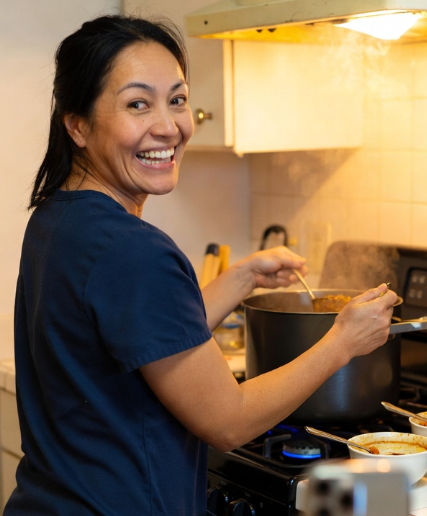
By The publisher responded. Not a yes. Not a no. A "we're interested, let's discuss." The three words that are not a book deal but are not a rejection and are, in the landscape of publishing, the equivalent of a first date — the mutual agreement to explore, the cautious willingness to see if the thing has potential. The thing has potential. The thing is my life in recipes. The potential has been simmering for six years.
I called Angela first. "They're interested." Angela screamed. The Santos scream. I called Lourdes. "The book people said they want to talk." Lourdes said, "Did you include the vinegar note?" I said, "Yes, Mama, the vinegar note is in the book." She said, "Good." The vinegar note — Lourdes's insistence that the book specify Datu Puti by name — is the most important detail in the entire sixty-page proposal, according to Lourdes. The book could be a bestseller or a disaster and Lourdes would evaluate it on a single criterion: did you specify the correct vinegar? The answer is yes. The book will be evaluated accordingly.
I made lechon kawali to celebrate. The crispy pork belly. The pork shattered. The vinegar dipped. The celebration was quiet — just me, at the table, eating pork that crackles and drinking a beer and feeling the particular warmth of a thing that might become a thing, the potential that is not yet reality but is closer to reality than it was yesterday.
I had planned lechon kawali — and I made it, I ate it, it was right for that night. But the next day the quiet thrill was still there, and quiet thrills deserve a second meal, something that cooks low and slow the way a good thing builds: the Company Pot Roast, which Lourdes always made when there was news worth honoring but too fragile to shout about. It’s the meal I reach for when I need the kitchen to do the celebrating while I sit still and try to believe the potential is real. Six years of simmering, and now the pot roast, and now we wait.
Company Pot Roast
Prep Time: 20 minutes | Cook Time: 3 hours 30 minutes | Total Time: 3 hours 50 minutes | Servings: 8
Ingredients
- 3 to 4 lbs boneless beef chuck roast
- 2 tablespoons olive oil
- 1 teaspoon kosher salt
- 1/2 teaspoon black pepper
- 1 large yellow onion, roughly chopped
- 4 cloves garlic, smashed
- 3 medium carrots, cut into 2-inch pieces
- 3 stalks celery, cut into 2-inch pieces
- 1 lb baby potatoes, halved
- 1 cup beef broth
- 1/2 cup dry red wine (or additional broth)
- 2 tablespoons tomato paste
- 1 tablespoon Worcestershire sauce
- 2 sprigs fresh thyme (or 1/2 teaspoon dried thyme)
- 1 bay leaf
- 2 tablespoons cornstarch mixed with 2 tablespoons cold water (optional, for gravy)
Instructions
- Preheat and season. Preheat your oven to 325°F (165°C). Pat the chuck roast dry with paper towels and season generously on all sides with salt and pepper.
- Sear the roast. Heat olive oil in a large Dutch oven over medium-high heat. Add the roast and sear without moving it for 4 to 5 minutes per side, until a deep brown crust forms. Transfer the roast to a plate.
- Build the base. Reduce heat to medium. Add the onion and celery to the Dutch oven and cook, stirring occasionally, for 3 to 4 minutes until softened. Add the garlic and cook 1 minute more. Stir in the tomato paste and cook for 2 minutes until it darkens slightly.
- Deglaze and combine. Pour in the red wine, scraping up any browned bits from the bottom of the pot. Add the beef broth, Worcestershire sauce, thyme sprigs, and bay leaf. Stir to combine.
- Return the roast and braise. Nestle the seared roast back into the pot. The liquid should come about halfway up the sides of the meat. Bring to a gentle simmer, then cover tightly and transfer to the oven.
- Add vegetables. After 2 hours, carefully remove the pot from the oven. Add the carrots and baby potatoes around the roast. Cover and return to the oven for an additional 1 hour to 1 hour 30 minutes, until the meat is fork-tender and the vegetables are cooked through.
- Rest and finish the gravy. Transfer the roast and vegetables to a serving platter and tent loosely with foil. Discard the thyme sprigs and bay leaf. If desired, bring the braising liquid to a simmer on the stovetop and whisk in the cornstarch slurry, cooking 2 to 3 minutes until thickened into a rich gravy. Taste and adjust seasoning.
- Serve. Slice or pull apart the roast and serve with the vegetables and gravy spooned over the top.
Nutrition (per serving)
Calories: 410 | Protein: 38g | Fat: 18g | Carbs: 22g | Fiber: 3g | Sodium: 480mg