
 By
By May. The light is returning in earnest now — sixteen hours of daylight, the sun up before 6 AM, the evening stretching past 10 PM, the Alaskan spring asserting itself with the particular aggressiveness of a season that has been waiting for five months. The light is medicine. Literal medicine — the SAD lamp is off now, the real sun doing the work the artificial one couldn't, the photons hitting my retinas and telling my brain: it's okay. You can relax. The dark is over. The dark is over for now.
The pandemic is not over. But the light makes the pandemic more bearable, the way light makes everything more bearable — the ER shifts still end in exhaustion, the PPE still leaves marks, the patients still come, some leave and some don't, but the driving-home happens in daylight now, and the driving-home-in-daylight is a completely different experience from the driving-home-in-darkness, and the difference is hope. Hope is photons. Hope is May in Alaska. Hope is the mountain out the car window catching the evening sun and turning gold.
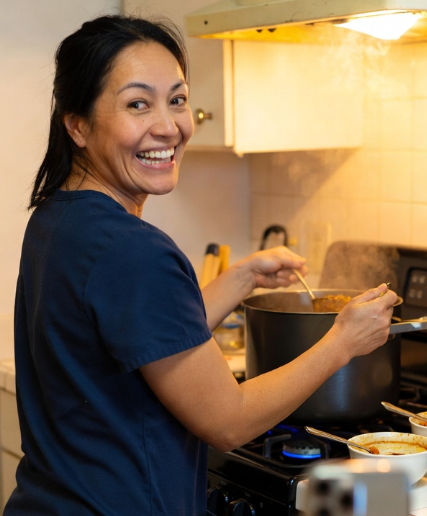
I started cooking for the ER staff more deliberately — weekly drops, batch-cooked, labeled, left in the break room. Adobo. Pancit. Sinigang. The Filipino comfort food canon, deployed in a hospital break room where exhausted nurses eat standing up between crises. Pete said, "Santos, you're feeding the whole department." I said, "Someone has to." He said, "We appreciate it." The "we appreciate it" was Pete-speak for "we love you and the food is keeping us alive and please don't stop." I won't stop. Feeding people is what I do. Feeding people is the thing that holds me together while everything else falls apart.
The blog readership has increased during the pandemic. People cooking at home, looking for recipes, finding my posts about Filipino food. The moose adobo post is getting shared again — people searching for comfort food, finding the essay about an immigrant kitchen in Alaska, connecting. Ten thousand readers last week. The pandemic is bringing people to the kitchen the way the breakdown brought me to the kitchen: desperately, necessarily, with no other option and the surprising discovery that the kitchen is the room where survival happens.
Pancit is the dish I make when someone needs to feel held — noodles batch-cooked in quantity, carried into a break room in foil pans, eaten standing up by people who are doing the hardest work of their lives. When I can’t make pancit on a given week, these curry noodle bowls are what I reach for instead: the same generous spirit, the same make-a-big-pot-and-share logic, the same warmth that says I see you, I made this for you, please sit down even if only for five minutes. They travel well, reheat beautifully, and they carry exactly the kind of comfort that May light and feeding people are both trying to deliver.
Comforting Curry Noodle Bowls
Prep Time: 15 minutes | Cook Time: 30 minutes | Total Time: 45 minutes | Servings: 6
Ingredients
- 8 oz rice noodles or egg noodles
- 1 tablespoon coconut oil or neutral oil
- 1 medium yellow onion, thinly sliced
- 4 cloves garlic, minced
- 1 tablespoon fresh ginger, grated
- 2 tablespoons red curry paste
- 1 teaspoon ground turmeric
- 1 teaspoon ground cumin
- 1 can (14 oz) full-fat coconut milk
- 4 cups low-sodium chicken or vegetable broth
- 1 tablespoon fish sauce (or soy sauce for vegetarian)
- 1 tablespoon lime juice, plus wedges for serving
- 2 cups cooked shredded chicken or sliced tofu
- 2 cups baby spinach or bok choy, roughly chopped
- Salt and pepper to taste
- Sliced green onions, fresh cilantro, and chili flakes for topping
Instructions
- Cook the noodles. Prepare noodles according to package directions until just al dente. Drain, rinse with cold water to stop cooking, and set aside. Toss with a little oil to prevent sticking.
- Build the base. Heat oil in a large heavy-bottomed pot or Dutch oven over medium heat. Add onion and cook, stirring occasionally, until softened and lightly golden, about 6–8 minutes.
- Bloom the aromatics. Add garlic and ginger and cook 1 minute until fragrant. Stir in curry paste, turmeric, and cumin; cook another 2 minutes, stirring constantly, until the paste darkens slightly and smells toasted.
- Add the liquids. Pour in the coconut milk and broth, scraping up any browned bits from the bottom of the pot. Stir in fish sauce and lime juice. Bring to a gentle simmer over medium heat.
- Simmer and season. Let the broth simmer uncovered for 12–15 minutes to develop flavor. Taste and adjust salt, pepper, lime juice, or curry paste as needed.
- Add protein and greens. Stir in shredded chicken or tofu and cook 3 minutes until heated through. Add spinach or bok choy and stir just until wilted, about 1–2 minutes.
- Assemble the bowls. Divide noodles among bowls or containers. Ladle the hot curry broth and solids over the noodles. Top with green onions, cilantro, and chili flakes. Serve with lime wedges.
- For batch cooking. Store noodles and broth separately in airtight containers. Refrigerate up to 4 days. Reheat broth on the stovetop or microwave and pour over noodles when ready to serve.
Nutrition (per serving)
Calories: 390 | Protein: 24g | Fat: 16g | Carbs: 38g | Fiber: 3g | Sodium: 620mg