
 By
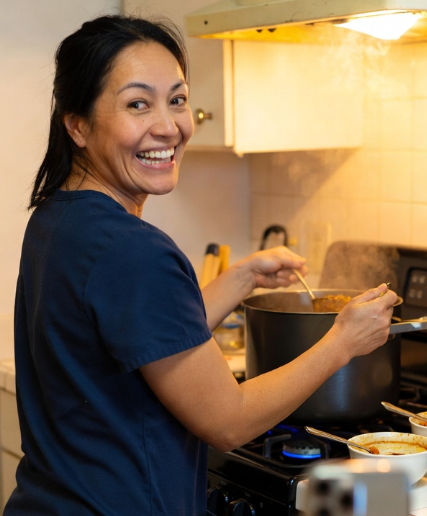
By The blog had a good week. I wrote about cooking alone — the specific, sustained experience of cooking for one in an apartment where the only sounds are the ones you make. The post wasn't sad. The post was honest. The honest included the parts that are good (the freedom to make whatever you want, the control over seasoning, the quiet that is sometimes peaceful) and the parts that are hard (the quiet that is sometimes lonely, the table set for one, the standing-up eating that happens when sitting alone at a table feels too formal for a solitary meal).
Eight thousand views. The alone-cooking audience is large and loyal and quietly grateful for a writer who doesn't treat cooking for one as either a pathology or a liberation but as a fact, a daily fact, the fact of a life that includes both the freedom and the loneliness and doesn't need either to be erased.
Pete asked about Lourdes this week. "How's your mom?" he said, in the break room, eating the sinigang I'd brought. Pete has been absorbed into the Santos family orbit — he asks about Lourdes, he knows about the twins, he remembers Angela's pregnancy. The absorption is complete. Pete is family now, in the way that people who eat your food three times a week become family — not by blood but by broth, not by birth but by bowl.
I made dinuguan — the pork blood stew, the challenging dish, the dish that doesn't apologize. I'm in a dinuguan mood this week — dark, rich, unapologetic. The mood is not bad. The mood is honest. Some weeks are dinuguan weeks. The darkness is a flavor, not a diagnosis. The richness is the reward for accepting the darkness. The stew is the whole mood. The mood is the whole stew.
I said it in the story and I’ll say it again: some weeks are dinuguan weeks, and this was one of them — dark, rich, and not interested in apologizing for either quality. Since I couldn’t exactly hand Pete a bowl of pork blood stew in the break room without a full explanation, I channeled that same unapologetic intensity into something that speaks the same flavor language: a coffee marinated steak, deeply savory, a little bitter, the kind of dish that doesn’t soften its edges for anyone. The coffee does what the blood does in dinuguan — it pulls the darkness forward and makes it the whole point.
Coffee Marinated Steak
Prep Time: 15 min + 1 hr marinating | Cook Time: 14 min | Total Time: ~1 hr 30 min | Servings: 4
Ingredients
- 2 lbs flank steak (or skirt steak)
- 1/2 cup strong brewed coffee, cooled to room temperature
- 3 tablespoons soy sauce
- 2 tablespoons olive oil
- 1 tablespoon brown sugar
- 4 cloves garlic, minced
- 1 teaspoon smoked paprika
- 1 teaspoon black pepper
- 1/2 teaspoon ground cumin
- 1/2 teaspoon kosher salt, plus more to taste
- Fresh parsley or cilantro, for serving (optional)
Instructions
- Mix the marinade. In a bowl or large zip-top bag, whisk together the cooled coffee, soy sauce, olive oil, brown sugar, garlic, smoked paprika, black pepper, cumin, and salt until the sugar dissolves.
- Marinate the steak. Add the flank steak to the marinade, turning to coat thoroughly. Seal and refrigerate for at least 1 hour, or up to 8 hours. Do not marinate longer than 8 hours — the coffee’s acidity will begin to break down the texture.
- Bring to room temperature. Remove the steak from the refrigerator 30 minutes before cooking. Pat dry with paper towels. Discard the marinade.
- Sear the steak. Heat a cast-iron skillet or grill pan over high heat until very hot. Add a thin film of oil. Sear the steak 5–7 minutes per side for medium-rare, depending on thickness, without moving it. You want a dark, caramelized crust.
- Rest before slicing. Transfer steak to a cutting board and let it rest for 8–10 minutes. This step is not optional — it keeps the steak juicy.
- Slice and serve. Cut against the grain into thin strips. Season with a pinch of flaky salt if desired, and finish with fresh parsley or cilantro.
Nutrition (per serving)
Calories: 370 | Protein: 42g | Fat: 19g | Carbs: 5g | Fiber: 0g | Sodium: 610mg