Spring has arrived with full conviction. Sixty-five degrees, sun, the kind of Detroit weather that makes you forget the six months of gray that preceded it. I grilled three times this week — Monday (burgers after work), Wednesday (chicken thighs for dinner), and Saturday (ribs, my second attempt, better than the first — less salt, more time, the rub has been refined). The balcony smells permanently of charcoal and smoke, and our downstairs neighbors have started appearing when I grill, attracted by the smoke the way deer are attracted to salt licks. Mr. Peterson from the third floor came up on Saturday and we grilled side by side — his steaks, my ribs — and we talked about heat management and coal placement and the philosophy of patience. Grilling is the most patient form of cooking. You light the fire and then you wait. You tend. You watch. You do not rush. The meat will be ready when the meat is ready. There is a life lesson in there that I have not fully absorbed but am working on.
Mama dropped off a container of greens on Tuesday. Unprompted. Unannounced. She pulled up, left the container on the porch, rang the bell, and drove away. The culinary drive-by is her signature move, deployed when she senses nutritional deficiency or emotional need or simply when she has made too much food, which is always. I ate the greens with cornbread (my recipe, from the cast-iron skillet) and hot sauce, and the meal was two generations in one bowl: her greens, my bread.
Zaria is nine months old and pulling herself to standing. She grabs the edge of the couch, the coffee table, Aiden's leg, anything that provides vertical leverage, and hauls herself upright with the determination of a climber summiting a wall. Once upright, she stands there, wobbling, triumphant, and then sits down with a thump and does it again. Aiden cheers every time: "Zee standing! Zee standing!" He is her biggest fan. It will not always be this way — sibling rivalry is inevitable — but right now, at three and nine months, they are allies, and the alliance is beautiful.
I made spaghetti on Thursday with a twist: homemade meat sauce, simmered for two hours. Not Mama's three-hour version — I do not have three hours on a Thursday — but a real sauce. San Marzano tomatoes (Mama specified the brand during a phone consultation), garlic, onion, Italian sausage, ground beef, basil, oregano, a little sugar to cut the acidity. It was noticeably better than the Ragu version. Brianna said, "This doesn't taste like the jar." It does not. It tastes like effort. Effort has a flavor. I am learning what it is.
That Thursday night spaghetti sauce changed something in me. Once Brianna said it didn’t taste like the jar, I knew I wasn’t going back. So the next weekend, with the grill cooling down from another round of ribs and Mr. Peterson’s encouragement still ringing in my ears, I took that same homemade meat sauce and layered it into a full Classic Italian Lasagna — the kind of dish that rewards patience the same way grilling does. Mama would have let it simmer three hours. I gave it what I had, and what I had was enough.
Classic Italian Lasagna
Prep Time: 30 minutes | Cook Time: 1 hour 30 minutes | Total Time: 2 hours | Servings: 10
Ingredients
- 1 pound ground beef
- 1 pound Italian sausage, casings removed
- 1 large yellow onion, diced
- 4 cloves garlic, minced
- 1 can (28 oz) San Marzano crushed tomatoes
- 1 can (15 oz) tomato sauce
- 2 tablespoons tomato paste
- 1 teaspoon sugar
- 2 teaspoons dried basil
- 1 teaspoon dried oregano
- 1/2 teaspoon red pepper flakes
- Salt and black pepper to taste
- 12 lasagna noodles
- 15 ounces ricotta cheese
- 1 large egg
- 1/4 cup fresh parsley, chopped
- 4 cups shredded mozzarella cheese, divided
- 1 cup freshly grated Parmesan cheese, divided
Instructions
- Brown the meat. In a large Dutch oven or deep skillet over medium-high heat, cook the ground beef and Italian sausage, breaking it into small pieces, until browned and no longer pink, about 8–10 minutes. Drain excess fat.
- Build the sauce. Add the diced onion to the pot and cook until softened, about 5 minutes. Add the garlic and cook 1 minute more. Stir in the crushed tomatoes, tomato sauce, tomato paste, sugar, basil, oregano, red pepper flakes, salt, and pepper. Bring to a simmer, then reduce heat to low and cook uncovered for 45 minutes, stirring occasionally.
- Cook the noodles. While the sauce simmers, bring a large pot of salted water to a boil. Cook lasagna noodles according to package directions until just al dente. Drain and lay flat on a lightly oiled sheet pan to prevent sticking.
- Make the ricotta filling. In a medium bowl, combine the ricotta cheese, egg, parsley, and a pinch of salt and pepper. Stir until smooth.
- Preheat the oven. Heat oven to 375°F.
- Layer the lasagna. Spread 1 cup of meat sauce on the bottom of a 9x13-inch baking dish. Layer 4 noodles over the sauce. Spread 1/3 of the ricotta mixture over the noodles, then top with 1/3 of the remaining meat sauce, 1 cup mozzarella, and 1/4 cup Parmesan. Repeat layers two more times. Top the final layer with remaining mozzarella and Parmesan.
- Bake. Cover tightly with aluminum foil and bake for 25 minutes. Remove foil and bake an additional 20–25 minutes until the cheese is golden and bubbling.
- Rest before serving. Let the lasagna rest for 15 minutes before cutting. This is the patience part — it lets the layers set so each slice holds together.
Nutrition (per serving)
Calories: 520 | Protein: 34g | Fat: 28g | Carbs: 32g | Fiber: 3g | Sodium: 980mg
About the cook who shared this
DeShawn Carter
Week 109 of DeShawn’s 30-year story
· Detroit, Michigan
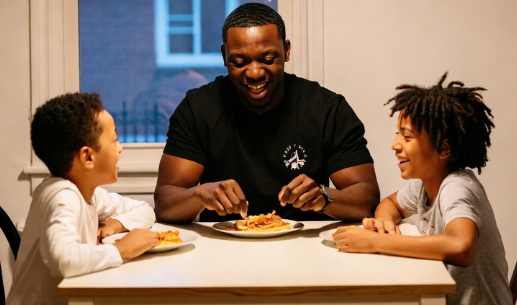
DeShawn is a thirty-six-year-old single dad, auto plant worker, and a man who didn't learn to cook until his wife left and his five-year-old asked, "Daddy, can you cook something?" He called his mama, who came over with two bags of groceries and spent six months teaching him the basics. Now he's the dad at the cookout who brings the ribs, the guy at the plant whose leftover gumbo starts fights, and living proof that it's never too late to learn.
