
 By
By May approaches and the pandemic has not broken. But something in me has shifted — from reactive to adaptive, from surviving to functioning, from grief to something that resembles, if not optimism, then at least forward motion. The drive-by feeding is in its fifth week. The cooking-with-Sofia sessions are daily. The firehouse runs on my stews and my tacos and the knowledge that the kitchen does not close, even when the world does.
I had an idea this week: teach Sofia fractions through cooking. She has been struggling with the worksheets from school — halves and quarters and thirds are abstract on paper, meaningless numbers that do not connect to anything she can see or touch. But in the kitchen, fractions are physical. Half a cup of flour. A quarter teaspoon of salt. One-third of a cup of sugar. You can see it, feel it, pour it, understand it through your hands instead of your head.
We spent Tuesday afternoon baking cookies — chocolate chip, the classic, from a recipe I found in a cookbook Elena gave me years ago. Every measurement was a fraction lesson. "Sofia, the recipe says one-half cup of butter. What does one-half mean?" She held up the measuring cup and studied the line. "It means... halfway up?" "Exactly. And if we need one-and-a-half cups of flour, how many half-cups is that?" She thought. She counted on her fingers. "Three half-cups?" "Three half-cups." She measured. She poured. She learned.
The cookies came out perfect. Sofia ate four (she earned them). Diego ate two (he stole them). Jessica ate one with coffee and said, "You know you are homeschooling with food, right?" I said, "I am cooking with my daughter. If fractions happen, that is a bonus." She gave me the look — the look that says she knows exactly what I am doing and is letting me pretend it is casual. Jessica always knows.
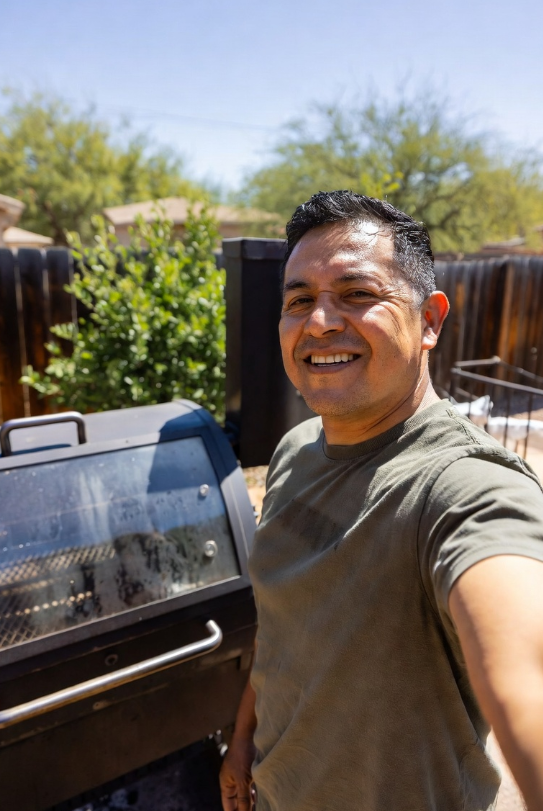
Called Roberto. He sounded better this week — more energy, less flatness. Elena has started a jigsaw puzzle, which Roberto considers a form of insanity but has reluctantly joined because there is nothing else to do. He told me he walked circles in the backyard for exercise — twenty laps around the cinder block grill, which he has measured to be approximately 1,200 steps. "I am walking around the grill, mijo. The grill is my gym." The image of Roberto Rivera, sixty-two, power-walking circles around the grill he built with his own hands, refusing to let diabetes or a pandemic or a locked front door stop him from moving — that image is everything. That is the stubbornness I was raised on. That is the Rivera way.
The chocolate chip cookies Sofia and I made that Tuesday were the spark, but cinnamon twirl cookies became our signature — the ones we kept coming back to because every single step is a fraction in disguise: rolling the dough, spreading the filling, slicing even spirals. They’re the kind of cookie that rewards patience and precision, which made them perfect for a kid learning that numbers mean something when your hands are in the dough. If you want to try the lesson yourself — or just want a cookie that tastes like a quiet Tuesday afternoon when the world outside finally felt manageable — this is the one.
Cinnamon Twirl Cookies
Prep Time: 25 min | Cook Time: 12 min | Total Time: 1 hr 10 min (includes chilling) | Servings: 36 cookies
Ingredients
- 1 cup (2 sticks) unsalted butter, softened
- 3/4 cup granulated sugar
- 1 large egg
- 1 teaspoon pure vanilla extract
- 2 1/4 cups all-purpose flour
- 1/2 teaspoon baking powder
- 1/4 teaspoon salt
- Cinnamon Filling:
- 1/3 cup packed brown sugar
- 1 1/2 teaspoons ground cinnamon
- 2 tablespoons unsalted butter, melted
Instructions
- Make the dough. In a large bowl, beat softened butter and granulated sugar together until light and fluffy, about 3 minutes. Add the egg and vanilla extract and mix until fully combined.
- Add dry ingredients. In a separate bowl, whisk together flour, baking powder, and salt. Gradually add the flour mixture to the butter mixture, stirring until a soft dough forms. Do not overmix.
- Chill the dough. Shape the dough into a flat disc, wrap in plastic wrap, and refrigerate for 30 minutes, or until firm enough to roll.
- Make the filling. Stir together the brown sugar and cinnamon in a small bowl. Set aside the melted butter separately.
- Roll and fill. On a lightly floured surface, roll the chilled dough into a rectangle roughly 10 by 14 inches and about 1/4 inch thick. Brush the surface evenly with melted butter, then sprinkle the cinnamon-brown sugar mixture evenly across the entire surface, leaving a 1/2-inch border along one long edge.
- Roll into a log. Starting at the long edge opposite the border, tightly roll the dough into a log. Press the seam gently to seal. Wrap the log in plastic wrap and refrigerate for 20 minutes.
- Preheat and slice. Preheat your oven to 375°F (190°C). Line two baking sheets with parchment paper. Using a sharp knife, slice the chilled log into rounds about 1/4 inch thick and arrange them 1 inch apart on the prepared baking sheets.
- Bake. Bake for 10 to 12 minutes, until the edges are just set and the bottoms are lightly golden. The centers may look slightly underdone — that’s perfect. They firm up as they cool.
- Cool and serve. Let cookies rest on the baking sheet for 5 minutes before transferring to a wire rack. Serve warm or at room temperature. Store in an airtight container for up to 5 days.
Nutrition (per serving)
Calories: 105 | Protein: 1g | Fat: 6g | Carbs: 13g | Fiber: 0g | Sodium: 35mg