
 By
The wedding. April 20, 2024. Luis Jr. and Ana Cristina Montes married at St. Patrick's Cathedral.
I am going to write about the cake first because the cake is what I can control, and the wedding is everything I cannot control, and the cannot-control is where the tears come from, and I have been crying for three days and the crying is not sadness — it is the particular form of joy that happens when your firstborn, your baby, the boy who was six pounds and had his father's face and his mother's stubbornness, stands at an altar and promises himself to another person, and the promising is the letting-go that mothering has been leading to since the day the doctor put him in my arms and I said: mine.
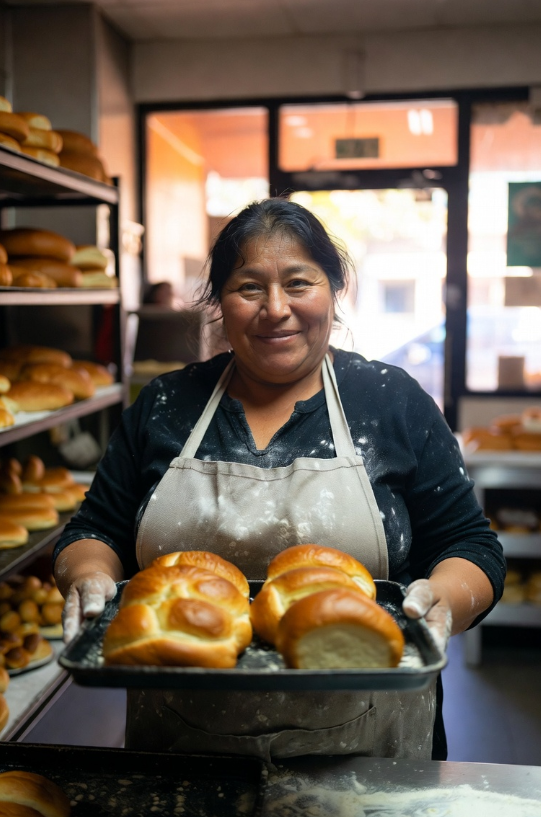
The cake: four tiers, vanilla and almond sponge, soaked in the three milks (evaporated, condensed, heavy cream — Rosa's proportions, which are sacred and non-negotiable), frosted with whipped cream stabilized with gelatin (Sofia's technique — she learned it from a pastry blog and tested it fourteen times), decorated with sugar flowers that Sofia sculpted over three days and that looked like they came from a professional bakery, which they did, because our bakery is a professional bakery, and Sofia is a professional baker, and the cake was the most beautiful thing that has ever left our kitchen, and the kitchen has produced eighty thousand conchas in nine years, and none of them were as beautiful as this cake. "Luis & Ana Cristina" in cursive. Two points larger than the practice cake. Sofia was right. Perfection was two points larger.
The ceremony: St. Patrick's Cathedral, the church where I light candles for the dead and now where my son exchanges vows with the living. Father Morales officiated — the same priest who heard Camila sing and said she had a gift, the same priest who called the bakery a prayer. He said: "Marriage is bread. You make it together. You knead it together. You wait for it to rise. And when it rises, you share it." Father Morales knows his audience. He is speaking to a baker's son in a baker's church, and the bread metaphor is not a metaphor — it is the literal truth of the Gutierrez family: everything we are, we are in bread.
Camila sang at the ceremony. "Ave Maria." The same "Ave Maria" she sang at Mass when she was six and Father Morales cried. She is eleven now, and her voice has deepened and strengthened and the "Ave Maria" that filled the church was not the voice of a child but the voice of a young woman who has been trained by Ms. Torres and shaped by the Children's Chorus and forged by five years of singing to her dead grandmother's photograph, and the voice filled the cathedral the way Rosa filled rooms — completely, effortlessly, with the gravitational pull that is the family inheritance — and every person in the church was silent, and the silence was the standing ovation, and the ovation was Camila, and Camila was Rosa, and Rosa was the "Ave Maria" rising through the stone of St. Patrick's and into the sky over El Paso.
The reception was at the bakery. The parking lot transformed: Diego's folding tables (eight of them, holding sixteen people each), white tablecloths borrowed from the church, and conchas as centerpieces — baskets of conchas on every table, because the Gutierrez family puts bread where other families put flowers, because bread is more honest than flowers, because bread says: eat, celebrate, be nourished by the same food that nourished the family that is welcoming you. The carne asada was grilled by Luis in the parking lot, the smoke mixing with the evening light, and the enchiladas were served from the bakery kitchen, and the tamales were passed, and the champurrado was poured, and the bakery — Rosa's bakery, my bakery, Sofia's bakery — was the wedding venue, and the wedding venue was the most important room in the city, and the room was a parking lot, and the parking lot was a cathedral, and the cathedral was a kitchen, and the kitchen was Rosa.
Luis Jr. danced with me. The mother-son dance. He held me the way he held me when he was small — with both arms, full commitment, the grip of a boy who has always known where his mother is in a crowd. He said, while we danced: "Mom, thank you for the tortillas." Not for the life. Not for the bakery. Not for the Army support or the deployment tamales or the Sunday dinners. For the tortillas. The flour tortillas at 4 AM on the morning he left for basic training. The tortillas that were the last thing we made together before he became a soldier. He remembered. He has always remembered. The tortillas are the mother-son dance, and the dance is the tortillas, and the tortillas are the love.
After the wedding — after the four tiers of tres leches and the sugar flowers and the mother-son dance and the conchas on every table in the parking lot that became a cathedral — I came home to my kitchen, and my kitchen was quiet for the first time in three weeks, and I needed to make something with my hands that had no weight to it, no pressure, no perfection required. These cinnamon swirled crescent rolls are what I made the morning after Luis Jr.’s wedding, just for me, just because Father Morales was right that everything we are, we are in bread, and a baker who has just given her whole heart away needs something small and sweet and warm to come home to.
Cinnamon Swirled Crescent Rolls
Prep Time: 15 minutes | Cook Time: 12 minutes | Total Time: 27 minutes | Servings: 8 rolls
Ingredients
- 1 can (8 oz) refrigerated crescent roll dough
- 3 tablespoons unsalted butter, softened
- 1/4 cup granulated sugar
- 1 1/2 teaspoons ground cinnamon
- 1/4 teaspoon vanilla extract
- 1/2 cup powdered sugar (for glaze)
- 1 to 2 tablespoons milk (for glaze)
- 1/4 teaspoon vanilla extract (for glaze)
Instructions
- Preheat oven. Heat your oven to 375°F. Line a baking sheet with parchment paper and set aside.
- Make the cinnamon filling. In a small bowl, stir together the softened butter, granulated sugar, cinnamon, and vanilla extract until a smooth, spreadable paste forms.
- Unroll the dough. Carefully unroll the crescent dough onto a lightly floured surface and separate it into the perforated triangles. Press any tears gently back together if needed.
- Spread and roll. Spread a thin, even layer of the cinnamon-butter filling across the surface of each triangle, going nearly to the edges. Starting at the wide end, roll each triangle toward the pointed tip, keeping it snug but not tight.
- Arrange and bake. Place the rolled crescents on the prepared baking sheet, point-side tucked underneath. Bake for 10 to 12 minutes, until golden brown and puffed. Watch the edges — they go from golden to too-dark quickly.
- Make the glaze. While the rolls bake, whisk together the powdered sugar, milk, and vanilla in a small bowl until smooth. Add milk a little at a time until you reach a drizzleable consistency.
- Glaze and serve. Let the rolls cool for 3 to 4 minutes, then drizzle the glaze over the top while they are still warm. Serve immediately.
Nutrition (per serving)
Calories: 185 | Protein: 2g | Fat: 9g | Carbs: 25g | Fiber: 0g | Sodium: 230mg