
 By
By Mid-September. Week three. Our toughest opponent of the regular season — a perennial 5A power from the western suburbs that beat us last year by ten and that has won two state championships in the past five years. Friday night home game. Capacity crowd. The booster club had to ask the school to open the overflow lot. The mood at the tailgate was different — less of the celebratory big-spread vibe of weeks one and two, more of a focused, competitive intensity. People were eating, but the eating was efficient. The conversations were shorter. The game was the point.
We won. Twenty-one to seventeen. We won on a Diego touchdown catch with one-fifty left in the fourth quarter, on a fourth-and-six from their twenty-eight, on a fade route that Marcus put in a perfect spot in the back corner of the end zone. Diego came up with the ball. The crowd lost their minds. The defense closed the game with three stops, including a Daquan sack on third-and-eight. We won by four. We were playing not to lose for the last six minutes, which is not the way I want to coach, but which the score and the situation demanded. We won. We won the game we had to win.
The locker room afterward was the kind of locker room that signals a championship-quality team. The boys did not lose their minds. They were happy, but they were measured. Daquan grabbed a Gatorade bottle and dumped it on his own head and laughed. The seniors collected each other into a tight circle and one of the captains said, "We just played four quarters against a team that thought we were going to fold and we did not fold. Take a knee." The whole team took a knee. The captain said the team prayer. The team responded. The room got quiet. I stepped in. I said, "Boys. Three games. Three wins. That is all this is. We have not done anything yet. Get rested. Drink water. See you Monday." That was the speech. The boys nodded. They got dressed. They went home with their parents.
I did not sleep well Friday night. I rarely do after a close win. The film of the close ones runs through my head until two or three in the morning. I got up at four, made coffee, opened my laptop, watched the game tape twice. The defense had bent. The defense had not broken. I had seen, in the second quarter, a shift in the way the other team's offensive line was attacking us — a small stunt they were running on the right side that we had not adjusted to fast enough — and we had given up forty yards and a field goal as a result. By the second half Tony had adjusted. The stunt did not work in the second half. We had given up the field goal but we had not given up the game. The bend-not-break. The hallmark of a team that is going to be there in November.
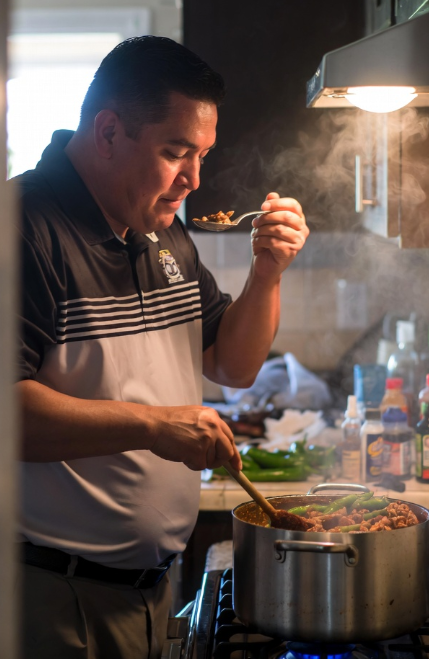
Saturday afternoon I made tortilla soup. The first tortilla soup of the year. The September air had cooled enough — sixty-eight at four in the afternoon, a slight breeze, the leaves starting to whisper — that the soup felt right for the first time. Tortilla soup is one of those recipes that I make with a slightly different cast every time but the same anchor: a long-simmered broth made from chicken bones and roasted tomatoes and dried chiles and onion and garlic, strained, served over fried tortilla strips, with shredded chicken, avocado, queso fresco, lime, cilantro, and a sprinkle of crema. The broth is the soul. The toppings are the dance. You can make it Mexican, Mexican-American, Tex-Mex, New Mexican, depending on what you put on top. Today I made it New Mexican — used a New Mexico chile in the broth, added a few strips of roasted green chile to each bowl, finished with cilantro and lime. It tasted like home.
Sofia came home from her Saturday workout, smelled the soup, and said, "Dad, that is what fall smells like." I said, "Yes it is." She had two bowls. She said, "I have a meet next Friday." I said, "I know. I will be at the team's game on Friday but I will get to Sunday's drills, do not worry. Mom will be at your meet." She said, "I know. I just wanted to tell you." She went up to her room. The way Sofia tells you something that matters to her is to mention it in passing while she is doing something else, and you have to be paying attention or you miss it. I was paying attention. The meet is on the calendar.
Lisa came down from a nap at five. She had a bowl of soup. She said, "Carlos, this is exactly right." I said, "It is the cool weather." She said, "It is also the year. The year is going well. The household is calm. The kids are okay. We are okay." I said, "Yeah. We are okay." She said, "Tell me about the game." I told her about the game. I told her about the bend-not-break. I told her about Diego's catch on the fade. I told her about Daquan's sack. She listened. The road bends. Feed your people. The game is won at the table.
The tortilla soup was the soul of that Saturday — the broth, the chile, the whole long-simmered anchor of it — but the recipe I keep coming back to when the fall really settles in, when the air drops into the sixties and the week has asked something real of you, is this cider-glazed pork tenderloin. It has that same quality the soup does: it does not rush, it rewards patience, and when you put it on the table the people you love lean in. After a win like the one we took on Friday night — four points, fourth-and-six, bend-but-don’t-break — this is the kind of meal that lets the household exhale.
Cider-Glazed Pork Tenderloin
Prep Time: 15 min | Cook Time: 30 min | Total Time: 45 min | Servings: 4
Ingredients
- 1 1/2 lbs pork tenderloin, trimmed
- 1 cup apple cider
- 2 tablespoons apple cider vinegar
- 2 tablespoons Dijon mustard
- 1 tablespoon brown sugar
- 2 teaspoons fresh thyme leaves (or 3/4 teaspoon dried)
- 2 cloves garlic, minced
- 1 tablespoon olive oil
- 1 teaspoon kosher salt
- 1/2 teaspoon black pepper
- 1/2 teaspoon smoked paprika
- 1 tablespoon unsalted butter
Instructions
- Preheat and season. Preheat oven to 400°F. Pat the pork tenderloin dry with paper towels. Combine salt, pepper, and smoked paprika, then rub evenly over the entire surface of the pork.
- Make the glaze. In a small saucepan over medium heat, combine the apple cider, cider vinegar, Dijon mustard, brown sugar, thyme, and garlic. Bring to a simmer and cook, stirring occasionally, for 8–10 minutes until reduced by about half and slightly syrupy. Remove from heat and stir in the butter until melted. Set aside.
- Sear the pork. Heat olive oil in an oven-safe skillet over medium-high heat until shimmering. Add the tenderloin and sear on all sides, turning every 1–2 minutes, until golden brown all around, about 5–6 minutes total.
- Glaze and roast. Brush the pork generously with the cider glaze. Transfer the skillet to the preheated oven and roast for 15–18 minutes, brushing with additional glaze once halfway through, until an instant-read thermometer inserted at the thickest point reads 145°F.
- Rest and slice. Transfer the tenderloin to a cutting board and let it rest for 5 minutes — do not skip this step. Slice into 3/4-inch medallions. Drizzle any remaining glaze from the pan over the top before serving.
Nutrition (per serving)
Calories: 310 | Protein: 36g | Fat: 11g | Carbs: 14g | Fiber: 0g | Sodium: 580mg