Christmas Eve. The julbord. Twenty-two people at the table in the Kenwood house, and every one of them came.
Peter came. He arrived Saturday afternoon — flew from Chicago to Minneapolis, rented a car, drove to Duluth in a snowstorm because that's what Johanssons do: we drive through snowstorms to eat meatballs. He looked thin. He looked tired. But he was here, and here is what matters.
Anna and David brought the kids on Friday. Sophie walked in wearing the red sweater I knitted for her last Christmas and hugged me like she meant it. Jakob carried bags. Lena carried a book about arctic wolves that she plans to discuss with Elsa at length. David carried wine and the expression of a man who has married into a family where the women run things and the men carry things.
Elsa came from Ely on Saturday morning, driving through the storm with the casual competence of a park ranger who considers snowstorms weather, not events. She brought Tom — not Tom Birch, not yet, but a flask of whiskey from the wolf research station and a carved wooden wolf ornament for the tree.
Erik came with Mamma. He drove her from Fifth Street, carrying her meatball pans the way a pallbearer carries a casket — with solemn, dedicated purpose. Astrid drove up from the Cities with Gary. Karin was on the phone from Stockholm, patched in on speakerphone and propped against the salt shaker so she could see the table through the camera.
The julbord was laid at five o'clock. The table: pickled herring — three kinds. The julskinka, golden-crusted, sliced thin. Jansson's temptation, bubbling from the oven. Gravlax with mustard dill sauce. Smoked salmon. Beet salad. Limpa bread. Rye crispbread. And the meatballs — two hundred of mine and three hundred of Mamma's — piled on platters with cream gravy and lingonberry jam.
Paul gave a toast. He does every year. This year he talked about the Edmund Fitzgerald — of course he did — but he connected it to Christmas, to the idea that the darkest season is when you need the brightest light, and that the table we sit at is the brightest light he knows. It was Paul at his best: simple, sincere, slightly maritime.
Mamma sat at the head of the table — the position that was Pappa's and became hers when Pappa died and that she occupies with the quiet authority of a woman who has been feeding this family for sixty years. She ate everything. She drank two aquavit. She did not wince.
The rice pudding came last. The almond was found by Jakob, who bit into it and said, "Huh" — the most enthusiasm Jakob has shown about anything since 2014. Good luck for the year. I'm choosing to believe in it.
After dinner, we sang. Swedish Christmas carols — "Nu tändas tusen juleljus" and "Stilla natt" and "Jul, jul, strålande jul" — and the voices filled the house and the candles flickered and the snow fell outside and Paul's arm was around my shoulder and Peter was here and Elsa was here and Anna was here and Mamma was here and the table was set for twenty-two and everyone came.
I did the dishes at midnight. Alone, by choice. The house was quiet — guests in beds and on couches and on the floor in sleeping bags. I stood at the sink and washed the platters that held the meatballs and the bowls that held the herring and the glasses that held the aquavit, and the water was warm on my hands and the kitchen smelled like everything I love and I thought: this. This is what I do. This is what Mamma does. This is what we've always done. We gather people and we feed them and we send them back into the world with full bellies and the memory of the table.
Perfect. It was perfect.
The rice pudding is the official ending — the almond, the toast, the good luck for the year — but the real ending, the one that happens after the singing and the dishes and the midnight quiet, is a tin of shortbread left on the counter for whoever wakes up first. I make these every year, the same recipe, because shortbread is what you press into someone’s hands when they leave: Peter at the door with his overnight bag, Elsa backing her truck out into the snow, Anna buckling the kids in with lingonberry jam still on their faces. You can’t send twenty-two people back into the world empty-handed. This is what you give them.
Christmas Shortbread Cookies
Prep Time: 20 min | Cook Time: 14 min | Total Time: 1 hr 4 min (includes chill time) | Servings: 24 cookies
Ingredients
- 1 cup (2 sticks) unsalted butter, softened to room temperature
- 1/2 cup powdered sugar, sifted
- 2 cups all-purpose flour
- 1/4 tsp fine sea salt
- 1/2 tsp pure vanilla extract
- 1/4 tsp almond extract
- 2 tbsp coarse decorating sugar or colored sanding sugar, for topping (optional)
Instructions
- Cream the butter. In a large bowl, beat the softened butter with a hand mixer or stand mixer on medium speed for 2 minutes until pale and fluffy.
- Add sugar and extracts. Add the powdered sugar, vanilla extract, almond extract, and salt. Beat on low until combined, then increase to medium and beat for 1 minute until smooth.
- Mix in flour. Add the flour in two additions, mixing on low after each until just incorporated. Do not overmix — the dough should be soft but not sticky.
- Shape and chill. Turn the dough onto a lightly floured surface and shape into a 1-inch-thick disk. Wrap tightly in plastic wrap and refrigerate for 30 minutes.
- Preheat and roll. Preheat oven to 325°F (165°C). Line two baking sheets with parchment paper. On a lightly floured surface, roll the dough to 1/4-inch thickness.
- Cut and decorate. Cut into shapes using your preferred cookie cutters (stars and trees are traditional). Transfer to prepared baking sheets, spacing 1 inch apart. Sprinkle with decorating sugar if using.
- Bake. Bake for 12—15 minutes, until the edges are just barely golden. The centers should look set but pale — do not overbake.
- Cool completely. Let cookies cool on the baking sheet for 5 minutes, then transfer to a wire rack. They firm up as they cool. Store in an airtight tin at room temperature for up to 10 days.
Nutrition (per serving)
Calories: 112 | Protein: 1g | Fat: 8g | Carbs: 10g | Fiber: 0g | Sodium: 38mg
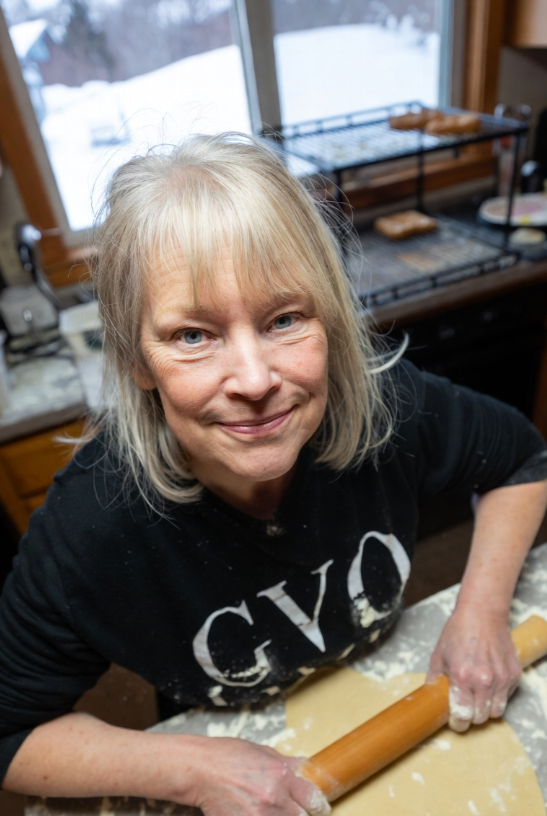
About the cook who shared this
Linda Johansson
Week 40 of Linda’s 30-year story
· Duluth, Minnesota
Linda is a sixty-three-year-old retired nurse from Duluth, Minnesota, living alone in the house where she raised her children and said goodbye to her husband. She lost Paul to ALS in 2020 after two years of watching the kindest man she'd ever known lose everything but his dignity. She cooks Scandinavian comfort food and Minnesota hotdish and the pot roast Paul loved, and she sets two places at the table out of habit because it makes her feel less alone. Every recipe she writes is a person she's loved.
