
 By
By Late September. The book will be published next spring — the timeline has clarified, March or April, the season of cherry blossoms, which feels cosmically appropriate for a book about a Japanese grandmother. Cherry blossom season. The book about the woman who never returned to Japan will arrive in the world when the Japanese trees are blooming in Portland. The symmetry is accidental and perfect.
I made Fumiko's oden for the first cold night of fall — the big pot, the multi-day simmer, the apartment filling with the smell of dashi and fish cake and the warmth that only a big pot of soup can provide. The oden is the transition food, the bridge between seasons, the dish that says: summer is over. The long cooking has begun. We are entering the season of patience and pots and the slow, rich food that takes time and repays the time with depth.
I wrote the fourth magazine column — about the oden and the transition, about how fall in Portland is the season when the cooking deepens and the writing deepens and the life deepens and the deepening is the practice and the practice is the commitment to depth, to the slow cooking, to the overnight soak, to the thing that takes two days instead of two minutes, because the two-day thing contains something the two-minute thing cannot: time. Time as ingredient. Time as flavor. Time as the thing that transforms raw into cooked, simple into complex, a block of kombu into dashi.
Miya read the Oregonian article about the book. She read it at the kitchen table, slowly, her finger tracking under each word, and when she finished she said, "You're famous." I said, "I'm not famous." She said, "You're in the newspaper." I said, "Being in the newspaper is not the same as being famous." She said, "What's the difference?" And I did not have a good answer, because at seven the distinction between newspaper-famous and actually-famous is irrelevant, and at thirty-eight the distinction is equally irrelevant, because the fame was never the point. The soup was the point. The soup has always been the point.
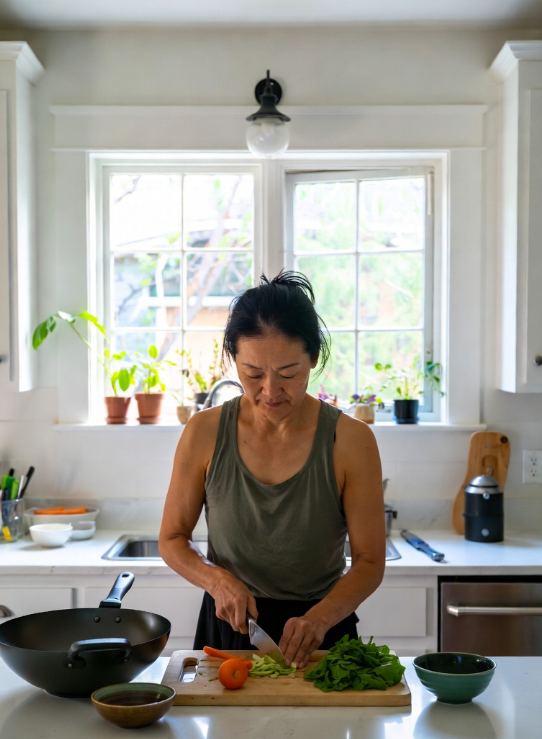
The oden went for two days, the way Fumiko’s always did, and on the third day there was still broth and quiet and the particular satisfaction of a kitchen that had been working. But the next night—the night after the big pot—I wanted something that used all that same focused energy in a faster, more crackling way: high heat instead of low, the wok instead of the stockpot, the sizzle instead of the simmer. This Chinese pork fried rice is the exhale after the long inhale of the oden. It is not the soup, but it lives in the same universe of commitment—good ingredients, real technique, and the belief that rice, like time, is never wasted when it is treated with care.
Chinese Pork Fried Rice
Prep Time: 15 min | Cook Time: 15 min | Total Time: 30 min | Servings: 4
Ingredients
- 3 cups cooked long-grain white rice, day-old and chilled
- 3/4 lb boneless pork loin or pork shoulder, cut into 1/2-inch pieces
- 2 tablespoons soy sauce, divided
- 1 tablespoon oyster sauce
- 1 teaspoon sesame oil
- 2 tablespoons neutral oil (vegetable or canola), divided
- 3 large eggs, lightly beaten
- 3 garlic cloves, minced
- 1 teaspoon fresh ginger, grated
- 3/4 cup frozen peas and carrots, thawed
- 3 green onions, thinly sliced
- 1/4 teaspoon white pepper
- Salt to taste
Instructions
- Marinate the pork. Toss the pork pieces with 1 tablespoon soy sauce and a pinch of white pepper. Set aside for at least 10 minutes while you prep the remaining ingredients.
- Make the sauce. In a small bowl, stir together the remaining 1 tablespoon soy sauce, oyster sauce, and sesame oil. Set aside.
- Break up the rice. Use your fingers or a fork to break any clumps in the chilled rice so the grains are as separate as possible. This is the single most important step for good fried rice.
- Cook the pork. Heat a wok or large skillet over high heat until very hot. Add 1 tablespoon oil, then add the pork in a single layer. Cook undisturbed for 90 seconds, then stir-fry until just cooked through, about 2 more minutes. Transfer to a plate.
- Scramble the eggs. Reduce heat to medium-high. Add a thin film of the remaining oil to the wok. Add the beaten eggs and scramble gently, leaving them slightly underdone. Push to the side of the pan.
- Build the fried rice. Add garlic and ginger to the empty side of the wok and stir for 30 seconds until fragrant. Add the rice and spread into an even layer. Let it sit undisturbed for 1 minute to develop some toasted color, then toss everything together, folding in the eggs as you go.
- Add vegetables and pork. Return the pork to the wok. Add the peas and carrots. Pour the sauce over everything and toss vigorously over high heat for 2–3 minutes until well combined, fragrant, and lightly caramelized.
- Finish and serve. Remove from heat. Taste and adjust salt as needed. Top with sliced green onions and serve immediately directly from the wok.
Nutrition (per serving)
Calories: 420 | Protein: 28g | Fat: 14g | Carbs: 44g | Fiber: 2g | Sodium: 720mg