
 By
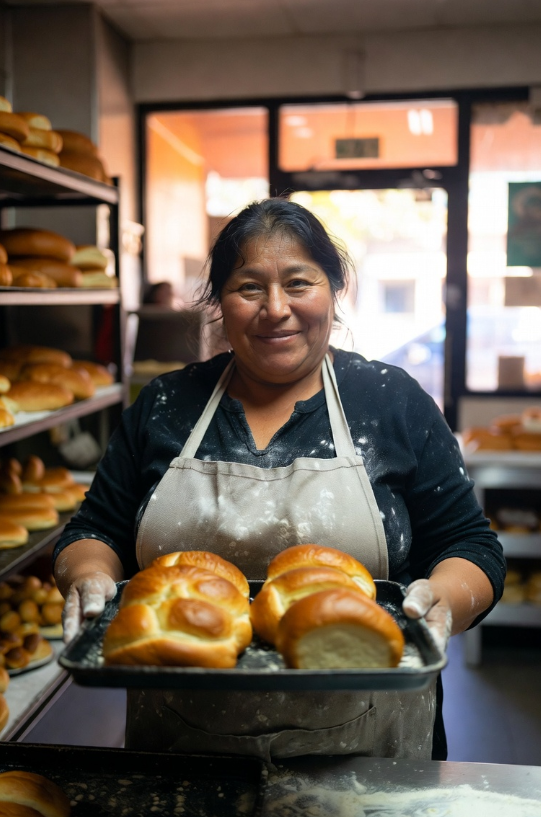
Summer schedule has begun and it is beautiful chaos. Luis Jr. works at the bakery four days a week now, mornings, and he has gotten good — not at baking, he has no feel for dough, his hands are too impatient — but at everything else. He loads the van, he carries supplies, he keeps the kitchen clean, he talks to customers with the polite reserve that people mistake for maturity but is really just shyness wearing a uniform. I pay him eight dollars an hour, which is less than minimum wage, which I feel guilty about, which Luis says I shouldn't because he's fifteen and living rent-free and eating our food, and Luis is right, but guilt is the default setting of a Mexican mother and I don't know where the off switch is.
Sofia comes to the bakery every morning by 7 AM. She preps ingredients — measuring flour, cracking eggs, sifting sugar — and she does it with a focus that is almost frightening. She doesn't chat. She doesn't look at her phone. She measures and sifts and cracks with the concentration of someone defusing a bomb, and I think: this child will run this bakery someday. Not because I want her to — I want her to do whatever she wants — but because the bakery wants her. Some places choose their people. This one chose Sofia.
Diego is in summer camp — a science camp at UTEP that Carmen told me about. It costs forty dollars for the whole summer, which is subsidized by a grant for low-income families, which I qualified for because I am low-income, which I know but don't like hearing officially. He comes home every day with experiments — a balloon that inflates from baking soda and vinegar, a kaleidoscope from a Pringles can, a paper bridge that can hold a book. He explains the science to me in English because that is the language he thinks in, and I nod and ask questions and try to understand, not the science but the boy. The boy who builds. The boy who wants to know how things work.
Camila is at Carmen's house most days while I'm at the bakery. Carmen has two grandchildren close to Camila's age and they play together — a roving gang of four-year-olds that Carmen manages with the patience of a woman who raised four children herself and has nothing left to prove. Carmen calls me at noon with updates: \"Camila painted the dog.\" \"Camila taught the other kids a song.\" \"Camila declared herself queen of the backyard.\" I am not surprised by any of this.
I made tamales this week. Not for a special occasion — just because it was Wednesday and I wanted to, and the beauty of running a bakery is that I have access to industrial quantities of masa and a kitchen big enough to spread out. I made two kinds: chile colorado with pork (Rosa's recipe, the one that defines what a tamale should be) and rajas con queso for the kids who can't handle the spice yet, meaning Camila, who believes peppers are poison, and Diego, who will eat anything but draws the line at chile colorado, which he says \"tastes like lava,\" which I take as a compliment to Rosa's recipe.
Isabella is volunteering at a clinic this summer — a free clinic in south El Paso that serves uninsured families, many of them immigrants, many of them undocumented. She is thirteen and she answers phones and files papers and sometimes holds babies in the waiting room while mothers see the doctor, and she comes home and talks about it with the same fire that I recognize from Rosa — the fire of a woman who has seen suffering and decided to do something about it instead of looking away. Isabella will be a nurse. Or a doctor. Or whatever she decides. The point is not the title. The point is the fire.
I got a letter from the IRS this week. Not a bad letter — a confirmation of our tax filing, everything in order — but the sight of a government envelope still makes my heart stop. It has been eighteen years since I crossed the bridge and sixteen years since I married Luis and became legal and four years since I became a citizen, and still, still, a government envelope makes my hands shake. I don't think that ever goes away. I think it is a scar, not a wound — healed but permanent, the body's way of remembering what the mind tries to forget.
I made the sign of the cross over the letter before I opened it, which is irrational and Catholic and exactly what Rosa would have done. Some things you inherit without choosing to. Some things live in the blood.
After a week that left my hands shaking over a government envelope — after all these years, still shaking — I needed something that required my whole body, something that could not be done with a distracted mind. Tamales demand you. You cannot worry and spread masa at the same time. So I called my mother’s voice up from wherever I keep it, thought about what lives in the blood, and I made chile colorado pork tamales the way Rosa made them and the way I make them now: slow, deliberate, and with both hands.
Chile Colorado Pork Tamales
Prep Time: 2 hours | Cook Time: 1 hour 30 minutes | Total Time: 3 hours 30 minutes | Servings: 24 tamales
Ingredients
- For the corn husks:
- 24–30 dried corn husks
- Hot water, enough to submerge husks
- For the chile colorado pork filling:
- 2 lbs pork shoulder, cut into 2-inch chunks
- 5 dried guajillo chiles, stemmed and seeded
- 3 dried ancho chiles, stemmed and seeded
- 2 dried pasilla chiles, stemmed and seeded
- 5 garlic cloves, divided
- 1/2 white onion, divided
- 1 tsp ground cumin
- 1 tsp dried Mexican oregano
- 1/2 tsp black pepper
- 2 tsp salt, divided, plus more to taste
- 3 cups pork cooking broth (reserved from boiling pork)
- For the masa:
- 4 cups masa harina for tamales (such as Maseca Tamale)
- 1 tsp baking powder
- 1 1/2 tsp salt
- 2/3 cup lard or vegetable shortening, at room temperature
- 3 to 3 1/2 cups warm pork broth or chicken broth
Instructions
- Soak the corn husks. Place corn husks in a large pot or deep baking dish. Cover completely with hot water and weigh them down with a heavy plate or pot lid. Soak at least 1 hour, until pliable and soft. Drain and pat dry before using.
- Boil the pork. Place pork shoulder chunks in a large pot with 3 garlic cloves, one quarter of the onion, 1 tsp salt, and enough water to cover by 2 inches. Bring to a boil, skim off any foam, then reduce to a steady simmer. Cook uncovered for 1 hour to 1 hour 15 minutes, until the pork is tender and shreds easily. Remove pork and set aside. Reserve 3 cups of the cooking broth for the chile sauce and masa.
- Toast and rehydrate the dried chiles. In a dry skillet over medium heat, toast the guajillo, ancho, and pasilla chiles for about 30 seconds per side, pressing lightly with a spatula, until fragrant and slightly darkened — do not scorch them or they will taste bitter. Transfer to a bowl, cover with boiling water, and soak 20 minutes until fully softened.
- Blend the chile colorado sauce. Drain the soaked chiles and add them to a blender along with the remaining 2 garlic cloves, the remaining onion quarter, cumin, oregano, black pepper, 1 tsp salt, and 1 cup of the reserved pork broth. Blend on high until completely smooth, 1 to 2 minutes. Strain through a medium-mesh sieve, pressing solids, and discard the skins left behind.
- Cook the sauce and shred the pork. Heat 1 tbsp lard or oil in a wide skillet or Dutch oven over medium-high heat. Pour in the strained chile sauce — it will spatter, so stand back. Cook, stirring frequently, for 8 to 10 minutes until the sauce deepens in color and thickens slightly. Meanwhile, shred the cooked pork into generous bite-sized pieces. Add pork to the sauce, stir to coat, and simmer together 10 minutes. Taste and adjust salt. The filling should be saucy but not soupy. Set aside to cool.
- Make the masa. Whisk together masa harina, baking powder, and salt in a large bowl. In a separate bowl, beat the lard with a hand mixer or stand mixer on medium-high until light and fluffy, about 2 minutes. Add the masa mixture to the lard in three additions, alternating with warm broth, mixing on medium speed after each addition. Beat until the masa is smooth, spreadable, and holds its shape — it should be the consistency of thick hummus. To test: drop a small ball into a glass of cold water; if it floats, the masa is ready. If it sinks, beat in a little more broth and test again.
- Assemble the tamales. Lay a soaked corn husk flat on your work surface, smooth side up, wide end facing you. Spread about 3 tablespoons of masa onto the upper two-thirds of the husk using the back of a spoon or a masa spreader, leaving a 1-inch border on the sides and a 2-inch border at the top. Spoon about 2 tablespoons of chile colorado pork filling in a line down the center of the masa. Fold one long side of the husk over the filling so the masa edges meet and seal around the filling, then roll the husk closed. Fold the narrow bottom end up and lay the tamale seam-side down. Repeat with remaining husks, masa, and filling.
- Steam the tamales. Stand tamales upright, open end up, in a large steamer pot or tamale steamer, packing them snugly so they support each other. If needed, fill gaps with extra soaked husks. Add 2 to 3 inches of water to the bottom of the steamer, making sure it does not touch the tamales. Cover tightly with a lid and steam over medium heat for 1 hour to 1 hour 15 minutes, checking every 30 minutes to replenish water as needed. Tamales are done when the masa pulls cleanly away from the husk without sticking. Remove from heat and let rest 10 minutes before serving — they will firm up as they rest.
Nutrition (per tamale)
Calories: 215 | Protein: 11g | Fat: 9g | Carbs: 22g | Fiber: 2g | Sodium: 390mg