
 By
By My name is Loretta Mae Simms, and I want you to understand something before we go any further: I did not set out to write anything down. I am not the kind of woman who writes things down. I am the kind of woman who stands at a stove for four hours and feeds whoever walks through the door, and if you want the recipe, you stand beside me and pay attention, the way I stood beside my mother and paid attention, the way she stood beside hers. That is how it has always been. That is how I learned everything I know.
But my daughter Destiny — she is twenty-nine years old, a social worker, and she has more good sense than any of us deserve — Destiny sat down at my kitchen table last Sunday after dinner and she said, “Mama, you need to write this down. For us. For somebody.” And I looked at her across the table and I thought about all the things I have not written down, all the things that exist only in my hands and my nose and the muscle memory of forty years of cooking, and I thought: she is right. She is almost always right, which is irritating, but there it is.
So here I am. It is Monday morning, November seventh, the year of our Lord two thousand and sixteen. The parsonage smells like coffee and the cast iron skillet I did not quite finish seasoning last night. Outside, the neighborhood is quiet in that particular way it gets when something big is coming — you can feel the weight of the air, something held. My husband Calvin is already at the church, because Calvin is always already at the church, which is his way and I have made my peace with it. Marcus, my youngest, my sixteen-year-old, left for school twenty minutes ago with his backpack on one shoulder and a biscuit in his hand, the way he does, the way he has done since he was old enough to carry both. Calvin Jr. is up in Huntsville with his wife Alicia. Destiny will call around noon, because she always does.
The house is mine for a few hours, which means the kitchen is mine, which means I can think.
I want to tell you who I am. And the only way I know how to do that is to tell you about the chicken.
My mother, Bernice Simms — and if you heard the way the church says her name, you would understand that she is not just my mother, she is a force of nature, a woman of God, a cook of such authority that deacons have been known to fall silent when she walks into the kitchen — my mother made fried chicken that required a testimony to describe. I am not being poetic. I mean that people at church suppers, grown adults, deacons and missionaries and women who had been cooking since before I was born, would take a bite of Bernice’s fried chicken and close their eyes and say something quiet and grateful, the way you do in church when the Spirit moves. That is what her chicken did. It moved people.
She learned it from her mother, who learned it from hers, going back through the generations to women whose names I don’t know but whose hands I carry. We were AME — African Methodist Episcopal — and in the AME tradition, the church kitchen is not separate from the sanctuary. It is the sanctuary continued by other means. You worship with your voice in the pews and you worship with your hands in the kitchen, and both are offerings, and both are holy, and my mother understood this down to her marrow.
I grew up in Bessemer, Alabama, the fourth of six children, in a house that smelled like whatever Mama was cooking, which was always something, because Bernice Simms did not believe in a cold kitchen. We were not wealthy. My father, Deacon Willie James Simms, worked at the steel plant. My mother cleaned houses in Mountain Brook for women who had more rooms than she had hot water, commuting ninety minutes each way on the bus. They were tired people. But on Friday night, Mama started brining the chicken, and by Sunday after morning worship, there was fried chicken on a platter in the middle of that table, and we were not tired anymore. We were fed. There is a difference.
I learned to cook standing beside her, stirring pots taller than I was, cracking eggs by the dozen for the church supper. She didn’t teach from a cookbook — she taught from her hands. “Watch the color,” she’d say, standing over the cast iron. “The oil will tell you when it’s ready. You just have to listen.” I was eight years old. I didn’t know what I was listening for. But I kept listening, and eventually I heard it — that particular sizzle when the chicken hits the fat, confident and even, not frantic, not timid. That sound is still the most reassuring thing I know.
The church kitchen was where Bernice was most herself — most powerful, most alive, most free. She ruled that kitchen the way she ruled nothing else in her life, because in 1970s Alabama, a Black woman’s authority was not something the world offered freely. But in that kitchen, she was sovereign. She organized the fifth-Sunday dinners that fed two hundred people, planned the funeral repasts, supervised the homecoming feasts. She made decisions. She gave orders. She was obeyed. I watched her and I understood something that took me years to put into words: cooking was the one thing she could control, the one thing she could give without asking permission, and she gave it with everything she had.
I married Calvin in 1992. He was a seminary student with a calling to preach and a voice that could fill a building without a microphone. We moved to Ensley when he got his first church — sixty members, a leaking roof, and a pastor’s salary that was more of a suggestion than a salary. I took the church kitchen. Not by title. By inheritance. Because Bernice had taught me that the kitchen was where ministry happened at ground level, and I am a ground-level person. I always have been.
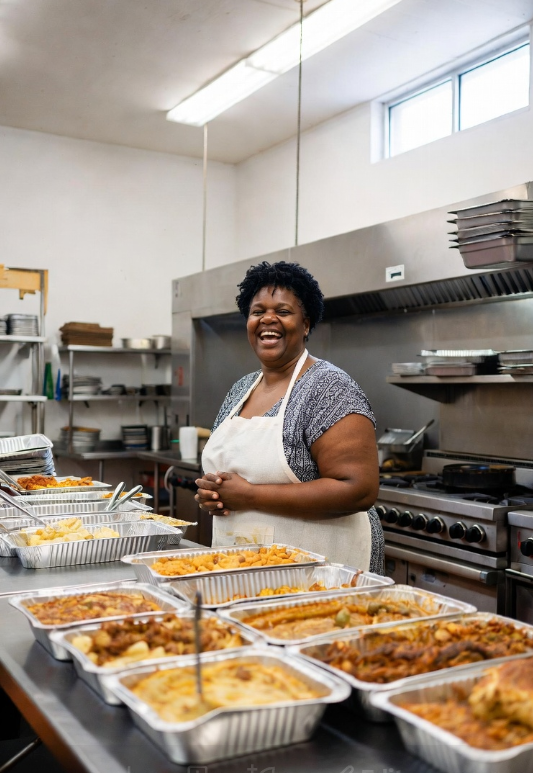
Calvin’s church has grown. We are at New Hope AME now — four hundred members, a roof that does not leak, a kitchen that I have organized within an inch of its life. I cook for funerals. I cook for weddings. I cook for the homeless ministry every Tuesday. I teach cooking classes for the young wives. I have fed, in the thirty years I have been a pastor’s wife in this city, more people than I can count, and the food has always been an answer to a question I didn’t know how to ask out loud: How do you love someone when words are not enough? You put food on a plate. You hand it to them. You say, with your hands, what your mouth cannot say. It works every time.
Now. The chicken.
Bernice’s recipe is not written anywhere. It exists in my body. But Destiny asked me to write it down, and Destiny is almost always right, so here it is: the church supper fried chicken that fed two hundred people on fifth Sundays in a west Birmingham AME church, that made missionaries close their eyes and give thanks, that I have been making since I was thirteen years old, and that is, without any exaggeration I can find in my conscience, the best fried chicken I have ever eaten. I am my mother’s daughter. I say this not with pride but with gratitude.
The secrets are three: the buttermilk brine, and how long you leave it (overnight, minimum — two nights if you can manage it); the seasoning, which goes into the flour and into the brine and onto the chicken before it hits the flour, because you season in layers or you do not season at all; and the oil temperature, which must be right and must stay right, which means you do not crowd the pan, which means you cook in batches, which means you have patience. Patience is the most important ingredient in any recipe and the one nobody ever lists.
Make this for someone you love. Make it for your church, your family, your grieving neighbor, your own tired self on a Sunday afternoon when you need to be fed and there is nobody to do the feeding but you. The chicken does not know who you are making it for. It only knows that it has been made with care, and care is what it will taste like. I promise you that.
Welcome to my kitchen. I am glad you are here.
Now I know what you are thinking — Loretta, you just told us about fried chicken and buttermilk brines, and here you come with lo mein noodles. But that is exactly the point. The care I learned standing next to Grandma Bernice at that stove, the patience, the layering of flavors — that goes into everything I make, whether it is a cast-iron skillet full of chicken or a big nonstick pan full of noodles and vegetables on a Tuesday night when nobody has the energy for a three-hour project. This Chicken Lo Mein is what I make when I want to feed my family something that feels like love but also feels like mercy on my own two feet. It is easy, it is quick, and it is good — and those three things are allowed to live in the same dish.
Chicken Lo Mein the EASY Way
Prep Time: 20 min | Cook Time: 20 min | Total Time: 40 min | Servings: 4
Ingredients
- 3 tablespoons soy sauce
- 2 tablespoons oyster sauce
- 1 tablespoon minced garlic
- 1 tablespoon rice wine vinegar or distilled white vinegar
- 1 tablespoon ketchup
- 2 teaspoons chopped ginger
- 1 teaspoon dark sesame oil
- 12 ounces Chinese Lo Mein noodles or linguine pasta (I used linguine cooked until barely al dente)
- 2 boneless skinless chicken breasts
- 1 tablespoon vegetable oil
- 1 large onion
- 1 1/2 cups shredded carrots
- 1 cup sliced fresh mushrooms
- 1 cup broccoli florets (steamed until just barely tender (they will cook longer in the stir-fry))
- Unsalted dry-roasted peanut halves (optional)
Instructions
- Make the sauce. Whisk all of the sauce ingredients together (soy sauce, oyster sauce, garlic, vinegar, ketchup, ginger, and sesame oil) in a 1-quart bowl.
- Cook the noodles. Cook the noodles according to package directions. Meanwhile, continue with the recipe, and when the noodles are done, drain and set aside.
- Start the stir-fry. Make the stir-fry sauce and set aside. Heat the oil in an extra-deep 12-inch nonstick skillet over medium heat. Peel and coarsely chop the onion, adding it to the skillet as you chop. Stir from time to time. While the onion cooks, slice the chicken into strips about 1/4-inch wide. Add the chicken to the skillet. Raise the heat to medium-high and stir occasionally.
- Add vegetables and finish. While the chicken cooks, add the carrots, broccoli and mushrooms and stir to mix. Stir-fry the mixture until the chicken is no longer pink. Immediately add the stir-fry sauce and noodles. Raise the heat to high and cook until the noodles and chicken are heated through and coated with sauce, 2–3 minutes, stirring constantly. Serve, garnished with peanut halves (if using — I did not).
Nutrition (per serving)
Calories: 554 kcal | Protein: 39g | Fat: 9g | Saturated Fat: 2g | Carbs: 78g | Fiber: 6g | Sugar: 8g | Cholesterol: 73mg | Sodium: 1215mg