
 By
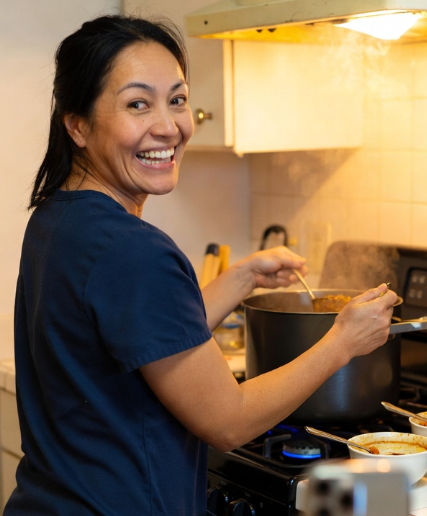
By Fourth of July again. The Filipino Community party, the lumpia, the lechon, Lourdes in full general mode directing the kitchen like a military operation where the ammunition is spring rolls and the objective is feeding a hundred people until they physically cannot eat another bite. This year I was on lumpia duty again — three hundred, same as last year, same as every year, the number as fixed as a law of physics.
But this year felt different. Last Fourth of July, I was four months out from the floor, still fragile, still uncertain. This year I stood at the wrapping station and my hands were steady and my head was clear and the wrapping was meditation, not survival. Fill, fold, roll, seal. The rhythm hasn't changed. I have. The woman wrapping lumpia this July is not the woman who wrapped them last July — she's the same hands, the same technique, but the interior is different. Rebuilt. Reinforced. The foundation poured again, level this time.
Angela noticed. She stood next to me, wrapping, and said quietly: "You're different this year." I said, "Better?" She said, "Steadier." Steadier is the right word. Not better — "better" implies the before was bad, and the before was me, and I wasn't bad, I was drowning. Steadier means I've found the surface. Steadier means my feet touch the bottom. Steadier means the water is still here but I know how to float.
The party was loud and full. The lumpia were perfect — Lourdes's recipe, my hands, three hundred small cylinders of love fried in oil and consumed in twenty minutes by people who understand that lumpia is not just food, it's identity. It's the taste of being Filipino in a place that isn't the Philippines. It's the thing your mother makes. It's the thing you learn to make. It's the thing that travels.
I also made halo-halo for the party — Filipino shaved ice dessert, the most chaotic and beautiful thing in the Filipino culinary catalog. Shaved ice layered with sweetened beans, coconut gel, jackfruit, sweet potato, leche flan, ube ice cream, and evaporated milk. It looks like a mess. It tastes like a carnival. It's the dessert equivalent of the Filipino community itself — a collection of disparate elements that shouldn't work together but absolutely do, colorfully, joyfully, with a sweetness that doesn't apologize for being excessive.
I ate the halo-halo in the sun — the midnight sun — and the ice melted and the colors ran together and the party hummed around me and I was here, in this, of this. Steadier. The lumpia in my hands. The ice on my tongue. The light that wouldn't end.
The lumpia were gone in twenty minutes — three hundred of them, consumed by people who understand that fried things made by hand are an act of love, not just a snack. That same meditative quality, the breading and pressing and lowering into hot oil, is exactly what I found in chicken katsu when I needed something to cook on a quieter night after the party. The rhythm is the same: dredge, coat, fry, rest. It’s the kind of cooking that asks your hands to stay busy and lets your mind go still — and after the year I’ve had, still is exactly where I want to be.
Chicken Katsu with Katsu Dipping Sauce
Prep Time: 15 minutes | Cook Time: 20 minutes | Total Time: 35 minutes | Servings: 4
Ingredients
- 4 boneless, skinless chicken breasts (about 6 oz each)
- 1 tsp kosher salt
- 1/2 tsp freshly ground black pepper
- 1/2 cup all-purpose flour
- 2 large eggs, beaten
- 1 1/2 cups panko breadcrumbs
- Vegetable oil for frying (about 2 cups)
- Steamed white rice and shredded green cabbage, for serving
For the Katsu Sauce:
- 1/4 cup ketchup
- 2 tbsp Worcestershire sauce
- 1 tbsp soy sauce
- 1 tbsp mirin (or 1 tsp honey)
- 1 tsp Dijon mustard
Instructions
- Pound the chicken. Place each chicken breast between two sheets of plastic wrap or in a zip-top bag and pound to an even 1/2-inch thickness using a meat mallet or rolling pin. This ensures even cooking and the satisfyingly thin, crispy result katsu is known for.
- Season. Pat the chicken dry with paper towels, then season both sides evenly with salt and pepper.
- Set up your breading station. Arrange three shallow bowls in a row: flour in the first, beaten eggs in the second, and panko breadcrumbs in the third.
- Bread the chicken. Working one piece at a time, dredge the chicken in flour and shake off the excess, dip it into the egg letting any extra drip off, then press it firmly into the panko on both sides, ensuring an even, thorough coat. Set breaded pieces on a plate or rack.
- Heat the oil. Pour vegetable oil into a wide, heavy skillet to a depth of about 1/2 inch. Heat over medium-high until shimmering and a pinch of panko sizzles immediately on contact — about 350°F on a thermometer.
- Fry the chicken. Working in batches to avoid crowding, carefully lower the breaded chicken into the oil. Fry for 4 to 5 minutes per side, adjusting heat as needed to maintain a steady sizzle, until deep golden brown and cooked through (internal temperature of 165°F). Transfer to a wire rack or paper-towel-lined plate to drain.
- Make the katsu sauce. While the chicken rests, whisk together the ketchup, Worcestershire sauce, soy sauce, mirin, and Dijon mustard in a small bowl until smooth.
- Slice and serve. Cut each katsu crosswise into strips. Serve over steamed rice alongside shredded cabbage, with the katsu sauce drizzled over the top or served on the side for dipping.
Nutrition (per serving)
Calories: 430 | Protein: 40g | Fat: 17g | Carbs: 27g | Fiber: 1g | Sodium: 710mg