
 By
By The relationship with Jason is good. I say this factually, clinically, the way a nurse charts a vital sign: the relationship is stable, the parameters are within normal range, the patient — which is me, which is always me — is tolerating it well. Dr. Reeves asked about it in our session. She asked if I'm being honest with him. I said, "He knows about the PTSD. He knows about the medication. He knows about the floor." She said, "Does he know about the fear?" I said, "Which fear?" She said, "The fear that you'll choose someone because they're safe, not because you love them."
This landed. It landed because it's a fear I recognize — the fear that my history has trained me to choose stability over passion, security over love, the man who doesn't leave over the man who makes me feel. Jason is stable. Jason is kind. Jason is safe. The question Dr. Reeves is asking, gently, is whether he's also the one I choose freely, not just the one I choose because he doesn't trigger the alarms.
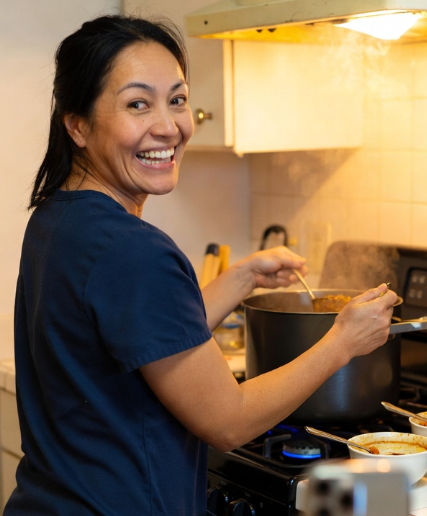
I went home and made chicken inasal — the Visayan grilled chicken, the one from Lourdes's region, marinated in vinegar and calamansi and lemongrass. It's a recipe that requires time — overnight marination — and attention — careful grilling, constant basting — and the result is chicken that tastes like it was loved into existence, each bite carrying the vinegar and citrus and smoke of a kitchen that took its time.
I thought about Dr. Reeves's question while I grilled. Do I choose Jason because he's safe, or because he's Jason? The answer, I think, is both. And I think "both" is okay. Safety is not a flaw in a partner. Safety is the thing that allows the rest — the vulnerability, the cooking together, the terrible adobo — to exist. You can't be vulnerable without a net. Jason is the net. But he's also the person holding the net, and the person is not the same as the function, and I'm learning the difference, slowly, the way I learn all things: at the stove, with vinegar, over time.
The inasal was good. The char was right, the lemongrass fragrant, the calamansi sharp. I packed half for Jason and left it on his porch with a note that said, "Safe and good are not mutually exclusive." He texted back: "Is this about the chicken or about us?" I texted: "Yes." He sent a laughing emoji. I ate my half standing at the stove. Some things haven't changed. The standing. The eating alone. But the alone has company now. The alone has a paramedic who asks about the chicken and the us in the same sentence, and that's new, and new is still strange, and strange is not bad.
The recipe below is the one I made that night — the chicken inasal I grilled while turning Dr. Reeves’s question over in my head, basting and thinking, thinking and basting. It’s the kind of recipe that asks you to slow down, to give it a full night in the marinade and your full attention at the grill, and maybe that’s why it felt right for a evening spent figuring out whether safe and chosen can be the same thing. If you make it, give it the time it needs. It gives it back.
Chicken Inasal
Prep Time: 20 minutes + overnight marination | Cook Time: 25 minutes | Total Time: 45 minutes (plus marination) | Servings: 4
Ingredients
- 2 lbs bone-in, skin-on chicken thighs and drumsticks
- 1/3 cup coconut vinegar (or white cane vinegar)
- 1/4 cup calamansi juice (about 10–12 calamansi, or substitute 2 tbsp lime juice + 1 tbsp orange juice)
- 3 stalks lemongrass, outer layers removed, finely minced
- 6 cloves garlic, minced
- 1 thumb-sized piece fresh ginger, grated
- 2 tbsp brown sugar
- 1 tbsp fish sauce
- 1 tsp freshly ground black pepper
- 1/2 tsp salt
- 1/4 cup annatto oil (see note below)
For the annatto oil:
- 1/4 cup neutral oil (canola or vegetable)
- 2 tbsp annatto (achuete) seeds
For the basting sauce:
- 3 tbsp annatto oil
- 2 tbsp melted butter
- 1 tbsp calamansi juice
- 1 clove garlic, minced
For serving:
- Steamed white rice
- Sinamak (spiced vinegar) for dipping
Instructions
- Make the annatto oil. Heat neutral oil in a small saucepan over low heat. Add annatto seeds and stir for 3–5 minutes until the oil turns deep orange-red. Strain out the seeds and set the oil aside to cool.
- Prepare the marinade. In a large bowl, combine the coconut vinegar, calamansi juice, lemongrass, garlic, ginger, brown sugar, fish sauce, black pepper, salt, and annatto oil. Whisk until the sugar dissolves.
- Marinate the chicken. Score the chicken pieces with shallow cuts to allow the marinade to penetrate. Add chicken to the marinade, turning to coat thoroughly. Cover and refrigerate overnight, or at least 8 hours, turning once halfway through.
- Make the basting sauce. Combine the annatto oil, melted butter, calamansi juice, and garlic in a small bowl. Set aside.
- Preheat the grill. Set up a charcoal or gas grill for medium-high heat, about 400°F. If using charcoal, wait until coals are ashed over and glowing.
- Grill the chicken. Remove chicken from the marinade, letting excess drip off. Place skin-side down on the grill. Cook for 6–7 minutes per side, basting generously with the annatto-butter sauce each time you turn, until the internal temperature reaches 165°F and the skin is charred and caramelized. Total grilling time is about 20–25 minutes, depending on the size of the pieces.
- Rest and serve. Let the chicken rest for 5 minutes. Serve over steamed rice with spiced vinegar on the side for dipping.
Nutrition (per serving)
Calories: 420 | Protein: 32g | Fat: 28g | Carbs: 10g | Fiber: 1g | Sodium: 680mg