
 By
By We drove to Las Cruces Saturday for Christmas. The whole family. The trophy was in the back of the truck. I had decided Wednesday night to bring the trophy. Lisa thought it was excessive. I told her I wanted Papá to hold it. Lisa stopped objecting. We packed Friday night. We left Saturday at five in the morning. We got there at five in the afternoon. Mamá had a pot of green chile stew on the stove. The house smelled like home. Papá was in his recliner. He stood up when we came in. He hugged each of the kids. He held Diego longer than the others. He said, "M'ijo. Champion." He said it three times. Diego nodded. Diego had to look away briefly. Papá pretended not to see.
I brought in the trophy from the truck. I set it on the dining room table. Mamá looked at it. She said, "M'ijo. Bring it here." She held it. She said, "Heavier than I thought." I said, "Yes, ma'am." She said, "We are going to put it in the kitchen for the weekend. So Hector can see it from his chair." I said, "Yes, ma'am." She moved the trophy to the kitchen counter. Papá looked at it from his recliner. He smiled. He looked at it on and off all evening. He fell asleep at ten with his eyes still on the trophy.
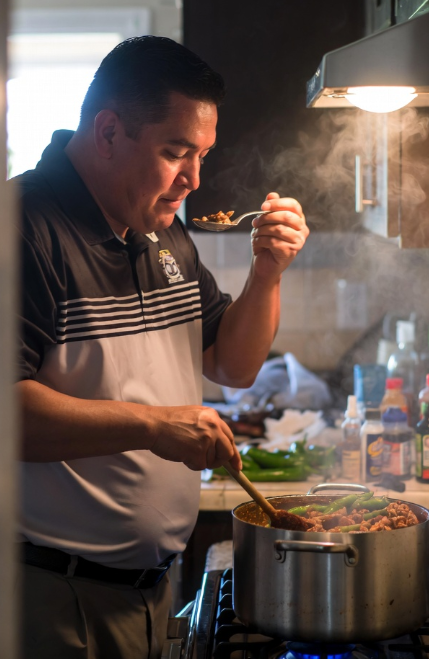
Sunday and Monday were the tamale production. Two days. The whole extended family was there. Miguel and Dolores and their kids. Patricia and Gilbert. Gabby and Ray. Marisol and Alex. My cousins from Las Cruces and Albuquerque. The kitchen was a factory. Mamá at the head of the table, directing. The masa was spread on corn husks. The fillings were prepared. The husks were folded. The bundles were stacked. The big pot was loaded. The pot steamed for hours. The smell filled the house and drifted out the doors and was, by the second day, in every fabric in every room.
This year's tamales were the same as every year's tamales — pork in red chile, chicken in green chile, sweet tamales with raisins and sugar for the kids — but they were more, in some way I do not know how to explain. Maybe it was the championship. Maybe it was the trophy on the counter. Maybe it was Papá's health, which has been on a slow decline that everyone is pretending not to notice. Maybe it was that Diego is a senior and this is his last Christmas in the house we grew up in before he becomes a college student in eight months and the relationship to Christmas in Las Cruces becomes a different relationship. Maybe it was all of it. The tamales were the same. The tamales were not the same. The tamales were what they always are: the central act of the Medina year, the thing we do that makes us a family, the labor that we have done together for as far back as anyone can remember.
I stood at the table for two days spreading masa. Diego stood next to me. He has helped with tamales since he was four. This year was the first year he was assembling them at full speed, with adult precision, without supervision. I watched him. I did not say anything. Mamá watched him too. Mamá said, "M'ijo. Diego is good at this." I said, "He has been watching." She said, "He has been doing." I said, "Yes." She said, "He is going to make tamales for his own children one day." I said, "Yes." She said, "And he is going to teach them." I said, "Yes." She said, "Carlos. The line is not broken." I said, "No, Mamá. The line is not broken." She nodded. She kept spreading masa. She did not say more. She did not have to.
Christmas Eve we went to Mass at midnight at the parish where I was baptized. The whole family. Three pews of Medinas. Father Domingo gave a homily about light coming into a dark world, which is the standard Christmas Eve homily, and which never gets less true. The choir sang in Spanish. The candles were lit. The kids were tired. The twins almost fell asleep in the pew. We came home at one-thirty. We went to bed.
Christmas morning. Coffee at six. The kids opened presents at eight. The big gift this year was for Diego — a new winter coat for college, custom-fitted with the Eldorado Prep state championship logo embroidered on the chest. Lisa had ordered it weeks ago. Diego held it. He could not speak. He hugged Lisa. He came over to me and hugged me. He said, "Dad. Mom. Thank you." That was all he said. Sofia got a stack of books and a new pair of running shoes. The twins got the toys they had asked for. We had Christmas breakfast at the dining room table — eggs and chorizo and potatoes and tortillas and orange juice and coffee — and at noon we walked to the cemetery. The whole family walked. The cemetery is half a mile from Mamá and Papá's house. We brought poinsettias. We laid them on graves. Ruben's grave. My grandparents' graves. My great-grandparents' graves. We stood. We did not say much. Diego stood at Ruben's grave for a long time. Alex stood next to him. Diego put his hand on Alex's shoulder. Alex is nine. He is the closest thing to Ruben we have. Diego held him there for a minute. We all stood together. We walked back. We ate lunch. Christmas. The road bends. Feed your people. The game is won at the table.
The tamales were the centerpiece — they always are — but Christmas morning was its own thing: coffee at six, the house still quiet, Papá in his recliner with his eyes moving to the trophy on the counter. We needed something for the table before the eggs and chorizo, something soft and a little sweet that the kids could pull at while the adults drank their first cups. This cherry yeast coffee cake is what I make now when I want that feeling — the slow morning after the big labor, the family still in the house, nobody needing to be anywhere yet.
Cherry Yeast Coffee Cake
Prep Time: 30 min + 1 hr 30 min rise | Cook Time: 30 min | Total Time: 2 hr 30 min | Servings: 12
Ingredients
- 2 1/4 teaspoons active dry yeast (1 packet)
- 1/2 cup warm water (105–110°F)
- 1/2 cup warm whole milk
- 1/3 cup granulated sugar, divided
- 1/3 cup unsalted butter, softened
- 1 teaspoon salt
- 2 large eggs
- 1 teaspoon vanilla extract
- 3 1/4 cups all-purpose flour, plus more for kneading
- 1 can (21 oz) cherry pie filling
- 1/2 teaspoon almond extract (optional)
- Glaze: 1 cup powdered sugar, 2 tablespoons milk, 1/2 teaspoon vanilla
Instructions
- Proof the yeast. Combine warm water, 1 teaspoon of the sugar, and the yeast in a small bowl. Stir gently and let stand 5–10 minutes until foamy.
- Make the dough. In a large bowl, beat butter and remaining sugar until light. Add eggs one at a time, then vanilla and salt. Stir in the warm milk and the yeast mixture. Add flour one cup at a time, mixing until a soft dough forms.
- Knead and rise. Turn dough onto a lightly floured surface and knead 6–8 minutes until smooth and elastic. Place in a greased bowl, cover with a clean towel, and let rise in a warm spot 1 hour or until doubled.
- Prepare the filling. Stir almond extract into cherry pie filling if using. Set aside.
- Shape the cake. Punch down dough. On a floured surface, roll into a 10x15-inch rectangle. Spread cherry filling evenly over the dough, leaving a 1-inch border. Roll tightly from the long side into a log. Place seam-side down in a greased 9x13-inch baking pan and form into a horseshoe or spiral shape, or slice the log into 1-inch rounds and arrange cut-side up for a pull-apart version.
- Second rise. Cover and let rise 30 minutes. Preheat oven to 350°F.
- Bake. Bake 28–32 minutes until golden and a toothpick inserted into the dough portion comes out clean. Cool 15 minutes in the pan.
- Glaze. Whisk powdered sugar, milk, and vanilla until smooth. Drizzle over the warm cake. Serve warm or at room temperature.
Nutrition (per serving)
Calories: 310 | Protein: 5g | Fat: 7g | Carbs: 56g | Fiber: 1g | Sodium: 220mg