
 By
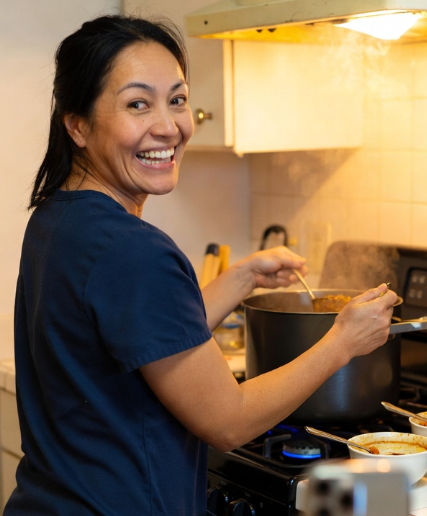
By I wrote a blog post that scared me. "Cooking After the Hard Shifts: What the Kitchen Gives Back." It's the most honest post I've written — not about recipes but about the practice of cooking as survival, about coming home from the ER at midnight and standing at the stove and letting the garlic and the vinegar and the sizzle reset a nervous system that has been on high alert for twelve hours. I didn't mention the PTSD by name. I didn't mention the floor. But I wrote around them with enough precision that anyone who's been there would recognize the shape of what I was describing.
The response was bigger than anything I've posted before. Not just comments — emails. Direct, personal emails from readers who recognized themselves in the post. A nurse in Seattle: "I thought I was the only one who cooks at 2 AM to come down from a shift." A paramedic in New York: "My wife doesn't understand why I have to cook when I get home. Now I can show her this." A social worker in Minnesota: "The kitchen is my therapy room too. Thank you for saying it."
I read the emails and cried — not the bad crying, the overwhelmed crying, the kind where you realize that the thing you thought was private and shameful is actually shared and human and the sharing of it connects people in ways you didn't anticipate. The kitchen-as-therapy is not just mine. It's everybody's. The midnight cooking is not just a coping mechanism. It's a community, scattered across kitchens in Seattle and New York and Minnesota, all of us standing at stoves at 2 AM because the alternative is lying in bed with the day replaying in our heads.
I made giniling — Filipino ground meat sauté, the simplest weeknight meal. Ground pork with potatoes, peas, carrots, tomato sauce, soy sauce. It takes twenty minutes. It feeds four. It requires nothing except a pan, a spoon, and the willingness to chop an onion after a twelve-hour shift. Giniling is the meal for when you're too tired to cook but you cook anyway because the cooking is not optional, the cooking is what keeps the gears turning, the cooking is the midnight prayer of exhausted healthcare workers who have found that the spatula is mightier than the Ambien.
I ate the giniling at midnight after a shift. It was simple and good. The emails sat in my inbox like small lights. The community exists. The kitchens are real. We're all cooking. We're all standing. The garlic is universal. The healing is shared.
The giniling I described in that post is my original midnight anchor, but on the nights when I want something I can eat with my hands, standing over the sink, still in my scrubs — something warm and salty and satisfying that requires nothing more than a pan and twenty minutes of motion — cheesesteak egg rolls have become that second prayer. There’s something about filling and folding and frying that is tactile in the right way, that keeps the hands busy and the head quiet. The emails were still glowing in my inbox when I made these. I needed something crispy on the outside and soft and yielding in the middle, which felt, honestly, exactly right.
Cheesesteak Egg Rolls
Prep Time: 20 min | Cook Time: 15 min | Total Time: 35 min | Servings: 4 (3 rolls each)
Ingredients
- 1 lb ribeye steak or shaved beef, very thinly sliced
- 1 medium yellow onion, finely diced
- 1 green bell pepper, finely diced
- 1 tablespoon Worcestershire sauce
- 1/2 teaspoon garlic powder
- Salt and black pepper to taste
- 6 oz provolone cheese, shredded (or American cheese slices, torn)
- 12 egg roll wrappers
- 1 egg, beaten (for sealing)
- Vegetable oil, for frying (about 3 cups)
- Ranch dressing or spicy mayo, for dipping
Instructions
- Cook the filling. Heat 1 tablespoon of oil in a large skillet over medium-high heat. Add the onion and bell pepper and sauté for 4–5 minutes until softened. Add the thinly sliced beef, breaking it apart with a spoon. Season with Worcestershire sauce, garlic powder, salt, and pepper. Cook until no pink remains, about 4 minutes. Remove from heat and let the mixture cool for 5 minutes, then fold in the shredded provolone until just melted and combined.
- Roll the egg rolls. Lay an egg roll wrapper on a clean surface in a diamond orientation. Place about 3 tablespoons of the filling in the center. Fold the bottom corner up over the filling, then fold in both side corners snugly. Roll upward tightly toward the top corner. Brush the top corner with beaten egg and press to seal. Repeat with remaining wrappers and filling.
- Heat the oil. Pour vegetable oil into a heavy-bottomed pot or deep skillet to a depth of about 2 inches. Heat over medium-high heat until the oil reaches 350°F. A small piece of wrapper dropped in should sizzle immediately.
- Fry in batches. Gently lower 3–4 egg rolls into the oil at a time to avoid crowding. Fry for 3–4 minutes, turning once halfway, until deep golden brown and crispy on all sides. Transfer to a paper-towel-lined plate and season lightly with salt while still hot.
- Rest and serve. Let the egg rolls rest for 2 minutes before cutting — the filling will be very hot. Slice diagonally and serve with ranch dressing or spicy mayo alongside.
Nutrition (per serving)
Calories: 480 | Protein: 28g | Fat: 24g | Carbs: 38g | Fiber: 2g | Sodium: 720mg