
 By
By Mid-January and the light is returning. Not dramatically — we're gaining about five minutes of daylight per day now, which doesn't sound like much but is everything when you've been counting minutes since the solstice. Sunrise at 10:04 AM. Sunset at 4:41 PM. Six hours and thirty-seven minutes of light. Last month it was five hours. The gain is measurable. The gain is hope expressed in minutes.
I spent Saturday at the Asian grocery on Mountain View Drive — the small one, the one Lourdes has patronized since 1985, where the owner, Mr. Nguyen, knows every Filipino mother in Anchorage by name and stocks Datu Puti vinegar and canned jackfruit and frozen banana leaves specifically because Lourdes asked him to in 1987 and he has never stopped. The store smells like fish sauce and rice and the particular fragrance of a place that serves immigrant communities — a mixture of nostalgia and necessity and the quiet determination to eat your own food in a country that doesn't stock it at Safeway.
I bought ingredients for laing — taro leaves simmered in coconut milk with shrimp paste and chili peppers. It's a Bicolano dish, not Ilonggo, but Lourdes adopted it because Reynaldo loved anything with coconut milk and chili, and love in the Santos kitchen trumps regional boundaries. The taro leaves are the challenge — they contain calcium oxalate crystals that make your throat itch if you don't cook them long enough, which means laing requires patience. Low heat. Long simmer. No shortcuts. The leaves break down slowly in the coconut milk, becoming silky and tender, absorbing the fat and the shrimp paste until each bite is rich, spicy, and faintly briny.
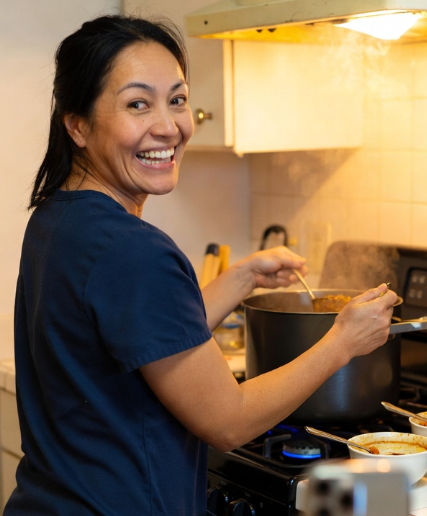
I cooked the laing for two hours. Two hours of stirring and waiting and trusting the process, which is a phrase I would never use in the ER — the ER doesn't trust processes, the ER trusts speed and skill and the willingness to cut — but in the kitchen, trusting the process is everything. The taro leaves need time. The coconut milk needs time. The flavors need time to merge into something greater than their parts. Rushing ruins it. Patience makes it.
Dr. Reeves would see the metaphor. I see the metaphor. The laing is the metaphor. Some things can't be rushed — not recovery, not grief, not taro leaves in coconut milk. You simmer. You wait. You trust that the chemistry of time and heat will do what force cannot. The laing was excellent. The patience was harder. But the result was worth the wait.
The laing taught me what it always teaches me — that the pot rewards the patient. When I want to carry that same slow, coconut-rich warmth into a weeknight that doesn’t allow two full hours, this cauliflower, chickpea, and chicken coconut curry is where I turn. It isn’t laing, and it doesn’t pretend to be, but it asks the same thing of you: low heat, a little trust, and the willingness to let the coconut milk do its work until everything in the pot becomes something greater than it started.
Cauliflower, Chickpea, and Chicken Coconut Curry
Prep Time: 15 minutes | Cook Time: 35 minutes | Total Time: 50 minutes | Servings: 4
Ingredients
- 1 1/2 lbs boneless, skinless chicken thighs, cut into 1-inch pieces
- 1 small head cauliflower, cut into florets (about 4 cups)
- 1 (15 oz) can chickpeas, drained and rinsed
- 1 (13.5 oz) can full-fat coconut milk
- 1 (14.5 oz) can diced tomatoes
- 1 medium yellow onion, diced
- 4 cloves garlic, minced
- 1 tablespoon fresh ginger, grated
- 2 tablespoons curry powder
- 1 teaspoon ground turmeric
- 1/2 teaspoon cayenne pepper (adjust to taste)
- 1 teaspoon kosher salt, plus more to taste
- 2 tablespoons neutral oil (such as canola or avocado)
- 1 tablespoon fresh lime juice
- 1/4 cup fresh cilantro, roughly chopped, for serving
- Cooked basmati rice, for serving
Instructions
- Sear the chicken. Heat oil in a large, heavy-bottomed pot or Dutch oven over medium-high heat. Season chicken pieces with 1/2 teaspoon salt. Add chicken in a single layer and sear without moving for 3–4 minutes until golden. Flip and sear 2 minutes more. Transfer to a plate — the chicken will finish cooking in the sauce.
- Build the base. Reduce heat to medium. Add the diced onion to the same pot and cook, stirring occasionally, for 5 minutes until softened and translucent. Add garlic and ginger and cook 1 minute more, stirring constantly, until fragrant.
- Bloom the spices. Add curry powder, turmeric, cayenne, and remaining 1/2 teaspoon salt directly to the onion mixture. Stir and cook for 60 seconds, pressing the spices into the aromatics, until the mixture is deeply fragrant and beginning to stick slightly to the bottom of the pot.
- Add the liquids and vegetables. Pour in the diced tomatoes with their juices and stir to deglaze any browned bits from the bottom of the pot. Add the coconut milk and stir to combine. Add the cauliflower florets and chickpeas and stir everything together.
- Return the chicken and simmer. Nestle the seared chicken pieces back into the pot, along with any accumulated juices. Bring the curry to a gentle boil, then reduce heat to low. Cover partially with a lid and simmer for 20–25 minutes, stirring every 5 minutes, until the cauliflower is completely tender and the sauce has thickened and deepened in color. Do not rush this step — the low, patient simmer is what makes it.
- Finish and serve. Remove from heat and stir in the fresh lime juice. Taste and adjust salt or cayenne as needed. Ladle over basmati rice and top generously with fresh cilantro.
Nutrition (per serving)
Calories: 480 | Protein: 36g | Fat: 26g | Carbs: 28g | Fiber: 7g | Sodium: 620mg