
 By
By Halloween costumes at the Filipino Community Pageant. Pete and I worked the night shift Friday. We talked between codes about the kids — his daughter's wedding planning, my sister's pregnancy. The talking was the keeping.
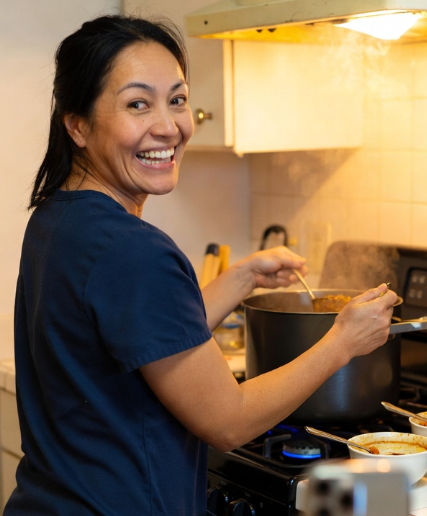
Lourdes is 74. She is in the kitchen. She is luminous. Joseph called Saturday. He told me Lourdes calls him every day. He answers every day. The pattern has held for 6 years.
I made caldereta Sunday. The celebration stew. The beef and tomato and olives. The dish you make when something good has happened.
The blog post on caldereta got picked up by a Filipino-American newsletter. Traffic doubled for two days. The traffic was the surprise.
Angela came over Saturday with the kids. We cooked. We argued about pancit proportions — she uses more soy, I use more calamansi. We are both wrong, according to Lourdes.
I stood at the counter eating leftovers in my pajamas. The standing was the small luxury. The luxury was the having of leftovers at all.
A blog reader sent me a photograph of her grandmother's wooden mortar and pestle, used since 1962. The photograph was holy. I wrote her back. The writing back is the work.
Angela texted me a photo of the kids. I texted back a heart. The exchange took thirty seconds. The thirty seconds was the keeping.
Auntie Norma called Sunday afternoon. She is now seventy-nine. She wanted a recipe. I gave it to her. She wanted to know how my week was. I told her, briefly. She told me about her week. The exchange took eighteen minutes. The eighteen minutes was the keeping.
The therapy session this month was about pacing. Dr. Reeves said, "Grace. The pacing is the love for the future self." I am working on the pacing. The pacing is harder than the loving.
The break room had cake Tuesday. Someone's birthday. We ate the cake. We did not ask whose birthday. The cake was the cake.
The light was good Saturday morning. I sat on the porch with a cup of coffee and watched the inlet for forty minutes. The watching was the small therapy. The therapy was free.
I had a long phone call with Dr. Reeves on Wednesday. We talked about pacing and rest and the way the body keeps a log of what it has carried. Dr. Reeves said, "Grace. The body remembers. The mind forgets. The cooking is the bridge." I wrote the line down. The line is now on a sticky note above the kitchen sink.
A reader from New Jersey wrote in about her grandmother's adobo, which used pineapple. I had never heard of pineapple in adobo. I tried it. It was strange. It was also good. The strange and the good are not opposites.
The grocery store had no calamansi. I substituted lime. The substitution was acceptable. The acceptable is the working version of perfect.
The Filipino Community newsletter announced the Saturday gathering. I will be on lumpia duty. I am always on lumpia duty.
I read a chapter of a novel before bed each night this week. The novel was about a Filipina nurse in California. The novel was good. The novel was, in some way, my own life adjacent.
I drove home Tuesday evening and the sun set at three forty-five and the highway was already iced at the bridges and the radio was on a station I did not recognize and I did not change it.
I made coffee at six AM. The coffee was the start. The start was always the same.
I took inventory of the freezer Sunday. The freezer had: twelve quarts of broth, eight pounds of adobo in vacuum bags, six pounds of sinigang base, fourteen lumpia trays at fifty rolls each, three pounds of marinated beef for caldereta, and a small bag of pandan leaves Tita Nening had sent me. The inventory was the proof of preparation. The preparation was the proof of love.
The reader from New Jersey and her grandmother’s pineapple adobo stayed with me all week — the way something unfamiliar can sit in your mouth and rearrange what you thought you knew. I had leftover pineapple from the caldereta prep and a bag of carrots on the counter, and I remembered that line I wrote down: the strange and the good are not opposites. So I made this. It is simple. It is sweet and a little bright and it goes with everything. It is the kind of dish Lourdes would set on the table without explaining, and you would eat it, and you would understand.
Carrots and Pineapple
Prep Time: 10 minutes | Cook Time: 20 minutes | Total Time: 30 minutes | Servings: 4
Ingredients
- 1 lb carrots, peeled and sliced into 1/4-inch coins
- 1 cup pineapple chunks (fresh or canned in juice, drained — reserve 2 tablespoons juice)
- 2 tablespoons unsalted butter
- 2 tablespoons brown sugar, packed
- 1/4 teaspoon salt
- 1/8 teaspoon ground ginger
- 1 tablespoon fresh flat-leaf parsley, chopped (optional, for serving)
Instructions
- Cook the carrots. Place sliced carrots in a medium saucepan and cover with cold water by one inch. Bring to a boil over medium-high heat, then reduce to a steady simmer. Cook 8 to 10 minutes, until the carrots are just tender when pierced with a fork but still hold their shape. Drain and set aside.
- Make the glaze. In the same saucepan over medium heat, melt the butter. Add the brown sugar, reserved pineapple juice, salt, and ginger. Stir until the sugar dissolves and the glaze begins to bubble gently, about 2 minutes.
- Combine and finish. Return the drained carrots to the pan along with the pineapple chunks. Toss gently to coat everything in the glaze. Cook over medium heat, stirring occasionally, for 5 to 6 minutes, until the glaze thickens slightly and clings to the carrots and pineapple.
- Serve. Transfer to a serving bowl. Scatter parsley over the top if using. Serve warm as a side dish alongside rice, roasted meats, or — yes — caldereta.
Nutrition (per serving)
Calories: 140 | Protein: 1g | Fat: 6g | Carbs: 22g | Fiber: 3g | Sodium: 190mg