The Fitzgerald anniversary. November 10. Paul's sacred day.
He can't wear the black tie anymore — I dress him, and ties are beyond what the morning routine can handle — but he asked me to tie it around his collar loosely, a symbolic gesture, the tie draped rather than knotted. I did it. The silk against his shirt. The loose ends. Paul Johansson, honoring his dead sailors, from a wheelchair in a rearranged living room in Duluth.
I played the Lightfoot song on the speaker. "The Wreck of the Edmund Fitzgerald." Paul closed his eyes and listened. Every verse. Six minutes and thirty seconds. His lips moved with the words. "We are holding our own."
We are holding our own.
After the song, he opened his eyes and said, "Read me the last chapter." His favorite book — the definitive account of the Fitzgerald sinking. I sat beside his chair with the book open on my lap and I read aloud. The final transmission. The search. The discovery of the wreck in 530 feet of water. The memorial service. The bell that rings twenty-nine times, once for each man.
Paul listened with closed eyes. When I finished, he said, "The lake doesn't apologize." I said, "No." He said, "Neither does this disease." I said, "No." He said, "But the men who sailed that ship — they knew the lake. They sailed it anyway. They went out into the storm because that's what you do. You go out." He looked at me. "We go out, Linda. Into the storm. Together."
I held his hand. His right hand, barely able to grip, but there, warm, present. I held it and the Lightfoot song echoed in the room and the lake was outside and the lake was inside — the lake of his disease, the storm of his body, the water rising.
We go out. Together.
I made a November dinner: beef and barley soup. Thick, hearty, the kind of soup that fights back against cold and dark and grief. Paul ate it from a cup. I held the cup. He drank. The soup was warm. The night was cold.
Twenty-nine men died on the Edmund Fitzgerald. November 10, 1975. Paul Johansson remembers them. He remembers them in a wheelchair, in a rearranged house, with a disease that doesn't apologize, and he remembers them because remembering is what Paul does and the disease hasn't taken his memory and it won't. The disease can have his hands and his arms and his legs and eventually his breath but it cannot have his memory, because memory lives in a place that motor neurons don't reach.
The bell rings twenty-nine times. Once for each man.
Paul is still here. The bell hasn't rung for him yet.
Every year on November 10th I need something on the stove that takes time — something that asks me to stand there and stir, to be patient, to tend to it — and this Buttery Onion Soup has become that thing for me. The onions caramelize slowly, a full half hour of low heat and quiet attention, and there is something honest about that: the soup cannot be rushed, the grief cannot be rushed, and Paul and I have learned that the things worth honoring take as long as they take. I ladle it into a cup he can hold to his lips, and when the warmth reaches him I can see it in his face. That’s enough. That is more than enough.
Buttery Onion Soup
Prep Time: 15 minutes | Cook Time: 50 minutes | Total Time: 1 hour 5 minutes | Servings: 6
Ingredients
- 4 tablespoons unsalted butter
- 1 tablespoon olive oil
- 4 large yellow onions, halved and thinly sliced
- 1 teaspoon granulated sugar
- 1/2 teaspoon kosher salt, plus more to taste
- 3 cloves garlic, minced
- 1/2 cup dry white wine or additional broth
- 5 cups low-sodium beef broth
- 1 teaspoon fresh thyme leaves (or 1/2 teaspoon dried)
- 1 bay leaf
- 1/4 teaspoon black pepper, plus more to taste
- 1 tablespoon Worcestershire sauce
Instructions
- Melt the butter. In a large heavy-bottomed pot or Dutch oven, melt the butter with the olive oil over medium heat until the butter is foamy and just beginning to turn golden.
- Add the onions. Add all of the sliced onions, the sugar, and 1/2 teaspoon salt. Stir to coat evenly. Cook over medium-low heat, stirring every 5 minutes, for 30—35 minutes until the onions are deeply golden, collapsed, and caramelized. Do not rush this step — the slow cook is what builds the flavor.
- Add the garlic. Stir in the minced garlic and cook for 1—2 minutes until fragrant, scraping up any browned bits from the bottom of the pot.
- Deglaze. Pour in the white wine (or broth) and stir vigorously to lift all the caramelized bits from the bottom. Let it cook for 2 minutes until mostly absorbed.
- Add broth and seasonings. Pour in the beef broth. Add the thyme, bay leaf, Worcestershire sauce, and pepper. Stir to combine and bring to a gentle boil.
- Simmer. Reduce heat to low and simmer uncovered for 15 minutes to let the flavors come together. Remove the bay leaf. Taste and adjust salt and pepper as needed.
- Serve. Ladle into bowls or mugs. Serve as is, or top with a slice of toasted crusty bread and shredded Gruyère if desired.
Nutrition (per serving)
Calories: 148 | Protein: 4g | Fat: 9g | Carbs: 13g | Fiber: 2g | Sodium: 430mg
About the cook who shared this
Linda Johansson
Week 137 of Linda’s 30-year story
· Duluth, Minnesota
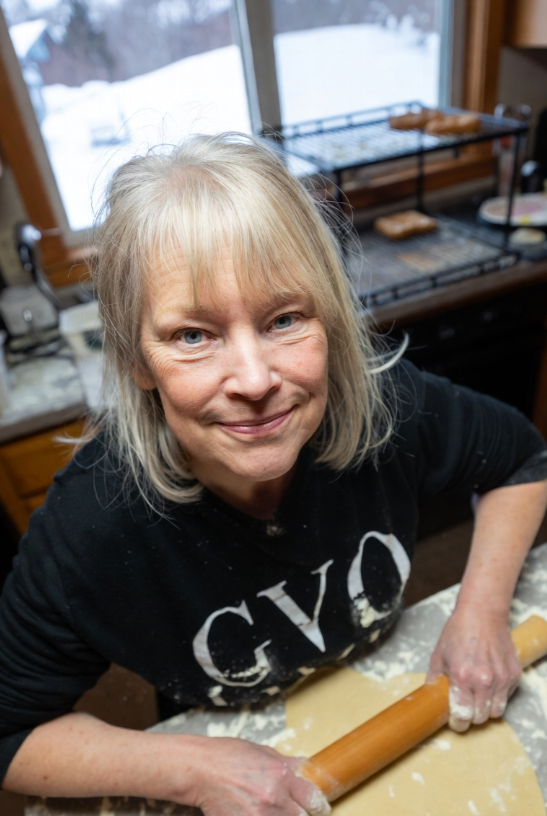
Linda is a sixty-three-year-old retired nurse from Duluth, Minnesota, living alone in the house where she raised her children and said goodbye to her husband. She lost Paul to ALS in 2020 after two years of watching the kindest man she'd ever known lose everything but his dignity. She cooks Scandinavian comfort food and Minnesota hotdish and the pot roast Paul loved, and she sets two places at the table out of habit because it makes her feel less alone. Every recipe she writes is a person she's loved.
