Chennai. My mother's city. And I am undone.
We took the train from Kochi — twelve hours through the Western Ghats, past rice paddies and coconut groves and small towns where the platforms were painted in bright colors and vendors sold chai in clay cups that you threw on the ground when you finished. Raj slept. I watched India go by through the window and thought about Amma making this same journey in reverse, thirty-one years ago, leaving everything she knew for a country that wouldn't recognize her chemistry degree.
Chennai is hot and loud and chaotic and I love it with an intensity that surprises me. We're staying with Amma's cousin Kamala — Kamala Aunty, who has a house in Mylapore with a courtyard and a kitchen that hasn't been renovated since 1985 and doesn't need to be. She cooks on a two-burner gas stove with a rolling stone grinder in the corner and produces meals that would make restaurant chefs weep.
Yesterday she made chettinad chicken for lunch. The masala — roasted fennel, star anise, kalpasi (stone flower), marathi mokku (dried flower buds) — ground on the stone grinder. The kitchen smelled like a spice market during an earthquake. I wrote down everything, but some of it can't be written. "How long do you roast the spices?" I asked. "Until they tell you they're ready," she said. Until they tell you. These women and their mystical cooking instructions.
Today we went to my grandparents' village — a small town called Srirangam, near Trichy. Amma's parents are both gone (Thatha died in 2004, Paati in 2009), but the house is still there, occupied by a distant cousin. Standing in the kitchen where my mother learned to cook — a dark room with a wood fire and a brass pot collection that's been in the family for four generations — I finally understood something about Amma that I couldn't have understood from Edison, New Jersey.
She didn't just leave India. She left a kitchen. She left a lineage. She left the specific brass pot her mother used for sambar, and the stone grinder her grandmother used for chutney, and she recreated all of it in a split-level in Edison with a wet grinder from the Indian grocery store and determination that could level mountains.
I bought a small brass cup from the village. A tumbler, the kind they drink filter coffee from. It's dented and old and probably worth nothing. I'm giving it to Amma when we get home.
Tonight Kamala Aunty is making filter coffee and murukku and we're sitting in the courtyard and I'm writing recipes as fast as I can because this is the motherboard, this is the source code, and I need to download everything before I lose the connection.
The notebook is almost full. I'm going to need another one.
Sitting in that courtyard with Kamala Aunty, filter coffee in hand and notebook almost full, I kept thinking about my mother’s determination—the way she rebuilt a whole culinary lineage from memory in a New Jersey kitchen. But when I got home, the first thing I made wasn’t from the notebook at all. It was this Buffalo Chicken Corn Chowder—smoky, loud, unapologetically American—because sometimes the dish you need after a pilgrimage isn’t the one you went looking for. It’s the one that says you’re back, you’re home, and you can hold two kitchens in your hands at once.
Buffalo Chicken Corn Chowder
Prep Time: 15 min | Cook Time: 1 hr | Total Time: 1 hr 15 min | Servings: 6
Ingredients
- 5 slices bacon, chopped
- 1 pound boneless skinless chicken breast or thighs, cubed
- ~1/4 cup Frank’s hot sauce, divided
- 2 tablespoons butter
- 1/2 yellow onion, chopped
- 2 stalks celery, diced
- 2 carrots, diced
- 1 clove garlic, minced
- 1/2 teaspoon smoked paprika
- 2-3 cans of corn (depending on how much corn you like in your chowder)
- 1 potato, peeled and diced small
- 1 1/2 cups cream
- 2 1/2 cups chicken stock
- Salt and pepper, to taste
- Chopped green onions, for topping
- Fresh cilantro, for topping
- Blue cheese crumbles, for topping
Instructions
- Cook the bacon. Heat a medium-sized pot over medium heat and cook the bacon until crispy. Remove the bacon from the pot and set it on a paper towel lined plate to drain.
- Sear the chicken. Drain half of the bacon fat, raise the heat to medium-high, and sear the chicken on all sides.
- Add the hot sauce. Pour in 2 tablespoons of the hot sauce and cook the chicken until it has absorbed most of the sauce. Remove the chicken from the pot and set it aside.
- Sauté the vegetables. Add the onions, celery, and carrots to the pot and sauté until the onions are almost translucent, about 5 minutes. Add the chopped potato and sauté another 5 minutes. Add the garlic, paprika, and a pinch of salt and pepper and sauté until the garlic becomes fragrant, about one more minute.
- Simmer the chowder. Add the corn to the pot and mix it well with the other ingredients. Cook for 5 more minutes. Add the chicken broth and cream and let warm. Slowly add in the hot sauce, mixing well, and taste testing as you add. Remember, it’s best to start with less and add more if necessary than to add too much right away and then have to try to cut the spice. When the mixture is slightly less spicy than you’d like (it will become spicier as it cooks), turn the mixture to a low simmer and cook for 20 minutes.
- Blend for creaminess. Ladle half of the soup into a blender or food processor and puree until creamy (or you can use an immersion blender). Pour the creamy soup back into the pot with the rest and stir to combine. Season with salt and pepper, to taste.
- Return the chicken. Put the chicken back into the pot and cook for another 5—10 minutes to heat the chicken back up.
- Top and serve. Top the chowder with the bacon crumbles, fresh cilantro, chopped green onions and blue cheese crumbles, and serve.
Nutrition (per serving)
Nutrition information not available for this recipe.
About the cook who shared this
Priya Krishnamurthy
Week 6 of Priya’s 30-year story
· Edison, New Jersey
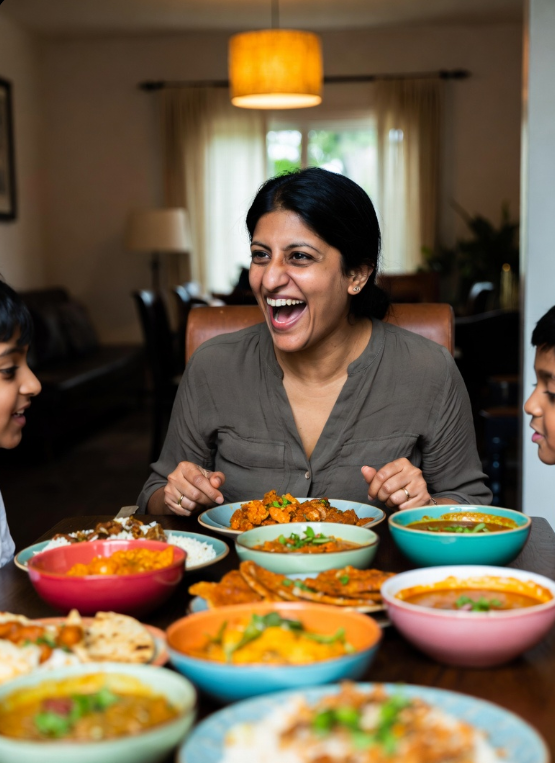
Priya is a pharmacist, wife, and mom of two in Edison, New Jersey — the town she grew up in, surrounded by the sights and smells of her mother's South Indian kitchen. These days, she splits her time between the hospital pharmacy, school pickups, and her own kitchen, where she cooks nearly every night. Her style is a blend of the Tamil recipes her mother taught her and the American comfort food her kids actually want to eat. She writes about the beautiful mess of balancing two cultures on one plate — and she wants you to know that ordering pizza is also an act of love.
