
 By
By Jack's garden operation grows more ambitious every year. The greenhouse, the market sales, the Farm Fund jar that now holds over three hundred dollars. He's 15 and he farms the way some kids play video games — obsessively, joyfully, with the deep understanding that this is not a hobby but a vocation wearing a hobby's clothes.
Thursday was tater tot hotdish, because Thursday is always tater tot hotdish and the schedule doesn't change for anything — not pandemics, not loss, not the passage of years. The tater tots go in at 375 and come out golden and the family eats them and the eating is the Thursday and the Thursday is the structure and the structure holds. But I also made asparagus risotto earlier this week, because the kitchen doesn't only look backward. The kitchen grows.
The garden is waking up. The garlic that overwintered is pushing green shoots through the soil, the annual proof that buried things come back. Jack's seedlings are hardening off in the greenhouse. The Marlene cherry tomato — generation 8 now — ready for transplanting. Every spring the planting is the memorial. Every spring the name goes back in the ground.
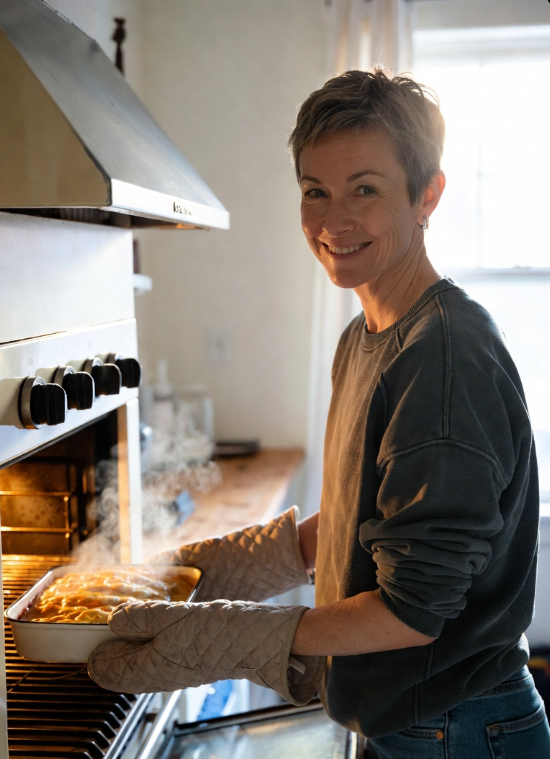
The kitchen doesn’t only look backward — that line has been rattling around in my head all week. Thursday has its hotdish, yes, and the schedule holds. But the other nights belong to whatever the season and the garden and the mood call for, and this week that meant a broccoli orzo bake: humble enough for a Tuesday, warm enough to feel like a hug, and just a little bit like risotto’s more practical cousin. It felt right alongside everything else that’s been quietly growing around here.
Broccoli Orzo Bake
Prep Time: 15 min | Cook Time: 35 min | Total Time: 50 min | Servings: 6
Ingredients
- 1 1/2 cups dry orzo pasta
- 3 cups small broccoli florets (fresh or thawed from frozen)
- 2 tablespoons olive oil
- 3 cloves garlic, minced
- 1/2 medium yellow onion, diced
- 2 tablespoons all-purpose flour
- 2 cups low-sodium vegetable or chicken broth
- 1 cup whole milk
- 1 cup shredded sharp cheddar cheese, divided
- 1/2 cup grated Parmesan cheese, divided
- 1/2 teaspoon Dijon mustard
- 1/2 teaspoon onion powder
- 1/4 teaspoon red pepper flakes (optional)
- Salt and black pepper, to taste
- 1/4 cup plain breadcrumbs
Instructions
- Preheat oven. Heat your oven to 375°F. Lightly grease a 9×13-inch baking dish and set aside.
- Par-cook the orzo. Bring a large pot of salted water to a boil. Cook orzo for 5 minutes (it will finish cooking in the oven), then drain and transfer to the prepared baking dish.
- Blanch the broccoli. In the same pot, bring water back to a boil and blanch broccoli florets for 2 minutes. Drain well and add to the baking dish with the orzo. Stir together gently.
- Build the sauce. In a medium saucepan, heat olive oil over medium heat. Add onion and cook until softened, about 4 minutes. Add garlic and cook 1 minute more. Whisk in the flour and cook, stirring constantly, for 1 minute.
- Add the liquids. Gradually pour in the broth, whisking to prevent lumps, then add the milk. Bring to a gentle simmer and cook until slightly thickened, 4–5 minutes.
- Finish the sauce. Remove from heat. Stir in Dijon mustard, onion powder, red pepper flakes, 3/4 cup cheddar, and 1/4 cup Parmesan. Season well with salt and black pepper.
- Combine and top. Pour the sauce over the orzo and broccoli in the baking dish and stir to combine. In a small bowl, mix the breadcrumbs with the remaining cheddar and Parmesan, then scatter evenly over the top.
- Bake. Bake uncovered for 20–25 minutes, until bubbling around the edges and the top is golden. Let rest 5 minutes before serving.
Nutrition (per serving)
Calories: 360 | Protein: 15g | Fat: 13g | Carbs: 46g | Fiber: 3g | Sodium: 420mg