Two weeks without Paul. Two weeks of lockdown. The two losses blur into one — the loss of him, the loss of the world, the loss of everything that used to fill the hours and the house.
I don't leave the house except to walk Sven. The walks are short — fifteen minutes, around the block, masked, gloved, the virus protocols that a nurse follows without thinking. The neighborhood is quiet. The streets are empty. Duluth in lockdown looks like Duluth in February, minus the snow — closed, silent, everyone inside.
The Damiano Center is closed to volunteers. No Thursday soup. No Gerald. The loss of the Damiano is the loss of my purpose outside this house — the fifty gallons of wild rice soup, the faces, Gerald's "good soup, Linda," the two hours of being someone other than a grieving wife. Gone.
Church is closed. Sunday service is on a screen. I watch it on my laptop at the kitchen table, with Sven at my feet and Paul's place set across from me. Pastor Eriksson speaks to a camera in an empty church, the same church where Paul's funeral was held two weeks ago, and the pews are empty and the sermon echoes and I watch from a screen and the screen is a poor substitute for presence.
I cook every day. Not because I want to. Because Elsa said to. Because the cooking is the structure that holds the day together — the morning coffee, the mid-morning baking, the afternoon soup, the evening dinner for one. The meals are simple: eggs, toast, soup, bread. The meals of a woman cooking through grief, cooking through lockdown, cooking through the specific loneliness of being alive in a house where the other person is not.
I set two places at every meal. I don't eat from Paul's plate. I don't fill Paul's glass. But the place is set. The plate is there. The glass is there. The setting says: you're still here. In the meatballs and the bread and the soup and the plate at the table, you're still here.
I called Mamma on Sunday. She's locked down at Fifth Street, alone. Erik checks on her from the doorway (six feet apart, masked — the Johanssons, who already communicated at a distance, now have a medical reason for it). She sounded strong. Sharp. "How are you, Linda?" she said. I said, "I'm cooking." She said, "Good. That's the answer."
That's the answer. Mamma. Eighty-nine years old. Locked down alone. Her son-in-law just died. Her daughter is grieving. And she says: cooking is the answer. Because it is. It always has been. In this family, the answer to every question — grief, loss, joy, fear, birth, death — is the kitchen.
Mamma said cooking is the answer, and I believed her — but some days I needed a recipe that used almost nothing, made almost no mess, and sat in the oven long enough for me to take Sven around the block and come back to something warm. A strata is eggs and bread, which is exactly what the story says: the meals of grief, the meals of lockdown, the meals of a kitchen that still has to function even when the person who used to eat across the table is gone. I started making this on the second week and I made it at least four times after that — once for me, once for the neighbors who left groceries on the porch, and once just because setting the timer felt like the most purposeful thing I could do before noon.
Broccoli Cheese Strata
Prep Time: 15 min | Cook Time: 50 min | Total Time: 1 hr 5 min | Servings: 6
Ingredients
- 6 large eggs
- 2 cups whole milk
- 1 teaspoon dry mustard
- 1/2 teaspoon salt
- 1/4 teaspoon black pepper
- 4 cups day-old bread, cut into 1-inch cubes (about 6 slices)
- 2 cups broccoli florets, cut small
- 1 1/2 cups shredded sharp cheddar cheese, divided
- 1/2 cup yellow onion, finely diced
- 1 tablespoon butter, for the baking dish
Instructions
- Preheat and prep. Heat your oven to 350°F. Butter a 9x13-inch baking dish generously. If your bread is fresh rather than day-old, spread the cubes on a baking sheet and toast them for 8–10 minutes first so they hold up in the custard.
- Blanch the broccoli. Bring a small pot of salted water to a boil. Add the broccoli florets and cook for 2 minutes, just until bright green. Drain and pat dry — excess moisture will make the strata soggy.
- Whisk the custard. In a large bowl, whisk together the eggs, milk, dry mustard, salt, and pepper until fully combined and slightly frothy.
- Layer the dish. Spread half the bread cubes in the buttered baking dish. Scatter the onion and broccoli evenly over the bread. Sprinkle 1 cup of the cheddar over the vegetables. Top with the remaining bread cubes.
- Pour and rest. Pour the egg custard evenly over the entire dish, pressing the bread down gently with the back of a spoon so every piece absorbs some liquid. Let it rest for at least 10 minutes (or cover and refrigerate overnight — it holds beautifully).
- Top and bake. Sprinkle the remaining 1/2 cup of cheddar over the top. Bake uncovered for 45–50 minutes, until the custard is set in the center and the top is golden. A knife inserted in the middle should come out clean.
- Rest before serving. Let the strata sit for 5 minutes before cutting. It slices cleanly and holds its shape. Serve warm, straight from the dish.
Nutrition (per serving)
Calories: 285 | Protein: 17g | Fat: 15g | Carbs: 21g | Fiber: 2g | Sodium: 430mg
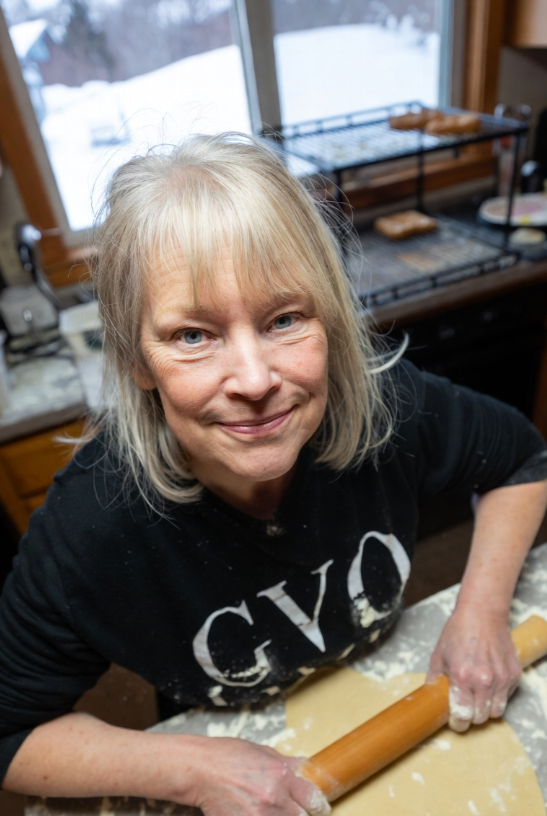
About the cook who shared this
Linda Johansson
Week 211 of Linda’s 30-year story
· Duluth, Minnesota
Linda is a sixty-three-year-old retired nurse from Duluth, Minnesota, living alone in the house where she raised her children and said goodbye to her husband. She lost Paul to ALS in 2020 after two years of watching the kindest man she'd ever known lose everything but his dignity. She cooks Scandinavian comfort food and Minnesota hotdish and the pot roast Paul loved, and she sets two places at the table out of habit because it makes her feel less alone. Every recipe she writes is a person she's loved.
