
 By
By November. Luis Jr. turns seventeen on the 18th. The last birthday before he is legally an adult, before he can sign papers without me, before the Army can have him. I am counting his birthdays the way you count anything that is running out — carefully, with the knowledge that each one is one fewer, and the counting makes you hold each one tighter, the way you hold a last piece of bread.
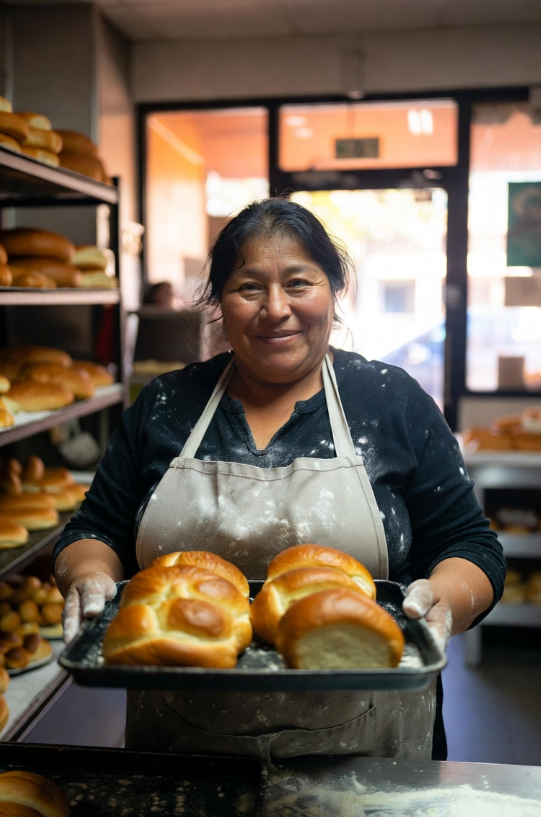
The bakery has been approached by a local grocery store — a small chain, three locations in El Paso — about carrying our conchas. Wholesale. They want to buy fifty dozen a week at a reduced rate and sell them in their bakery section. Sofia is ecstatic. I am cautious. Wholesale means more production, more hours, more staff. It means the bakery becomes less of a neighborhood spot and more of a business, and I don't know if I want the bakery to be a business. I want it to be Rosa's kitchen, extended. I want it to be hands and flour and personal. Wholesale is not personal. Wholesale is units and logistics and the exact thing that Luis Jr. wants to do in the Army, and I don't want my bakery to become an Army of conchas.
I told Sofia I would think about it. She said, "What's to think about? More revenue, more exposure, more—" I said, "More work. More stress. Less time with you." She stopped. She heard it. She is twelve and she heard that the bakery is not just a business to me — it is the place where I am with her, where we make bread together, where Rosa's recipes pass from my hands to hers. If the bakery becomes a factory, the passing stops. The hands are replaced by machines. And the hands are the whole point.
I made mole de olla this week — a lighter mole, a soup really, with beef and xoconostle (prickly pear cactus fruit) and chayote squash and green beans in a guajillo chile broth. Not the thick, complex mole poblano. This is the every-day mole, the mole of Wednesday nights and leftover beef and whatever vegetables are in the crisper. Rosa made a version of this — she called it caldo rojo, red broth, and she served it on cold nights when the desert wind came down from the mountains and rattled the tin roof in Anapra and the cold seeped through the cinder block walls and the only warm thing was the pot on the stove and the family around it.
I said no to the grocery store. Not now. Maybe later. Maybe when Sofia is older and the bakery can handle it. But not now. Now the bakery is eight tables and three employees and Rosa's name on the door and my hands in the dough and Sofia learning beside me, and that is enough. That has always been enough. Enough is not a limitation. Enough is a choice.
The week I said no to the grocery store, the week I chose hands over units and Rosa’s name over logistics, I wanted to cook something that felt like the bakery at its best — slow, enriched, made from bread that took real effort to make. Brioche French toast is that. It is what you make when you have a loaf of good bread and a cold morning and a twelve-year-old who is still learning beside you at the stove, and you want the whole house to smell like something worth staying home for. Sofia cracked the eggs. That is the whole point.
Brioche French Toast
Prep Time: 10 min | Cook Time: 15 min | Total Time: 25 min | Servings: 4
Ingredients
- 8 thick slices brioche bread (about 1 inch thick, day-old is ideal)
- 3 large eggs
- 3/4 cup whole milk
- 2 tablespoons heavy cream
- 1 tablespoon granulated sugar
- 1 teaspoon pure vanilla extract
- 1/2 teaspoon ground cinnamon
- 1/8 teaspoon fine salt
- 2 tablespoons unsalted butter, divided
- Powdered sugar, for serving
- Warm maple syrup, for serving
- Fresh berries or sliced fruit, optional
Instructions
- Make the custard. In a wide, shallow bowl, whisk together the eggs, milk, heavy cream, sugar, vanilla extract, cinnamon, and salt until fully combined and slightly frothy. The mixture should be uniform — no streaks of egg white.
- Soak the bread. Working with 2 slices at a time, lay the brioche into the custard and let it soak for 25—30 seconds per side. Press gently so the bread drinks in the custard without tearing. Brioche is soft — do not rush this step or over-soak.
- Heat the pan. Melt 1 tablespoon of butter in a large heavy skillet or griddle over medium heat. Wait until the foam settles and the butter just begins to turn golden at the edges before adding the bread.
- Cook the first batch. Add 2—3 soaked slices without crowding the pan. Cook undisturbed for 2 1/2—3 minutes until the underside is deep amber and the edges look set. Flip carefully and cook another 2—2 1/2 minutes. Transfer to a warm oven (200°F) while you finish the rest.
- Finish remaining slices. Add the second tablespoon of butter and repeat with the remaining soaked bread, adjusting heat down slightly if the pan is very hot. Each batch should be evenly golden, not scorched.
- Serve immediately. Dust generously with powdered sugar and serve with warm maple syrup. Add fresh berries alongside if you have them. Eat while the bread is still warm from the pan — this does not hold.
Nutrition (per serving)
Calories: 375 | Protein: 11g | Fat: 17g | Carbs: 44g | Fiber: 1g | Sodium: 310mg