
 By
Christmas morning in Las Cruces. The twins woke up at five AM because three-year-olds do not respect the concept of sleeping in, and by five-fifteen all four kids were tearing through wrapping paper in Gloria's living room while Hector drank coffee in his recliner and watched with the quiet satisfaction of a man who has seen forty-six Christmases in this house and intends to see forty-six more. Diego got a football, obviously. Sofia got books, obviously. Marco got a toy fire truck that makes a siren noise so loud I considered returning it before the batteries were even in. Elena got a matching fire truck because the twins share everything, including the ability to destroy a grandparent's living room in under ten minutes.
Gloria made menudo for Christmas breakfast. Tripe simmered overnight in red chile broth with hominy and oregano — the smell thick and earthy and unmistakable, the kind of smell that divides a room into people who grew up with it and people who didn't. Lisa is, after eleven years, a person who grew up with it. She ate a bowl at the table with a flour tortilla and said, "Your mother's menudo could raise the dead." Gloria nodded. This was not a compliment to Gloria. This was a fact. The menudo is beyond compliment. It simply is.
We drove back to Denver on Tuesday. The cooler was packed with leftover tamales, two bags of frozen green chile, and a container of menudo that Gloria insisted I take because "you'll need it for New Year's." She's right. Menudo on New Year's Day is tradition — the cure for the old year, the fuel for the new one. I don't drink anymore, haven't in sixteen years, so I don't need the hangover cure that menudo is famous for. But I heat it up on January first anyway, because tradition isn't about need. It's about continuity. It's about standing in the same river your parents stood in and their parents before them and letting it carry you forward.
New Year's Eve was quiet. Lisa worked until eight. I put the kids to bed at their regular time because three-year-olds don't know what New Year's Eve is and nine-year-olds don't need to. Lisa and I sat on the couch with the TV on mute and ate reheated tamales and didn't stay up until midnight. We were asleep by eleven. This is what New Year's looks like when you're thirty-seven with four kids and a wife who just worked a twelve-hour shift. It is not glamorous. It is exactly right.
Feed your people. The game is won at the table.
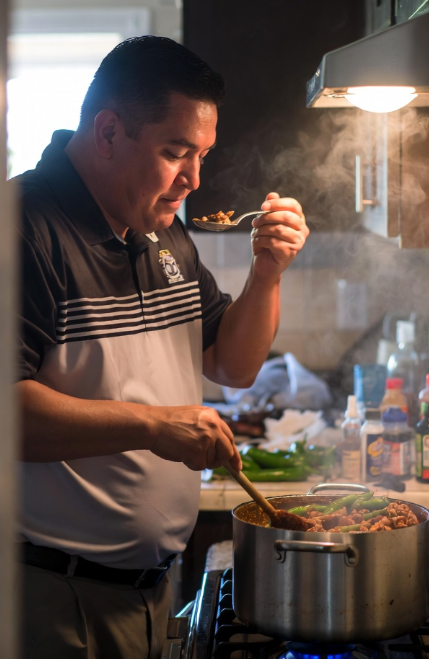
That idea of continuity—of standing in the same river your people stood in—is what pulled me toward feijoada this week. It’s a dish built the same way menudo is built: low and slow, humble cuts of meat, nothing wasted, everything earned. Feed your people. Here’s how I made it.
Brazilian Feijoada
Prep Time: 20 min | Cook Time: 3 hrs | Total Time: 3 hrs 20 min | Servings: 8
Ingredients
- 1 lb dried black beans, soaked overnight and drained
- 1 lb smoked pork sausage (linguica or kielbasa), sliced into rounds
- 1/2 lb thick-cut bacon, chopped
- 1 lb bone-in pork shoulder, cut into 2-inch chunks
- 1 large yellow onion, diced
- 6 cloves garlic, minced
- 2 bay leaves
- 1 tsp smoked paprika
- 1/2 tsp cumin
- 1/2 tsp black pepper
- 1 tsp kosher salt, plus more to taste
- 4 cups low-sodium chicken broth
- 2 cups water
- 2 tbsp olive oil
- Fresh orange slices, for serving
- Cooked white rice, for serving
- Chopped fresh cilantro, for garnish
Instructions
- Brown the meats. Heat olive oil in a large Dutch oven or heavy pot over medium-high heat. Working in batches, brown the pork shoulder chunks on all sides, about 3–4 minutes per batch. Remove and set aside. Add the bacon and sausage to the same pot and cook until the bacon is just starting to crisp, about 4 minutes. Remove and set aside with the pork.
- Build the base. Reduce heat to medium. Add the diced onion to the pot and cook in the rendered fat until softened and translucent, about 5 minutes. Add the garlic and cook 1 minute more, stirring constantly, until fragrant.
- Add beans and liquids. Return all browned meats to the pot. Add the drained black beans, chicken broth, water, bay leaves, smoked paprika, cumin, black pepper, and salt. Stir to combine. Bring to a boil over high heat.
- Slow simmer. Reduce heat to low, cover partially, and simmer for 2 1/2 to 3 hours, stirring occasionally, until the beans are completely tender and the broth has thickened into a rich, dark stew. If the pot looks dry at any point, add water 1/2 cup at a time.
- Adjust and finish. Remove bay leaves and discard. Taste for salt and adjust as needed. Use the back of a spoon to mash a handful of beans against the side of the pot to thicken the broth further if desired.
- Serve. Ladle feijoada over white rice. Garnish with fresh cilantro and serve with orange slices on the side — the citrus cuts the richness and brightens the whole bowl. Leftovers reheat beautifully and taste even better the next day.
Nutrition (per serving)
Calories: 520 | Protein: 38g | Fat: 22g | Carbs: 41g | Fiber: 10g | Sodium: 810mg