
 By
By The first week after. They don't tell you about the first week after. They tell you about the funeral and the crying and the casseroles, but they don't tell you about the Tuesday morning when you reach for the phone to call your mother and remember, and the remembering is a physical thing — a blow to the chest, a hand around the throat. They don't tell you about the way the phone sits on the counter and the counter becomes the saddest place in the house because the counter is where the phone is and the phone is where Rosa used to be.
I went back to the bakery on Monday. I had been away for five days — the longest I have been away since we opened — and walking through the door was like walking into a building that belonged to someone else, someone I used to be, someone whose mother was alive. Graciela had held it together. Sofia had helped on the weekend — my eleven-year-old, my girl, who made conchas from Rosa's recipe while I was burying the woman who invented the recipe, and the circularity of that is either beautiful or devastating and I don't have the strength to decide which.
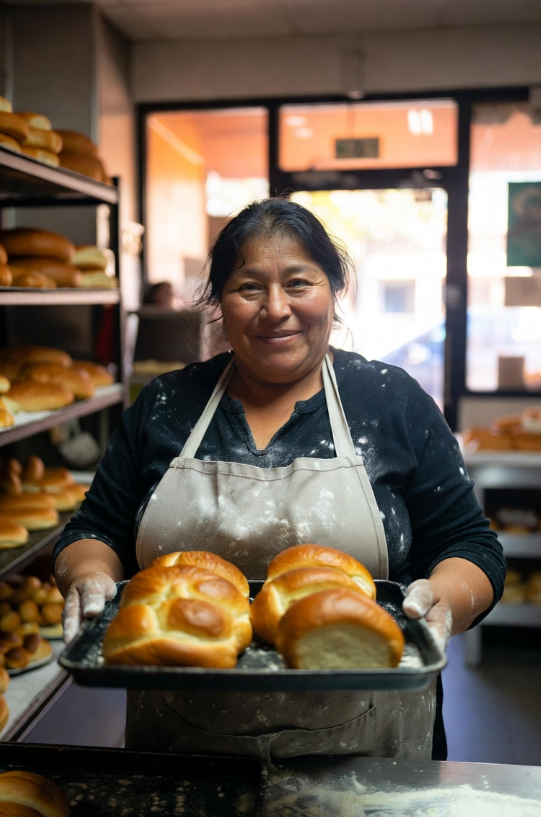
I stood in the bakery kitchen at 4 AM on Monday and I put my hands in the flour and I said out loud, to no one, to Rosa, to the air: "Okay, Mamá. Let's make bread." And I made bread. I made conchas and bolillos and polvorones and empanadas and I didn't cry. Not because I wasn't sad — the sadness is a continent, it is vast and unmapped and I am standing in the middle of it — but because the bread needed me to be present, and being present means the hands move and the eyes focus and the grief goes to the place where grief waits while you are busy, which is everywhere, which is the back of every thought, but at least it waits.
The children are handling it in their own ways. Luis Jr. is stoic — sixteen in November, already more man than boy, and he carries grief the way Luis carries grief, internally, silently, like a weight in a pocket that you adjust to. Isabella cried for two days and then stopped and started a journal, because Isabella processes everything through writing and words and the organized arrangement of feelings into sentences. Sofia has been baking more — at the bakery, at home, constantly — and I recognize this because it is what I do. We bake our grief. We knead it into dough and let it rise and punch it down and let it rise again and eventually it becomes bread and the bread feeds people and the feeding is the healing. Diego is confused. He is eight and death is still abstract for him, a thing that happens in movies and books, and the idea that Abuela Rosa is permanently gone does not fit into his schema of how the world works. He keeps asking when she's coming back. I keep saying she is not coming back. We are both broken by the repetition.
Camila drew a picture of Rosa. In the picture, Rosa is in a kitchen in the sky, making tortillas on a cloud. Camila said, "She's making tortillas for God because God probably doesn't know how." I put the drawing on the refrigerator, next to all the other drawings, and it is the most important thing on the refrigerator, and the refrigerator is the most important wall in the house, and my house is held together by tape and crayon and the faith of a four-year-old who believes her grandmother is feeding God.
I started the notebook this week. The spiral-bound notebook from Dollar Tree. I sat at the kitchen table after the children were in bed and I wrote down every recipe I could remember. Flour tortillas — three cups flour, one teaspoon salt, one tablespoon baking powder, one tablespoon lard, warm water to the earlobe consistency. Chile colorado — the dried New Mexico chiles, soaked, blended with garlic and cumin and oregano. Caldo de res — the beef shanks, the corn on the cob cut in rounds, the cabbage, the cilantro, the squeeze of lime. I wrote for three hours. My hand cramped. I kept writing. I wrote like a woman copying a sacred text before the library burns, because that is what this is. Rosa's kitchen is a library and Rosa is gone and the recipes are the books and I am the only one who can copy them before they disappear.
Luis found me at midnight, writing. He said, "Come to bed." I said, "I can't stop." He said, "You can stop and start again tomorrow. The recipes aren't going anywhere." He is right. He is always right about the things I am too wild with grief to see. I went to bed. I lay next to him and listened to him breathe and thought about Rosa lying next to Alejandro for forty years, listening to him breathe, and how there is a sound that becomes so familiar it is silence, and how silence can be the loudest form of love.
When I sat down with that spiral notebook and wrote cumin and lime from memory — the same cumin that went into Rosa’s chile colorado, the same squeeze of lime she pressed into every bowl of caldo de res — I realized those two flavors are the smell of her kitchen, the sound of her voice, the whole of what she left me. I couldn’t make her caldo that week; I wasn’t ready to stand over that pot without her. But I could make something that carried her fingerprints: bright and simple, cumin and lime, the building blocks she handed me. This salad is not Rosa’s recipe. But it is made of her.
Black Bean Corn Avocado Salad with Cumin Lime Vinaigrette
Prep Time: 15 min | Cook Time: 0 min | Total Time: 15 min | Servings: 6
Ingredients
- 2 cans (15 oz each) black beans, drained and rinsed
- 1 1/2 cups fresh or thawed frozen corn kernels
- 2 medium avocados, diced
- 1 cup cherry tomatoes, halved
- 1/2 red onion, finely diced
- 1/2 cup fresh cilantro, roughly chopped
- 1 jalapeño, seeded and minced (optional)
- Cumin Lime Vinaigrette:
- 3 tablespoons fresh lime juice (about 2 limes)
- 3 tablespoons olive oil
- 1 teaspoon ground cumin
- 1/2 teaspoon garlic powder
- 1/2 teaspoon kosher salt
- 1/4 teaspoon black pepper
- 1/4 teaspoon smoked paprika
Instructions
- Make the vinaigrette. In a small bowl or jar, whisk together the lime juice, olive oil, cumin, garlic powder, salt, pepper, and smoked paprika until well combined. Taste and adjust salt or lime as needed.
- Combine the salad base. In a large mixing bowl, add the drained black beans, corn, cherry tomatoes, red onion, and jalapeño if using. Toss gently to distribute evenly.
- Dress the salad. Pour the cumin lime vinaigrette over the salad base and stir to coat all the ingredients. Let sit for 5 minutes so the beans and corn absorb the dressing.
- Add avocado and cilantro. Gently fold in the diced avocado and fresh cilantro just before serving to keep the avocado from browning or breaking down.
- Serve. Serve immediately as a side dish, over greens, with tortilla chips, or spooned into warm flour tortillas. Leftovers keep well refrigerated for up to 2 days — add fresh avocado when serving again.
Nutrition (per serving)
Calories: 280 | Protein: 9g | Fat: 13g | Carbs: 34g | Fiber: 11g | Sodium: 320mg