
 By
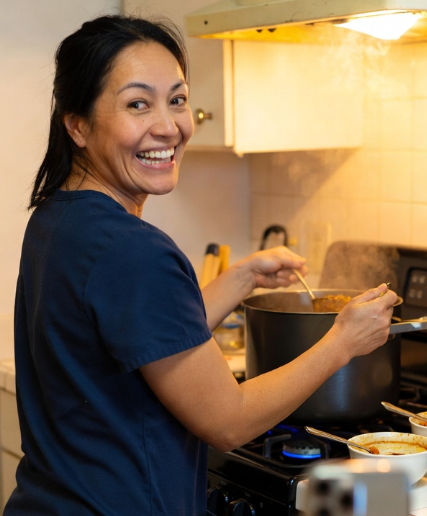
By February looms. The anniversary month. I'm preparing the way I prepared last year — extra therapy, adjusted expectations, the frozen adobo stocked, the sinigang portioned. But this year I have something I didn't have last year: Jason. He knows about February. He knows about Reynaldo. He knows that the second week of the month will be hard and the hardness will express itself in nightmares and distance and the particular silence of a woman carrying a grief anniversary through a dark month in a dark state.
I told him what I need. Not what I think I should need, but what I actually need, which is: don't ask if I'm okay. I'm not okay and we both know it and the asking forces me to perform a response that takes energy I don't have. Instead: be present. Bring food. Sit on the couch. Let the silence be silent. He said, "I can do that." I believe him. Paramedics are good at being present without performing. They show up. They assess. They hold what needs holding. The skill translates.
I made maja blanca again — the coconut pudding that Reynaldo loved, the one he ate three squares of while calling them "small." I make it every year before the anniversary, a preemptive act of remembering that is softer than the actual anniversary, less sharp, more like visiting a grave with flowers than visiting it with grief. The maja blanca set in the fridge and the latik on top was golden and crunchy and the pudding was sweet and cool and white and it tasted like memory and the memory was gentle, this time. Not always. But this time.
I also wrote a blog post — "February and the Food We Make for the Dead." About cooking for anniversaries, about the Filipino tradition of feeding the dead at Undas, about how I make my father's favorite recipes in the month he died and eat them in his honor and the eating is communion, the closest thing to Mass I have outside of church. The post was personal. The post was as close to the floor as I've come in public writing. I published it and closed the laptop and made adobo and didn't check the comments for three days.
When I checked, there were thirty-two comments. Thirty-two people who cook for their dead. Thirty-two kitchens where the absent are fed through the hands of the living. We are an army of grievers, standing at stoves, making food that no one dead will eat, and the making is the point, and the army is larger than I knew.
Reynaldo loved sweets — the maja blanca was his, always his — but when Jason asked what he could bring to sit with me through the second week of February, I told him chocolate cake. Something darker, more substantial, something that felt less like memory and more like now: the two of us on the couch in the particular silence of a woman carrying grief and a man who knows how to hold it. I’ve made this fudgy chocolate cake enough times to know that it doesn’t ask anything of you while you make it, which is exactly the kind of recipe February calls for. It just comes together, dense and honest and a little bitter at the edges, the way grief is when it finally starts to soften.
Best Fudgy Chocolate Cake
Prep Time: 20 minutes | Cook Time: 35 minutes | Total Time: 55 minutes | Servings: 12
Ingredients
- 1 3/4 cups all-purpose flour
- 2 cups granulated sugar
- 3/4 cup unsweetened cocoa powder
- 2 teaspoons baking soda
- 1 teaspoon baking powder
- 1 teaspoon fine sea salt
- 2 large eggs, room temperature
- 1 cup buttermilk, room temperature
- 1 cup strong brewed black coffee, hot
- 1/2 cup neutral oil (such as vegetable or avocado oil)
- 2 teaspoons pure vanilla extract
- For the fudgy chocolate frosting:
- 1 cup unsalted butter, softened
- 3/4 cup unsweetened cocoa powder
- 3 cups powdered sugar, sifted
- 1/3 cup heavy cream, plus more as needed
- 1 teaspoon pure vanilla extract
- Pinch of fine sea salt
Instructions
- Preheat and prepare. Preheat your oven to 350°F (175°C). Grease two 9-inch round cake pans and line the bottoms with parchment paper. Grease the parchment as well.
- Mix the dry ingredients. In a large bowl, whisk together the flour, sugar, cocoa powder, baking soda, baking powder, and salt until evenly combined.
- Combine the wet ingredients. In a separate bowl or large measuring cup, whisk together the eggs, buttermilk, hot coffee, oil, and vanilla extract until smooth.
- Make the batter. Pour the wet ingredients into the dry ingredients and whisk until the batter is smooth and glossy. It will be quite thin — this is correct. Do not overmix.
- Bake. Divide the batter evenly between the prepared pans. Bake for 30–35 minutes, until a toothpick inserted into the center comes out with only a few moist crumbs attached. Do not overbake.
- Cool completely. Let the cakes cool in the pans for 10 minutes, then turn out onto a wire rack and cool completely before frosting. Do not rush this step.
- Make the frosting. Beat the softened butter on medium-high speed for 2–3 minutes until pale and fluffy. Add the cocoa powder and mix on low until combined. Add the powdered sugar one cup at a time, alternating with splashes of heavy cream, beating well after each addition. Add the vanilla and salt. Increase speed to medium-high and beat for 2 minutes until light and silky. Add more cream a tablespoon at a time if needed to reach a spreadable consistency.
- Frost and serve. Place one cake layer on a serving plate or cake stand. Spread a generous layer of frosting over the top. Place the second layer on top and frost the top and sides of the cake. Slice and serve at room temperature.
Nutrition (per serving)
Calories: 520 | Protein: 5g | Fat: 24g | Carbs: 76g | Fiber: 3g | Sodium: 340mg