
 By
By The pipeline schedule shifted in February—a different crew rotation that gave me more consistent weekdays off. I used some of that time to start planning the land more seriously. I wanted to put in a food forest planting this spring: persimmon trees, pawpaw, serviceberry, a row of native hazelnut. The kinds of trees that produce food without much intervention once they're established, that build the land's capacity over decades rather than seasons.
I drove to a native plant nursery near Tahlequah and spent two hours talking to the woman who runs it, a botanist who had been growing native species for fifteen years. She knew her stock and she knew the land—when I described the soil conditions and the light on my parcel she made specific recommendations without me having to ask twice. I ordered fifteen trees and a flat of native shrubs to go in as understory.
Caleb asked me when I was going to build a house on the land. I said not yet. He said when. I said eventually. He said that's not an answer. I said it's the only answer I have right now and he let it go.
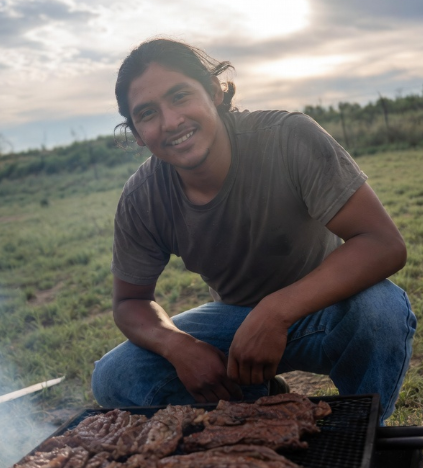
In the meantime: the barn was becoming what I wanted it to become—a working space, not just storage. I'd built a prep table along one wall, put in a simple wood-burning setup for cooking, hung a few of Danny's old tools on the wall next to my own. It was becoming a kitchen in the way that places become kitchens: by being used as one, repeatedly, until the space knows what it's for.
Cooked in the barn on a cold February Saturday: venison stew, corn soup, the last of the fall's dried beans. Three pots, three fires, the barn warm in a way it had never been when it was just storage. That felt like the right direction.
That Saturday in the barn—three pots going, the wood fire cutting the February cold—was the kind of cooking that makes a place feel real. I’ve been making versions of this beef and zucchini soup since long before I had land to think about, but it fits that day perfectly: it’s the kind of recipe that rewards patience and a steady heat, the kind you can tend between tending other things. If you don’t have venison on hand, good beef does exactly what you need it to do here.
Beef Zucchini Soup
Prep Time: 15 min | Cook Time: 45 min | Total Time: 1 hr | Servings: 6
Ingredients
- 1 lb ground beef (or cubed venison, if you have it)
- 2 medium zucchini, diced (about 2 cups)
- 1 medium yellow onion, chopped
- 3 cloves garlic, minced
- 2 medium carrots, sliced into rounds
- 2 stalks celery, sliced
- 1 can (14.5 oz) diced tomatoes, undrained
- 4 cups beef broth
- 1 cup water
- 1 tsp dried thyme
- 1 tsp dried oregano
- 1/2 tsp smoked paprika
- 1/2 tsp black pepper
- 1 tsp salt, or to taste
- 1 tbsp olive oil or lard
- 1 tbsp tomato paste
Instructions
- Brown the meat. Heat oil in a large heavy pot over medium-high heat. Add the ground beef (or cubed venison) and cook, breaking it up, until browned all over, about 6–8 minutes. Drain excess fat if needed.
- Build the base. Add onion, carrot, and celery to the pot. Cook, stirring occasionally, until the onion is translucent and the vegetables begin to soften, about 5 minutes. Add garlic and cook 1 minute more.
- Add tomato paste and spices. Stir in the tomato paste, thyme, oregano, smoked paprika, salt, and pepper. Let the paste cook against the bottom of the pot for about 1 minute to deepen the flavor.
- Add liquids and tomatoes. Pour in the diced tomatoes (with their juices), beef broth, and water. Stir to combine and bring to a boil over high heat.
- Simmer. Reduce heat to medium-low, cover partially, and simmer for 20 minutes until the carrots are nearly tender.
- Add zucchini. Stir in the diced zucchini and simmer uncovered for another 10–12 minutes, until zucchini is tender but not mushy.
- Taste and finish. Adjust salt and pepper to taste. Serve hot, directly from the pot.
Nutrition (per serving)
Calories: 220 | Protein: 18g | Fat: 11g | Carbs: 12g | Fiber: 3g | Sodium: 680mg