
 By
By Second week at the food science workshop and we had moved into the more complex material: fermentation, enzyme activity, the specific chemistry of Louisiana ingredients — why cane sugar behaves differently from beet sugar, what the Capsaicin molecule actually does, how tannins in file powder interact with the starches in gumbo. I was taking notes faster than I usually do because the connections were coming faster than I could track them.
Dr. Fontenot assigned a final project: develop a recipe that demonstrates a specific food science principle, with a written explanation of the chemistry. I chose the Maillard reaction — the browning reaction that happens when proteins and sugars are heated together — and built my project around the dark roux that is the foundation of Cajun and Creole cooking. I argued that the dark roux is a controlled Maillard reaction taken to an extreme degree, and that understanding the chemistry explains why roux behaves the way it does and why patience is not just a cultural instruction but a chemical requirement. The flavor compounds develop at specific temperatures over time that cannot be compressed.
I wrote the paper in two evenings and felt genuinely excited about it in a way that is different from the excitement of doing well. This was the excitement of saying something true that felt like a discovery even if others already knew it. I presented it Friday to the full group and Dr. Fontenot stopped me after to say it was one of the best student projects she had seen in the program's three years. Maya said, "I told you." I said, "You were right." She was going to be a chemist. I was going to be whatever I was going to be. We were both going to be very good at it.
The drive home on Saturday felt triumphant. Daddy picked me up and on the way home I described every session of the workshop with the contained energy of someone who has been in an excellent place and is finally allowed to tell someone about it. He listened the whole two hours and asked good questions. I love him so much.
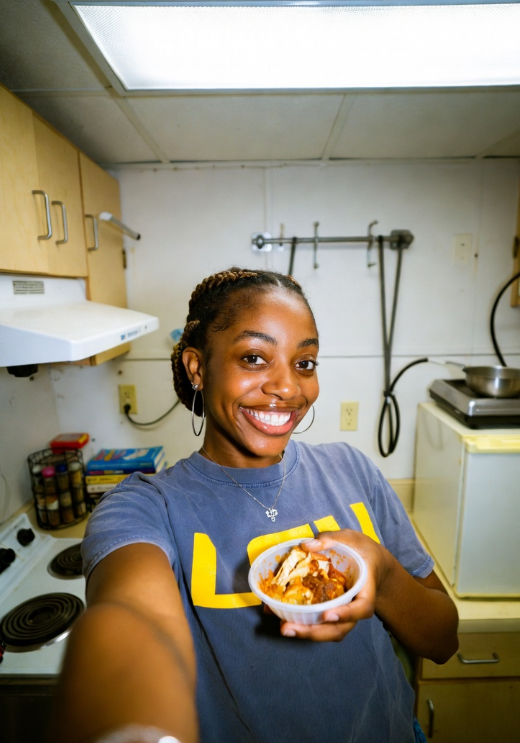
When I got home that Saturday, still buzzing from Daddy’s two-hour drive and every question he asked, I didn’t want to just talk about the Maillard reaction — I wanted to stand at the stove and do it. Beef in onion gravy is exactly the kind of dish where the roux earns its reputation: the browning is the flavor, the patience is the chemistry, and every minute you rush it, you taste the difference. After arguing in front of Dr. Fontenot’s entire group that you cannot compress the time it takes for those flavor compounds to develop, making this recipe felt less like cooking and more like demonstrating a theorem I already knew was true.
Beef in Onion Gravy
Prep Time: 15 min | Cook Time: 1 hr 30 min | Total Time: 1 hr 45 min | Servings: 4
Ingredients
- 1 1/2 lbs beef chuck, cut into 1 1/2-inch cubes
- 1 teaspoon salt
- 1/2 teaspoon black pepper
- 1/2 teaspoon garlic powder
- 3 tablespoons vegetable oil, divided
- 2 tablespoons all-purpose flour
- 2 large yellow onions, thinly sliced
- 3 cloves garlic, minced
- 1 tablespoon Worcestershire sauce
- 2 cups beef broth
- 1 tablespoon tomato paste
- 1 teaspoon fresh thyme leaves (or 1/2 teaspoon dried)
- Cooked white rice or egg noodles, for serving
Instructions
- Season and sear the beef. Pat beef cubes dry with paper towels and season all over with salt, pepper, and garlic powder. Heat 2 tablespoons of oil in a heavy-bottomed Dutch oven or deep skillet over medium-high heat. Add beef in a single layer without crowding and sear undisturbed for 3–4 minutes per side until a deep mahogany crust forms. Work in batches if needed. Transfer browned beef to a plate and set aside.
- Build the roux. Reduce heat to medium and add the remaining 1 tablespoon of oil to the same pot, scraping up any browned bits. Whisk in the flour and cook, stirring constantly, for 3–5 minutes until the roux deepens to a nutty, caramel-brown color. Do not rush this step — the color and aroma are your signal that the Maillard reaction is doing its work.
- Caramelize the onions. Add sliced onions to the roux and stir to coat. Cook over medium-low heat for 20–25 minutes, stirring occasionally, until onions are deeply golden and soft. Add garlic and cook 1 minute more until fragrant.
- Build the gravy. Stir in tomato paste and Worcestershire sauce. Slowly pour in beef broth, whisking constantly to prevent lumps. The roux will thicken the broth into a glossy, rich gravy as the liquid heats up.
- Braise the beef. Return the seared beef and any resting juices to the pot. Add thyme. Bring to a gentle simmer, then reduce heat to low. Cover and cook for 55–65 minutes, stirring occasionally, until beef is fork-tender and the gravy has thickened and deepened in flavor.
- Taste and serve. Adjust seasoning with salt and pepper. Spoon generously over cooked white rice or egg noodles and serve immediately.
Nutrition (per serving)
Calories: 420 | Protein: 34g | Fat: 22g | Carbs: 16g | Fiber: 2g | Sodium: 680mg