
 By
By I want to tell you something about March in Savannah, baby. March is when the azaleas decide they’ve had enough of being polite and they just — explode. Pink and white and that deep fuchsia that looks like the Lord spilled His paintbox. The whole city looks like a wedding. You drive down any street in the historic district and you think: how does a place get to be this beautiful and still have all the same troubles as everywhere else? But it does. It always does. Beauty and trouble live right next door to each other in Savannah, same as anywhere.
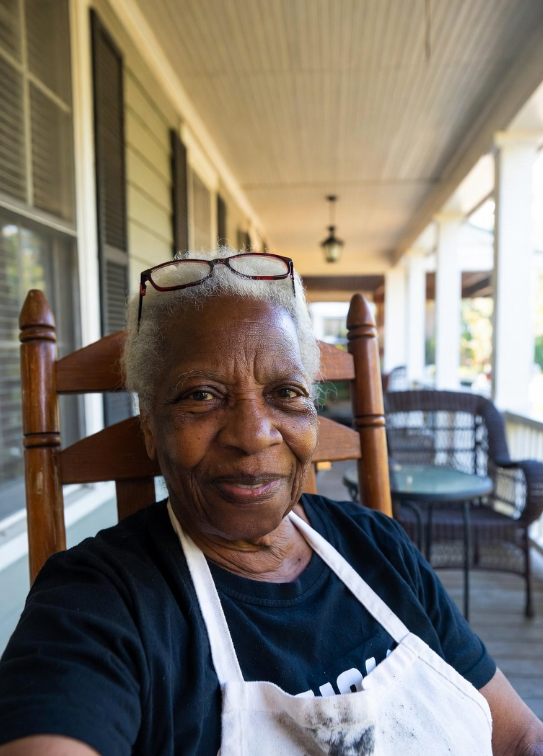
My name is Dorothy Henderson. Most people call me Dot, and I will be grateful for the rest of my days if you do too. I am sixty years old and I have been cooking since I was ten, which means I have been feeding people for fifty years, and I am not tired yet. Not even a little. I am the head cook at Hodge Elementary School here in Savannah, where I have worked for thirty-one years. I feed four hundred children a day. I know most of them by name. The ones I don’t know by name, I know by what they eat and what they push to the side of the tray, which tells you more about a child than their name ever could.
This morning I stood at the window over my kitchen sink at four forty-five — before the sun had any business being up — and I looked out at my husband’s garden. Earl built that garden fifteen years ago, raised beds and everything, in the side yard of our house in Thunderbolt, right near the marsh. Yesterday afternoon we planted the first tomatoes of the season. Cherokee Purples, because they are ugly and beautiful and taste like summer distilled into a fruit. Earl sat in his lawn chair and supervised, which means he told me I was planting them too close together, same as he does every year, and I ignored him, same as I do every year. This morning I could already see the little green stakes he put in, standing up out of the dark soil, catching the first gray light. And I thought: we made it through another winter.
Earl is sixty-seven. He had a massive heart attack back in 2003 — out there mowing this very lawn, dropped the mower and went down, and the doctors said it was a miracle they brought him back. He retired after that. He moves slow now, gets winded going to the mailbox, and he watches the weather channel like it is going to tell him something he doesn’t already know. But he is here. Baby, after everything Earl and I have been through, “here” is the most beautiful word in the English language.
I started writing this because my youngest, Denise — she’s thirty-two, lives ten minutes away, and checks on me like I am the child — she set me up with this iPad and said, “Mama, you should write down your recipes.” I have been meaning to do that for forty years, so I suppose now is as good a time as any. But I am warning you right now: I don’t just write recipes. I write what’s happening when I cook them. Because food doesn’t happen in a vacuum, sugar. Food happens in a life. And my life is full. Full of love and loss and butter and too many grandchildren to keep straight, and I would not trade a single minute of it.
I grew up in a shotgun house on the east side of Savannah. Fourth of six children. My daddy, James, worked the docks unloading cargo ships until his back gave out. My mama, Hattie Pearl, cleaned houses for white families in the historic district and came home and made a feast out of whatever she had. That woman could take a ham hock and a pot of dried beans and feed eight people and make them feel rich. I have never in my life met anyone who could do what Hattie Pearl Williams could do in a kitchen, and I have spent fifty years trying to come close.
I started helping her when I was ten. I won’t tell you today all the reasons why I needed that kitchen to be the center of my world at ten years old — some stories take time to tell, and I have only just introduced myself — but I will say this: the kitchen saved me. The weight of a cast iron skillet in your hand, the sound of onions hitting butter, the way a whole house changes when something good is cooking on the stove — those things are medicine. They were then. They still are now.
Living where we lived, in the Lowcountry, on the coast of Georgia, shrimp was not a luxury. Shrimp was Tuesday. My daddy’s friends worked the shrimp boats, and a man who worked the docks knew people, and those people knew to set a portion aside for a family that needed it. Hattie Pearl would fry them in lard with cornmeal, stew them with tomatoes and rice, fold them into grits with butter and cheddar and a handful of green onions. I learned every one of those preparations standing at her elbow, and I have been making them ever since.
There is a man down at the dock here in Savannah who knows to save me the good ones. Has for years. You get to be a certain kind of person in this town, a person who has fed enough people for long enough, and you develop what I call a network of the grateful. He saves me the big ones, the ones that are still sweet from the water, and I bring him cornbread when I remember, which is most of the time.
Last night, after we put the tomato stakes in and came inside and Earl settled back into his recliner, I made us shrimp and grits on the back porch — stone-ground grits from a mill on Sapelo Island, butter, cheddar, those good shrimp cooked in a cast iron skillet that belonged to Hattie Pearl and is nearly sixty years old and better seasoned than most people. We ate with the marsh smell coming in, that low-tide, green, ancient smell that I have known my whole life. Earl said it was the best batch I had ever made. He says that every time. I let him.
But the recipe I want to give you today is not the grits. The grits are for when it is a Tuesday night and you are tired and you need something warm and fast and real. The recipe I want to give you is for when you want to do something beautiful with a shrimp. When you want to sit down at a table and feel like you did right by the day.
Baked stuffed shrimp is not a recipe my mama made. Hattie Pearl fried her shrimp and stewed her shrimp, but the stuffed ones — those I learned from a woman named Miss Eunice who cooked at a supper club on the island when I was in my twenties, a place where the white tablecloths were actually white and the shrimp came out looking like something you’d frame and put on a wall. Miss Eunice showed me how to butterfly a big shrimp and mound it with a crab stuffing, and baby, the first time I tasted that — the sweet of the shrimp and the richness of the crab and the butter running down into everything — I understood something new about what food could do.
I have been making my version ever since. I use lump crab meat because you cannot stuff a shrimp with something cheap and expect it to taste like anything. I use the biggest shrimp I can get. I use real butter, not that margarine business, because Hattie Pearl would haunt me from the other side if I put margarine in a dish I was proud of. And I use Old Bay because I am a Georgia Lowcountry woman and Old Bay is not a seasoning, it is a fact of life.
I lost my brother James Jr. last year. Prostate cancer. He was the oldest boy, the one who stepped up and held the family together after — well, after things that I will tell you about another time. I am still carrying that loss around, if I am honest. Some weeks I pick up the phone to call him before I remember. Some weeks I cook something he loved and set a plate at the table and then have to put it away. Grief is funny like that. It pretends to leave and then it shows up at dinner.
James Jr. loved stuffed shrimp. He would have eaten the whole pan and asked if there were more. So when I make these, baby, I make them big and I make them with love, and I think about him sitting at my table with his napkin tucked into his collar the way he always did, and I smile instead of cry. Most days. Most days I smile.
You make these when you want to feed somebody special. You make them for Sunday company, or for the person who needs to feel like somebody went to some trouble on their behalf. You can have them on the table in forty-five minutes, and they will look like you spent all day. That is the gift of a good shrimp — it is already beautiful. All you have to do is not ruin it.
I typed this whole thing with one finger. Denise is going to read it and fix my spelling before she puts it up, because I am sixty years old and I did not grow up with computers and I am doing the best I can. But I wanted the words to be mine, even the slow ones.
Now go on and feed somebody.
So here is what I made him, all those years ago, and what I still make when I want to feel like he is sitting at my table again—because some recipes carry people inside them, and this one carries Earl. It is not a complicated dish, but it asks you to pay attention, and I think that is what love is most of the time anyway. Here is how you do it.
Baked Stuffed Shrimp
Prep Time: 25 minutes | Cook Time: 20 minutes | Total Time: 45 minutes | Servings: 4
Ingredients
For the shrimp:- 24 large shrimp (16/20 count), peeled and deveined, tails on
- 2 tablespoons butter, melted, for drizzling
- Lemon wedges, for serving
- 8 oz lump crab meat, picked over for shells
- 6 tablespoons unsalted butter, divided
- 1/2 cup celery, finely diced
- 1/4 cup yellow onion, finely diced
- 2 cloves garlic, minced
- 1 cup seasoned dry breadcrumbs
- 1 tablespoon Old Bay seasoning
- 1 tablespoon fresh lemon juice
- 2 tablespoons fresh flat-leaf parsley, finely chopped
- 1/4 teaspoon black pepper
- Salt to taste
Instructions
- Heat the oven. Preheat your oven to 375°F. Butter a 9x13 baking dish or a large rimmed baking sheet and set it aside.
- Build the stuffing base. Melt 4 tablespoons of butter in a skillet over medium heat. Add the celery and onion and cook, stirring occasionally, until softened and translucent, about 5 minutes. Add the garlic and cook one minute more. You want everything soft and sweet-smelling before you go any further.
- Finish the stuffing. Remove the skillet from the heat. Add the breadcrumbs, lump crab meat, Old Bay, lemon juice, parsley, and black pepper. Stir gently — you want to combine everything without breaking up those pieces of crab. Taste it. If it needs salt, add a little. If it seems dry, melt the remaining 2 tablespoons of butter and stir it in. The stuffing should hold together when you press it but not feel like paste.
- Butterfly the shrimp. Lay each shrimp flat on your cutting board. Using a sharp knife, cut along the back (the curved outer side) deeply enough to spread the shrimp open like a book — but do not cut all the way through. Press the shrimp gently open and flat. If the tail curls up, that is fine. That is just the shrimp being a shrimp.
- Stuff and arrange. Place the butterflied shrimp in your prepared baking dish, cut-side up. Mound a heaping tablespoon of crab stuffing onto each opened shrimp, pressing it gently so it sits without falling. Arrange them close together; they will hold each other up.
- Drizzle with butter. Melt the remaining 2 tablespoons of butter and drizzle it over the tops of the stuffed shrimp. This is what gives them that golden color and keeps everything moist. Do not skip this step.
- Bake until done. Bake uncovered for 18 to 22 minutes, until the shrimp are pink and curled and the stuffing on top is golden and smells like the best thing in your house. If the tops are not as golden as you’d like after 20 minutes, you can run them under the broiler for 2 minutes — but watch them. Shrimp go from done to ruined faster than you think.
- Serve immediately. These want to be eaten hot, with lemon wedges on the side. Set them down in the middle of the table and step back. Let people come to them. That is the right way.
Nutrition (per serving)
Calories: 415 | Protein: 33g | Fat: 22g | Carbs: 19g | Fiber: 1g | Sodium: 880mg