
 By
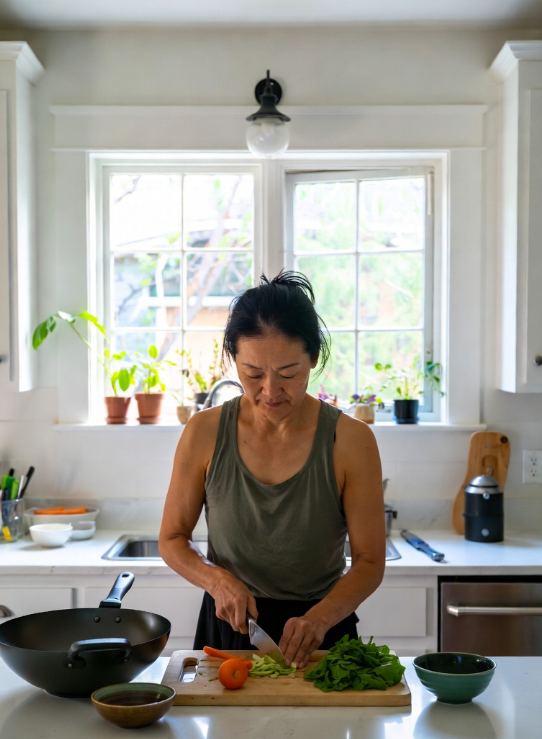
By Mid-August. Post-forty. The decade has begun and the beginning feels like — a Tuesday. Forty feels like a Tuesday. The ordinariness of it is the gift: the morning after forty is the same morning as the morning before forty. The dashi steams. The miso dissolves. The chipped bowl holds. The practice does not know that I am forty. The practice knows only that the kombu was soaked overnight and the bonito flakes need to be added now. The now is the only tense the practice speaks.
I made Fumiko's nasu dengaku — the miso-glazed eggplant, the late-summer dish, the threshold between August and September. The eggplant was the last of the season, the Japanese eggplant from the farmers market glossy and heavy and surrendering to the broiler the way only August eggplant surrenders: completely, with the specific sweetness that only the end of a season produces.
The Greatest Hits project with Miya is complete — ten dishes, ten weeks, ten Fumiko recipes perfected by a nine-year-old. The ten dishes: miso soup, tamagoyaki, onigiri, gyoza, kabocha nimono, nasu dengaku, chirashizushi, oden (simplified), curry udon, and the final dish — ozoni. The ozoni was the graduation ceremony. Miya made the New Year's soup in August, off-season, not-ritual, just: the recipe, made perfectly, by a child who has been training since she was six, standing on a stool, stirring miso into dashi, and is now standing flat-footed, no stool needed, making the soup that her great-grandmother made and her mother makes and she, now, makes.
The ten dishes are Fumiko's legacy, carried in Miya's hands. The hands are small. The legacy is enormous. The hands hold the legacy anyway. The holding is the practice. The practice is the chain. The chain has added a link. The link is nine years old. The link is strong.
Miya’s ten dishes included tamagoyaki — the rolled egg, the one she learned first, standing on her stool at age six — and when I went looking for something to share alongside this story, I kept coming back to the egg. This baked omelet roll is not tamagoyaki, but it carries the same quiet logic: eggs, patience, a roll, a reveal. It is the kind of recipe that rewards the person who has practiced, and it felt right to honor the dish that taught Miya what practice even means.
Baked Omelet Roll
Prep Time: 15 min | Cook Time: 20 min | Total Time: 35 min | Servings: 4
Ingredients
- 6 large eggs
- 1/4 cup whole milk
- 1/4 teaspoon fine sea salt
- 1/4 teaspoon black pepper
- 1/2 cup shredded cheese (mild cheddar or Monterey Jack)
- 1/4 cup finely diced bell pepper (any color)
- 2 tablespoons finely sliced green onions
- 1 tablespoon unsalted butter, melted
Instructions
- Preheat and prepare. Heat oven to 375°F. Line a 10×15-inch rimmed baking sheet (jelly roll pan) with parchment paper and brush evenly with the melted butter.
- Whisk the egg base. In a medium bowl, whisk together the eggs, milk, salt, and pepper until fully combined and slightly frothy, about 60 seconds.
- Add fillings. Stir in the diced bell pepper and half the green onions. Pour the mixture evenly onto the prepared pan.
- Bake. Bake for 16–18 minutes, until the egg is just set in the center and the edges are lightly golden. Do not overbake — the roll needs flexibility.
- Add cheese and roll. Remove from oven and immediately scatter the shredded cheese over the surface. Working quickly from the short end, use the parchment paper to help roll the omelet into a tight log. Hold the seam side down for 1 minute to seal.
- Rest and slice. Let the roll rest for 3 minutes, then slice crosswise into 1-inch rounds. Garnish with the remaining green onions and serve warm.
Nutrition (per serving)
Calories: 210 | Protein: 14g | Fat: 15g | Carbs: 3g | Fiber: 0g | Sodium: 290mg