
 By
By Week one in Busan. I have been here six days and I have eaten approximately forty-seven meals, which is not mathematically possible but feels accurate. Jisoo feeds me with a determination that borders on military strategy. Breakfast: rice, soup, three banchan, fruit. Lunch: whatever she is developing that morning — this week it was a new version of japchae with wild fern shoots she found at the market. Dinner: a full Korean table, seven to ten dishes, always anchored by rice and doenjang jjigae and something she made for the baby specifically (this week it was kongguksu, cold soybean noodle soup, because she read that soy protein is good for fetal brain development). I am gaining weight. I do not care. The weight is love measured in grams.
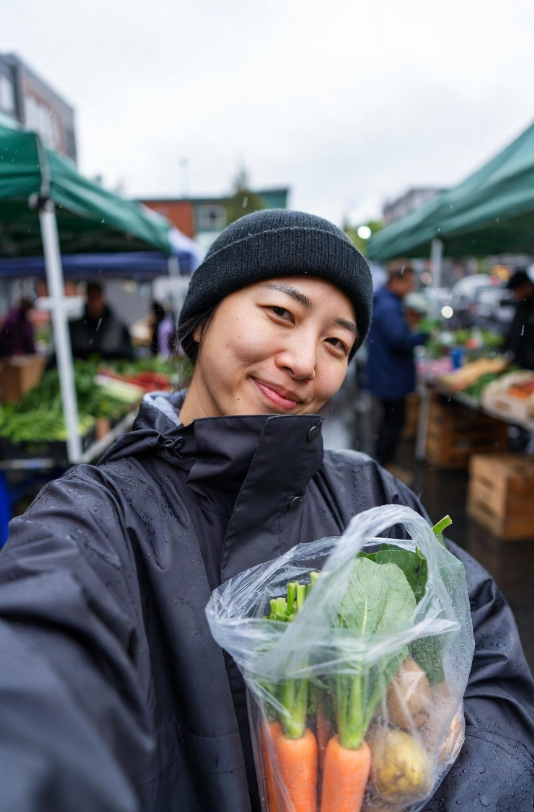
On Monday, Jisoo took me to Jagalchi Fish Market, the largest seafood market in Korea. We walked through rows of live octopus, squid, abalone, sea cucumbers, fish I could not name. Jisoo knew every vendor. She has been shopping here for forty years. She negotiated prices in Busan dialect — faster and more clipped than standard Korean, with a musicality I am only beginning to hear. She bought haemul — mixed seafood — for a jjamppong she was planning. She bought me a cup of raw sea squirt (meongge) from a cart and said, "Eat. It is good for pregnant women." I ate it. It was briny and strange and extraordinary. My baby ate raw sea squirt in utero at Jagalchi Market. This is a fact I will tell this child every year on their birthday.
Eunji came for dinner on Wednesday. She is thirty-one now, a nurse at a hospital in Busan, competent and still slightly guarded around me, though the guard is thinner each visit. She brought a box of pat-bingsu — red bean shaved ice — from a shop she loves. We ate it on Jisoo's balcony, looking at the Haeundae skyline, three women who are bound by blood and separated by decades and slowly, visit by visit, becoming sisters. Eunji asked about the pregnancy. She asked medical questions — clinical, specific, the nurse in her. She asked about my OB, my blood type, my prenatal vitamin regimen. Then she said, "The baby will have many aunts. Korean aunts and American aunts." She said "American aunts" with a small smile. She meant: you are both Korean and American and that is okay and I accept it now. It took five years. The acceptance is real.
I have been cooking with Jisoo every day. This is the purpose of the trip, underneath the eating and the market visits and the family time — the real purpose is to stand beside my birth mother in her kitchen and learn. She moves through the kitchen the way I move through code: with fluency, with instinct, with a confidence that comes from decades of repetition. She does not measure. She does not taste-test. She knows. Her hands know. I watch her hands — my hands, the same hands — and I am learning not just recipes but rhythms, the way she stirs, the way she salts, the way she tilts the pot. These are the things you cannot learn from a cookbook. These are the things you learn from your mother. I am learning them thirty years late, and the lateness makes them more precious, not less.
The recipe this week is Jisoo's kongguksu — cold soybean noodle soup, a summer dish that she is making in October because "the baby needs it." Dried soybeans, soaked overnight, boiled until soft. Blended with water until smooth and creamy. Strained. Chilled. Served over thin wheat noodles with julienned cucumber and a sprinkle of sesame seeds and a pinch of salt. The broth is cold and nutty and protein-rich and tastes like a cloud made of soybeans. I drank two bowls. Jisoo approved.
I came home from Busan still tasting Jisoo’s kongguksu — that cold, nutty soybean broth over thin noodles — and I understood for the first time why noodle dishes, in any culture, feel like the most honest form of care. Back in my own kitchen, I wasn’t ready to attempt soybeans I’d have to soak overnight, but I needed something that honored that same spirit: a bowl of noodles that asked something of you, that rewarded attention, that tasted like someone made it with their hands. This artichoke tomato pasta is what I made that first night back — bright, simple, and quietly nourishing, the way the best food always is.
Artichoke Tomato Pasta
Prep Time: 10 minutes | Cook Time: 20 minutes | Total Time: 30 minutes | Servings: 4
Ingredients
- 12 oz linguine or spaghetti
- 2 tablespoons olive oil
- 4 cloves garlic, thinly sliced
- 1 pint cherry tomatoes, halved
- 1 can (14 oz) artichoke hearts, drained and quartered
- 1/4 teaspoon red pepper flakes
- 1/3 cup dry white wine or vegetable broth
- 1/2 teaspoon kosher salt, plus more for pasta water
- 1/4 teaspoon freshly ground black pepper
- 1/4 cup fresh flat-leaf parsley, roughly chopped
- 1/2 cup freshly grated Parmesan cheese, plus more to serve
- 1 tablespoon fresh lemon juice
Instructions
- Cook the pasta. Bring a large pot of generously salted water to a boil. Cook the linguine according to package directions until al dente. Reserve 1/2 cup of pasta cooking water before draining.
- Soften the garlic. While the pasta cooks, heat olive oil in a large skillet over medium heat. Add the sliced garlic and red pepper flakes and cook, stirring frequently, for 1 to 2 minutes until fragrant and just beginning to turn golden. Do not let it brown.
- Build the sauce. Add the cherry tomatoes to the skillet and cook for 4 to 5 minutes, stirring occasionally, until they begin to burst and release their juices. Add the white wine or vegetable broth and let it simmer for 2 minutes, scraping up any bits from the bottom of the pan.
- Add the artichokes. Stir in the quartered artichoke hearts, salt, and black pepper. Cook for another 3 to 4 minutes until the artichokes are heated through and the sauce has thickened slightly.
- Combine with pasta. Add the drained pasta directly to the skillet. Toss well to coat, adding splashes of the reserved pasta water as needed to loosen the sauce to a silky consistency.
- Finish and serve. Remove from heat. Stir in the lemon juice and half the Parmesan. Divide among bowls, top with chopped parsley and remaining Parmesan, and serve immediately.
Nutrition (per serving)
Calories: 430 | Protein: 16g | Fat: 11g | Carbs: 66g | Fiber: 6g | Sodium: 520mg