
 By
By Bayamón. Week one of the trip.
The plane landed at 2 PM. The heat hit me at the jet bridge. I stood still for a moment and let the island recognize me — it does this every year, mi amor, the way a dog recognizes its person, it sniffs the air and decides yes, you are mine, come in. Marisol picked me up at baggage claim. She looks older every year. I look older every year. We are the old ones now. The realization is always a small shock. I still remember her as fourteen.
The new house in Hato Tejas is not the concrete block house. The concrete block house was torn down after María — the foundation too damaged, the neighborhood changed. Marisol's current house is two streets over from where we grew up, newer construction, smaller, with air conditioning that actually works. I stood in her kitchen on Tuesday morning and listened to the coquí frogs start at dusk — they live in the hedges, they live everywhere, they are the sound of the island and the sound of my childhood and I missed them all year — and I made alcapurrias.
Alcapurrias. Fried yautía-and-green-banana fritters stuffed with picadillo. A food that does not survive travel — you cannot make them in Hartford the way you make them in Bayamón because the yautía at the Park Street bodega is not the same, the green bananas are a week older, the oil is not the oil of the island. They are a food that demands to be made here, now, with these ingredients, standing barefoot in Marisol's kitchen at 10 AM while the radio plays bolero.
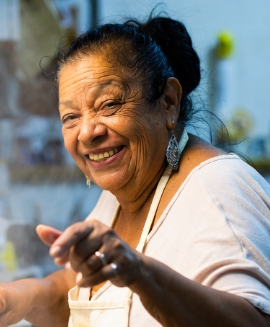
We made twenty. We ate eight. Marisol's neighbor Doña Esperanza, who has lived on this street for sixty years and knew our mother when Luz María was a teenager, came over with her two grandchildren to eat the rest. Doña Esperanza is ninety-two and sharper than most people at fifty. She looked at me and said, "Carmen Delgado, your mother was a seamstress who made my wedding dress in 1963 and she charged me twelve dollars because I could not afford twelve-fifty. Tell her Esperanza sends love." I told her. Mami did not remember her. But Mami smiled at the name and said, "Esperanza was a good customer." Close enough.
Wednesday I walked Hato Tejas alone. The bakery where we bought pan sobao as children is closed now — the owner died in 2019 and no one took it over. The little park where Papi used to sit and argue politics with other men still exists, though the benches are new. I sat on one of the benches for a long time. I thought about Héctor, who used to play dominoes here with his friends when he was fourteen and already running a little wild. I thought about him the way I always think about him — with love, with the unanswerable ache, with the knowledge that he was who he was and the family was who it was and some deaths you do not solve, you carry.
The island is beautiful. The island is broken. Both things. Always both. Wepa.
I did not make a frittata in Marisol’s kitchen — I made alcapurrias, and they were exactly right, and I will make them again next year. But when I got back to Hartford and the gray came back and the coquí frogs were nowhere, I needed something I could make with my hands in my own kitchen that would feel like what that morning felt like: warm, communal, unhurried, made for sharing with whoever shows up at the door. A frittata asks for the same things a good alcapurria asks for — attention, a hot pan, and the willingness to feed people. Doña Esperanza would have eaten this too. I am almost certain of it.
Artichoke and Onion Frittata
Prep Time: 10 min | Cook Time: 20 min | Total Time: 30 min | Servings: 4
Ingredients
- 8 large eggs
- 1/4 cup whole milk
- 1/2 teaspoon kosher salt
- 1/4 teaspoon black pepper
- 2 tablespoons olive oil
- 1 medium yellow onion, thinly sliced
- 2 cloves garlic, minced
- 1 can (14 oz) artichoke hearts, drained and roughly chopped
- 1/4 cup grated Parmesan cheese
- 2 tablespoons fresh flat-leaf parsley, chopped
Instructions
- Whisk the eggs. In a large bowl, whisk together the eggs, milk, salt, and pepper until smooth and slightly frothy. Set aside.
- Soften the onion. Heat olive oil in a 10-inch oven-safe skillet over medium heat. Add the sliced onion and cook, stirring occasionally, for 8–10 minutes until soft and golden at the edges.
- Add garlic and artichokes. Stir in the minced garlic and cook for 1 minute until fragrant. Add the chopped artichoke hearts and stir to combine, spreading the mixture evenly across the pan.
- Pour in the eggs. Reduce heat to medium-low. Pour the egg mixture over the vegetables. Sprinkle the Parmesan over the top. Cook undisturbed for 4–5 minutes, until the edges are set but the center is still slightly loose.
- Finish under the broiler. Transfer the skillet to a broiler set to high and cook for 2–3 minutes, watching closely, until the top is puffed, golden, and fully set.
- Rest and serve. Remove from the broiler and let rest for 2 minutes. Scatter fresh parsley over the top, slice into wedges, and serve directly from the pan.
Nutrition (per serving)
Calories: 280 | Protein: 18g | Fat: 17g | Carbs: 10g | Fiber: 3g | Sodium: 520mg