
 By
By July sky. The light at nine PM still warm. Sunday farmers market. Tomatoes, shiso, kabocha when in season, mushrooms in fall. The shopping list is short and exact.
Miya, 9, can shape onigiri without falling apart. She uses wet hands. She knows the order without being told. I drank miso from Fumiko's chipped bowl. The chip fits my lip. The lip fits the chip. The bowl is the small daily ritual.
Shiso salad. Tomatoes from the garden, cucumber, shiso ribbons, sesame dressing. A salad that smells like summer.
The shiso. The chipped bowl. The newsletter on Sunday.
Therapy Tuesday. We talked about the wedding. We talked about Barbara. We talked about Fumiko. The hour passed. The work continues.
Miya's old room is now my office. The desk is by the window. The shiso outside. The newsletter in progress. The afternoons are quiet.
Coffee with a friend Saturday morning. We talked about books, about kids, about the way our forties became our fifties. The talking is the thing.
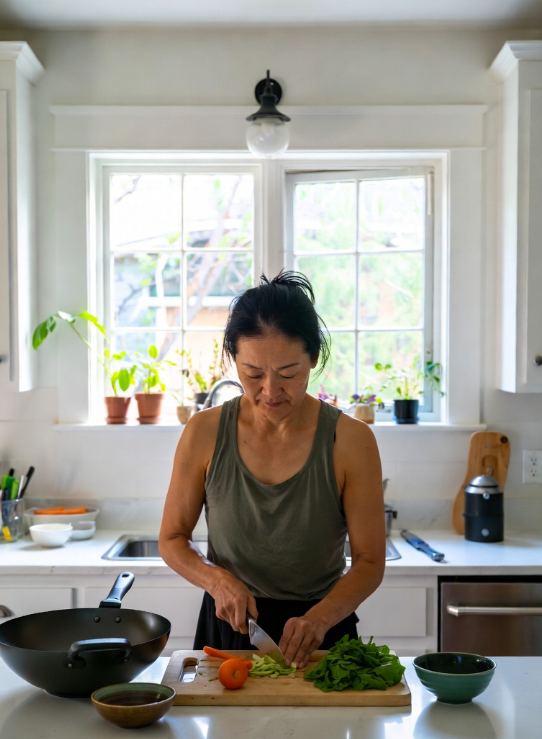
I cleaned the kitchen Sunday afternoon. Wiped the counters. Reorganized the drawer where the chopsticks live. Sharpened the knife. The reset was the reset.
A panic flicker Tuesday evening, brief, manageable. I breathed. I drank water. I went outside and walked around the block. The flicker passed. The body did its work.
A reader sent me a handwritten card this week. Her grandmother had cooked Japanese food in 1970s Boise. She had felt alone in it. The newsletter, she wrote, made her feel less alone. I taped the card to the wall above my desk.
Tomi watered the garden Saturday morning. The shiso was head-high. The shishito peppers were producing. The kabocha was running on the fence.
I read for an hour Sunday night. A book of essays by a Korean-American writer about food and grief. I underlined a paragraph that said exactly what I had been trying to say in the newsletter for months.
Miya is in elementary school. The Saturday Japanese school continues. She still complains. She is still going.
The cat was the cat. Mochi at fifteen sleeps most of the day. She still eats with enthusiasm. She still sits at the kitchen window watching the back garden.
I wrote at the kitchen table from six to eight. The newsletter was forming. The opening sentence was the hard sentence — they always are. I rewrote it five times. The fifth time was the right time.
I drove to Uwajimaya Wednesday. Kombu, bonito flakes, white miso, a small bag of mochiko for tomorrow's project. The store smells like home.
Yoga Tuesday morning. The studio in Sellwood. Eight students. The class was the class.
I made onigiri for tomorrow's lunch. Three triangles. Salted plum in the center. Wrapped in nori. The cling wrap. The drawer where I keep them. The system.
Sunday farmers market in the rain. The vendors knew me. The Hood River apple stand had honeycrisps. I bought four pounds.
Made dashi at five-thirty AM. Ten minutes in the kitchen alone with the kombu and the bonito flakes. The day's first prayer.
I texted Miya a photo of the shiso. She texted back a heart and a single word: home.
The rain in long sheets Tuesday afternoon. I made tea. I watched it from the porch. The cottonwoods on the next block were silver in the wet.
The neighbor's dog barked at nothing for twenty minutes Sunday afternoon. The neighbor apologized. I told him I had been writing through it and the white noise was helpful. He laughed.
I bought four pounds of honeycrisps that rainy Sunday without knowing exactly what I’d do with them — only that the Hood River stand was there and the apples were right and some things you just carry home. A few went into lunches, one went to Mochi’s general vicinity and was ignored, and the rest became this bread: the kind that fills the kitchen with cinnamon while the newsletter is still open on the table. It is not a complicated recipe. That is exactly why it belongs to this kind of week.
Apple Raisin Bread
Prep Time: 20 min | Cook Time: 55 min | Total Time: 1 hr 15 min | Servings: 12
Ingredients
- 2 cups all-purpose flour
- 1 tsp baking soda
- 1 tsp baking powder
- 1/2 tsp fine sea salt
- 1 tsp ground cinnamon
- 1/4 tsp ground nutmeg
- 3/4 cup granulated sugar
- 2 large eggs, room temperature
- 1/2 cup neutral vegetable oil
- 1/4 cup sour cream or plain whole-milk yogurt
- 1 tsp pure vanilla extract
- 1 1/2 cups peeled, cored, and diced honeycrisp or other firm apple (about 2 medium)
- 3/4 cup raisins
Instructions
- Heat the oven. Preheat oven to 350°F. Grease a 9x5-inch loaf pan and line the bottom with a strip of parchment paper.
- Combine dry ingredients. In a large bowl, whisk together the flour, baking soda, baking powder, salt, cinnamon, and nutmeg until evenly mixed.
- Whisk wet ingredients. In a separate medium bowl, whisk together the sugar, eggs, oil, sour cream, and vanilla until smooth and slightly thickened, about 1 minute.
- Bring it together. Pour the wet ingredients into the dry ingredients and fold with a spatula until just combined — a few streaks of flour are fine. Do not overmix.
- Fold in fruit. Add the diced apple and raisins and fold gently until evenly distributed through the batter.
- Bake. Scrape batter into the prepared loaf pan and smooth the top. Bake on the center rack for 50–55 minutes, until the top is deep golden and a toothpick inserted in the center comes out clean. If the top browns too quickly, tent loosely with foil after 40 minutes.
- Cool completely. Let the bread rest in the pan on a wire rack for 15 minutes, then turn out and cool fully before slicing. It slices cleanest when completely cool, though no one will wait that long.
Nutrition (per serving)
Calories: 248 | Protein: 3g | Fat: 10g | Carbs: 38g | Fiber: 1g | Sodium: 190mg