
 By
By Halloween costumes at the Filipino Community Pageant. A quiet shift Saturday — appendicitis, a fishhook in a thumb, a college student's alcohol. The quiet was the gift.
Lourdes is 75. She is slower. She still cooks. She still tells me to find a husband even though I have one. Joseph called Saturday. He told me Lourdes calls him every day. He answers every day. The pattern has held for 7 years.
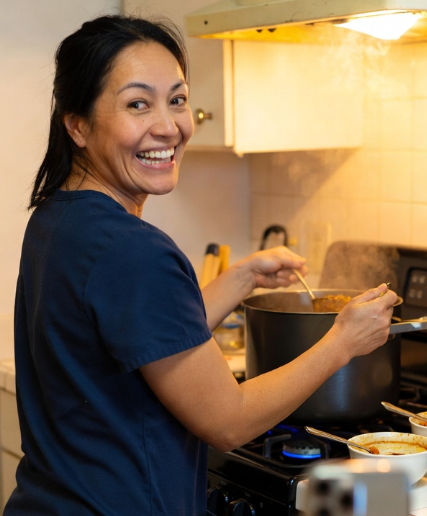
I made pork sinigang Sunday. The rib bones, the tamarind broth, the kangkong. The classic.
The blog post this week was about kitchen rituals at Anchorage latitudes. It got six hundred comments.
Angela came over Saturday with the kids. We cooked. We argued about pancit proportions — she uses more soy, I use more calamansi. We are both wrong, according to Lourdes.
The week was ordinary. The ordinary is the point now. The ordinary is the keeping.
I checked email at the kitchen table while the rice cooked. There were one hundred and twenty unread messages. I closed the laptop. The unread can wait.
The break room had cake Tuesday. Someone's birthday. We ate the cake. We did not ask whose birthday. The cake was the cake.
The neighbors invited us over for a small dinner Thursday. They are an Iñupiaq family — Aana and her grandson Joe. We ate caribou stew and rice. I brought lumpia. The kitchens of Anchorage have always been the small UN. The food is the proof.
I made tea late at night. The tea was the small comfort. The comfort was the marker.
The grocery store had no calamansi. I substituted lime. The substitution was acceptable. The acceptable is the working version of perfect.
A reader from New Jersey wrote in about her grandmother's adobo, which used pineapple. I had never heard of pineapple in adobo. I tried it. It was strange. It was also good. The strange and the good are not opposites.
I took a walk on the coastal trail Saturday. The light was good. The body was tired but moving.
I sat on the balcony in the cold for ten minutes Sunday night with a cup of broth in my hands. The cold was the cold. The broth was the broth. The body held both.
I had a long phone call with Dr. Reeves on Wednesday. We talked about pacing and rest and the way the body keeps a log of what it has carried. Dr. Reeves said, "Grace. The body remembers. The mind forgets. The cooking is the bridge." I wrote the line down. The line is now on a sticky note above the kitchen sink.
Auntie Norma called Sunday to ask if I had a recipe for a particular merienda from Iloilo. I did not. I said I would ask Lourdes. I asked Lourdes. Lourdes had it. The chain.
I read a chapter of a novel before bed each night this week. The novel was about a Filipina nurse in California. The novel was good. The novel was, in some way, my own life adjacent.
Auntie Norma called Sunday afternoon. She is now seventy-nine. She wanted a recipe. I gave it to her. She wanted to know how my week was. I told her, briefly. She told me about her week. The exchange took eighteen minutes. The eighteen minutes was the keeping.
I drove home Tuesday evening and the sun set at three forty-five and the highway was already iced at the bridges and the radio was on a station I did not recognize and I did not change it.
I read three chapters of the novel Saturday night before sleep. The novel was about a Filipina nurse in California. The nurse was being undone by her work. I knew the unraveling. I had lived the unraveling. I read on. The reading was the witnessing.
Sunday night I sat on the balcony in the cold with a cup of broth and I thought about how the body holds comfort in a vessel — how it doesn’t matter much what is in the cup, only that the cup is warm and the hands are around it. I had made sinigang that afternoon, and the broth was already gone, so I made tea instead. This hibiscus tea — deep red, a little tart, a little sweet — is the one I come back to when the week has been full and the body needs something that is not food but is close to food. Dr. Reeves said the cooking is the bridge; I think the tea is the bridge too, the smaller one, the one you cross in the dark.
Agua de Jamaica (Hibiscus Tea)
Prep Time: 5 minutes | Cook Time: 15 minutes | Total Time: 20 minutes | Servings: 6
Ingredients
- 1 cup dried hibiscus flowers (jamaica)
- 6 cups water, divided
- 1/2 cup sugar, or to taste
- 1 cinnamon stick
- 3 whole cloves
- 1 tablespoon fresh lime juice
- Ice, for serving (optional — or serve warm)
Instructions
- Simmer the base. Combine 3 cups of water with the dried hibiscus flowers, cinnamon stick, and cloves in a medium saucepan. Bring to a boil over medium-high heat, then reduce to a simmer. Cook for 10 minutes until the water is deeply red and fragrant.
- Sweeten. Remove from heat and stir in the sugar until fully dissolved. Taste and adjust sweetness — the hibiscus is naturally tart, so add sugar gradually to your preference.
- Strain and dilute. Pour the concentrate through a fine mesh strainer into a pitcher, pressing the flowers gently to extract all the liquid. Discard the solids. Add the remaining 3 cups of cold water and the lime juice. Stir to combine.
- Serve. Serve over ice for a cool drink, or pour directly into a mug for a warm, late-night cup. The concentrate keeps in the refrigerator for up to one week.
Nutrition (per serving)
Calories: 70 | Protein: 0g | Fat: 0g | Carbs: 18g | Fiber: 0g | Sodium: 5mg