
 By
By The week after the funeral. The fog week. The week where everything is both too clear and too blurry, where the tasks of death — the paperwork, the phone calls, the thank-you notes for casseroles, the decisions about what to keep and what to give away — replace the tasks of living, and the replacement is mechanical and exhausting and necessary.
I cleaned the kitchen. Not the big cleaning — that comes later — but the daily cleaning, the washing of the dishes that the community brought, the returning of the casserole pans to their owners (a task that requires a spreadsheet because Iowa funeral food arrives in unlabeled pans and matching pan to owner is a forensic exercise). The refrigerator held forty-seven containers of food brought by neighbors. I organized them by date and type. I made a plan for eating them. The plan was the closest thing to cooking I did that week — not cooking but managing, organizing, directing, the work of a woman who can't quite make herself stand at the stove but can make herself stand in front of the refrigerator and impose order on chaos.
Roger was quiet. Quieter than his usual quiet, which was already very quiet. He sat in his chair. He watched the crop reports. He drank tea — too strong, the same as always, made by his own hand now because the hand that used to drink it is gone. He didn't complain. He didn't cry, not that I saw. He sat in the quiet and he lived in the quiet and the quiet was his grief, the same way my cooking is my grief, the same way Noah's music is his grief, the same way Jack's soil jar is his grief. Everyone grieves in their own language. Roger's language is silence.
I called Mom's quilting circle to tell them. Seven women on a Zoom call, all crying, all asking what they could do, and I said the only thing I knew to say: "She'd want you to keep quilting." They're making a memorial quilt. Marlene's fabrics. Marlene's patterns. The quilt will hang in the church hall, where the quilting circle meets, where Marlene sat every Tuesday and stitched with the precision that was her trademark and her love language. The quilt will be there. Marlene will be there, in the stitches, in the fabric, in the pattern that her hands designed and other hands will finish.
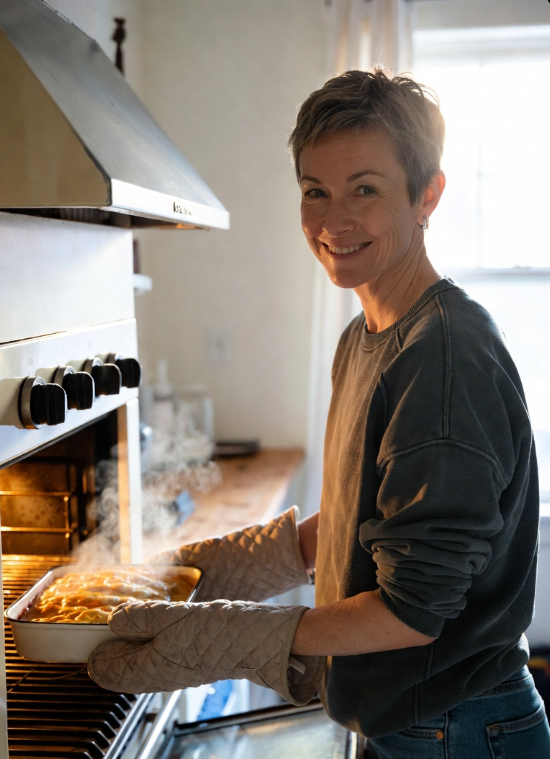
By the end of that fog week, the neighbors’ casseroles were dwindling and I knew I’d have to cook again eventually — not because I wanted to, but because Roger needed something warm and I needed to feel useful in a way that wasn’t just managing a spreadsheet. This 10-minute spinach lasagna was the answer: simple enough that I could make it in the mechanical, step-by-step way I was moving through everything that week, substantial enough to feel like a real meal, and close enough to the casserole spirit of all those unlabeled pans that it felt right. It’s the dish you make when you’re not quite ready to cook but you’re ready to try.
10-Minute Spinach Lasagna
Prep Time: 5 min | Cook Time: 5 min | Total Time: 10 min | Servings: 6
Ingredients
- 9 no-boil lasagna noodles
- 1 jar (24 oz) marinara sauce
- 1 container (15 oz) whole-milk ricotta cheese
- 1 package (10 oz) frozen chopped spinach, thawed and squeezed very dry
- 2 cups shredded mozzarella cheese, divided
- 1/4 cup grated Parmesan cheese
- 1 large egg
- 1 teaspoon Italian seasoning
- 1/2 teaspoon garlic powder
- 1/4 teaspoon salt
- 1/4 teaspoon black pepper
Instructions
- Mix the filling. In a medium bowl, stir together the ricotta, squeezed-dry spinach, 1 cup of the mozzarella, the Parmesan, egg, Italian seasoning, garlic powder, salt, and pepper until fully combined.
- Spread the base. Pour about 1/2 cup of marinara sauce into the bottom of a microwave-safe 9x13-inch baking dish and spread it into an even layer.
- Layer the lasagna. Lay 3 no-boil noodles over the sauce (they will overlap slightly). Spread half the ricotta-spinach mixture over the noodles, then spoon on about 3/4 cup of marinara. Repeat with 3 more noodles, the remaining ricotta mixture, and another 3/4 cup of sauce. Finish with the last 3 noodles and pour the remaining marinara evenly over the top.
- Add the cheese. Scatter the remaining 1 cup of mozzarella evenly across the top layer of sauce.
- Microwave. Cover the dish tightly with microwave-safe plastic wrap, leaving one corner vented. Microwave on high for 8 to 10 minutes, rotating the dish halfway through, until the noodles are tender and the cheese is melted and bubbling at the edges.
- Rest and serve. Let the lasagna stand, still covered, for 2 minutes before cutting. This allows the layers to set so it slices cleanly. Serve warm.
Nutrition (per serving)
Calories: 390 | Protein: 23g | Fat: 17g | Carbs: 36g | Fiber: 3g | Sodium: 710mg