
 By
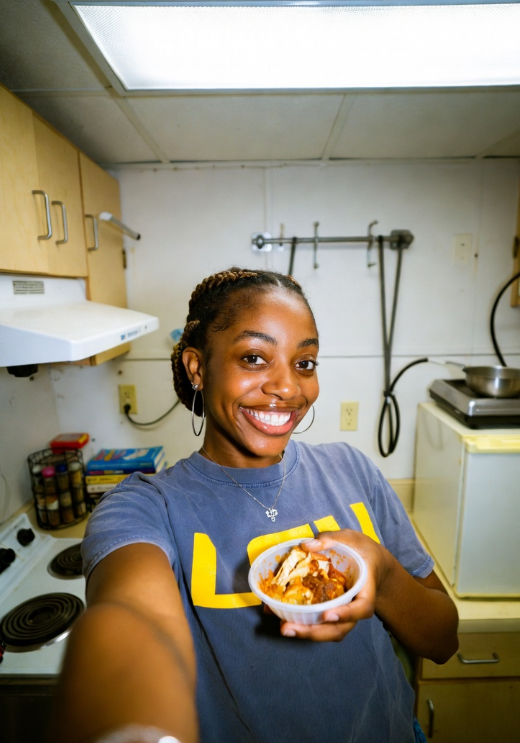
By The apartment has changed everything. Not the studying — the studying is the same, desk, flashcards, library — but the living. I come home and the kitchen is there. Not a communal kitchen shared with forty strangers, but MY kitchen, and the difference between communal and personal is the difference between borrowing and owning, between visiting and inhabiting. I inhabit this kitchen. I have spread out in it. The spice rack is organized by frequency of use (cumin on the left, Tony Chachere's on the right, because I reach for Tony's more often and MawMaw Shirley would say this is both expected and correct). The cast iron pot has a permanent place on the back burner. The recipe card is pinned to the wall above the stove with a thumbtack.
I have started cooking on a budget that I track meticulously — not because I have to, but because the tracking is the point. How much does a pot of red beans cost? $3.47 if I use dried beans and smoked sausage from Walmart. How far does it stretch? Five meals if I portion correctly. What is the cost per meal? $0.69. Less than a dollar. I am writing these numbers down because someday, when I have a medical practice in north Baton Rouge, I am going to teach the parents of my patients how to feed their families for less than a dollar a meal, and the credibility of that teaching will come from having done it myself, in a one-bedroom apartment on Highland Road, at nineteen years old, with MawMaw Shirley's recipes and Mama's efficiency and my own stubborn refusal to believe that poverty and nutrition are mutually exclusive.
Saturday at Baker. MawMaw Shirley was in the garden, harvesting the last of the summer okra. She filled a paper bag and handed it to me. "For your kitchen," she said. I took the okra home and fried it that night — cornmeal dusted, cast iron fried, the way she taught me — and ate it standing at the counter because I was too hungry to wait for a plate. Fried okra eaten standing up in your own kitchen at 9 p.m. is not a meal. It is a milestone.
That night with the fried okra reminded me what cooking in my own kitchen actually means — not just feeding myself, but honoring the whole chain of people who taught me how. So when I wanted something that could stretch across a week and still taste like intention, I went back to another one of MawMaw Shirley’s fundamentals: a low-and-slow roast beef with gravy, built in one pot, over steady heat, with no shortcuts. It’s the kind of meal that makes a one-bedroom apartment smell like somebody’s grandmother lives there, which, in a way, she does.
Roast Beef and Gravy
Prep Time: 15 min | Cook Time: 3 hrs | Total Time: 3 hrs 15 min | Servings: 6
Ingredients
- 3 to 3 1/2 lb boneless chuck roast
- 1 1/2 tsp kosher salt
- 1 tsp black pepper
- 1 tsp garlic powder
- 1 tsp onion powder
- 2 tbsp vegetable oil
- 1 large yellow onion, roughly chopped
- 4 cloves garlic, smashed
- 2 cups beef broth
- 1 tbsp Worcestershire sauce
- 2 tsp fresh thyme (or 3/4 tsp dried)
- 3 tbsp all-purpose flour
- 2 tbsp cold water
Instructions
- Season the roast. Pat the chuck roast completely dry with paper towels. Combine salt, pepper, garlic powder, and onion powder, then rub the mixture evenly over all sides of the roast. Let it rest at room temperature for 15 minutes while the oven preheats to 300°F.
- Sear on all sides. Heat vegetable oil in a large cast iron pot or Dutch oven over medium-high heat until shimmering. Sear the roast for 3 to 4 minutes per side until a deep brown crust forms. Do not rush this step — the crust is where the flavor lives. Transfer the roast to a plate.
- Build the base. Reduce heat to medium. Add the chopped onion to the pot and cook, stirring occasionally, for 3 to 4 minutes until softened and golden at the edges. Add the smashed garlic and cook 1 minute more. Pour in the beef broth and Worcestershire sauce, scraping up any browned bits from the bottom of the pot.
- Braise low and slow. Return the seared roast to the pot, nestling it into the liquid. Add thyme. The liquid should come about 1/3 of the way up the roast — add a splash more broth if needed. Cover tightly and transfer to the oven. Cook for 2 1/2 to 3 hours, until the meat is fork-tender and pulls apart easily.
- Rest the roast. Transfer the roast to a cutting board and tent loosely with foil. Let it rest for 10 minutes before slicing or shredding.
- Make the gravy. Place the pot with drippings over medium heat on the stovetop. Whisk together the flour and cold water in a small bowl until smooth, then pour the slurry into the simmering drippings, whisking constantly. Cook for 3 to 4 minutes, stirring often, until the gravy thickens to your liking. Taste and adjust salt and pepper.
- Serve. Slice or pull the beef and arrange on plates or over rice. Spoon the pan gravy generously over the top and serve hot.
Nutrition (per serving)
Calories: 390 | Protein: 38g | Fat: 22g | Carbs: 7g | Fiber: 1g | Sodium: 540mg