
 By
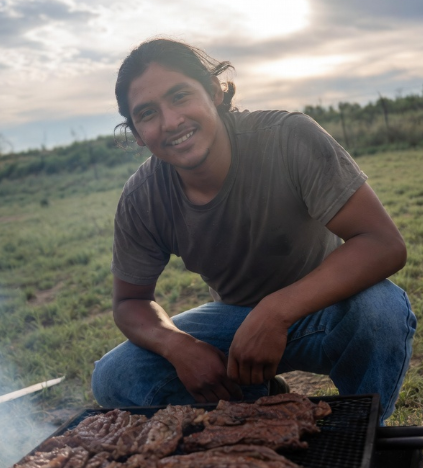
By Wren cooked her first deer the following Sunday. She came at nine in the morning with a list she'd written in her notebook — the herbs she needed, the chiles, the dried corn she'd asked me to save from last season. Hannah drove her and stayed, which I was glad of. This was Wren's kitchen time but it was also Hannah's moment to watch.
She worked methodically, the way she does, cutting the venison shoulder into pieces of a consistent size and explaining as she went why she was keeping them that size, what it meant for the cooking time. She had the chiles soaking in warm water from the start. She built the braise in stages — brown the meat, build the base, add the chiles and stock, let it go. She adjusted the heat twice without being told to. She smelled the pot at each stage and added what it needed.
The stew finished after three hours and we sat down to eat — Hannah, Thomas, me, and Wren, who served everyone else before herself. She sat down last and tasted her stew and was quiet for a moment and then said: "It needs more time." I tasted it. She was right; the meat was almost there but not quite. We put it back on the stove for forty-five minutes. When we ate again it was exactly right.
That note — it needs more time — is the whole skill. Knowing when something isn't ready, being able to identify it, being willing to wait rather than serve what isn't done. Some people never learn that. Wren learned it at twelve on her first deer. I wrote it into the copy of the practical guide I gave her as a gift that afternoon. She read my note and then pressed the book to her chest for a moment before putting it in her bag.
That afternoon I kept thinking about what Wren said — it needs more time — and how rarely anyone says that out loud, about food or anything else. The venison stew she made was a three-hour project, but the same instinct lives in a much simpler pan dinner. This is the recipe I reach for on a weeknight when I want that same quality of patience and attention: pork chops built in stages, apples and onions coaxing something sweet and savory out of the fond, the whole thing asking you to smell it, taste it, and wait until it’s actually done.
One Pan Pork Chops with Apples and Onions
Prep Time: 10 minutes | Cook Time: 30 minutes | Total Time: 40 minutes | Servings: 4
Ingredients
- 4 bone-in pork chops (about 3/4 inch thick, roughly 8 oz each)
- 1 teaspoon kosher salt, plus more to taste
- 1/2 teaspoon freshly ground black pepper
- 1/2 teaspoon smoked paprika
- 2 tablespoons olive oil or neutral oil
- 1 tablespoon unsalted butter
- 1 large yellow onion, halved and sliced 1/4 inch thick
- 2 medium apples (such as Honeycrisp or Granny Smith), cored and sliced 1/4 inch thick
- 3 cloves garlic, thinly sliced
- 1 teaspoon fresh thyme leaves (or 1/2 teaspoon dried)
- 1/2 cup apple cider or unsweetened apple juice
- 1/2 cup low-sodium chicken broth
- 1 teaspoon Dijon mustard
Instructions
- Season the chops. Pat pork chops dry with paper towels. Season both sides evenly with salt, pepper, and smoked paprika. Let them sit at room temperature for 5 to 10 minutes while you prep the remaining ingredients.
- Sear the pork. Heat the oil in a large, heavy skillet (cast iron works well) over medium-high heat until shimmering. Add the pork chops in a single layer and sear without moving them for 3 to 4 minutes per side, until a deep golden crust forms. Transfer to a plate and set aside — they will finish cooking in the sauce.
- Build the base. Reduce heat to medium. Add the butter to the same pan. Once melted, add the onion and cook, stirring occasionally, for 6 to 8 minutes until softened and beginning to caramelize at the edges. Add the garlic and thyme and cook for 1 minute more, until fragrant.
- Add the apples. Add the sliced apples to the pan and stir gently to combine with the onions. Cook for 2 to 3 minutes until the apples begin to soften slightly but still hold their shape.
- Deglaze and braise. Pour in the apple cider and chicken broth, scraping up any browned bits from the bottom of the pan. Stir in the Dijon mustard. Bring to a gentle simmer, then nestle the pork chops back into the pan, settling them into the apple and onion mixture.
- Finish and rest. Cover the pan loosely and cook over medium-low heat for 10 to 14 minutes, until the pork chops are cooked through and register 145°F at the thickest part. Taste the sauce and adjust salt as needed. Remove from heat and let the chops rest in the pan for 5 minutes before serving, spooning the apples and onions over the top.
Nutrition (per serving)
Calories: 390 | Protein: 34g | Fat: 19g | Carbs: 18g | Fiber: 2g | Sodium: 470mg