The week began the way the weeks begin now: coffee at 5:30 AM in the dark kitchen, Sven at my feet, the lake beginning to show itself through the window as the gray of pre-dawn turned into the gray of full dawn. The silence is no longer the silence I feared. The silence is the architecture of a life I am still learning to live in. I have lived in this house for thirty-seven years. The first thirty-two of them, Paul lived here too. The last five, he has not. The math gets clearer every year and the meaning gets harder.
Mamma called Tuesday. Her voice was small but her mind was sharp. She wanted to talk about Pappa, of all people. About the time he fixed her bicycle in 1962. About how he always said "there" when he had finished a job, the same way every time, the small declarative finality. She had not thought of this in years, she said. The memory came to her in the kitchen, while she was peeling an apple. I listened. I did not interrupt. The memory was unprovoked and total. The memory is everything.
Erik came over Sunday. He chopped wood for me without being asked — the pile by the back door was getting low, and Erik had noticed, and Erik had brought his ax, and Erik had spent forty-five minutes splitting and stacking and not making a single comment about how the wood needed to be done. He drank coffee. He left. The whole visit was forty-five minutes. It was perfect. Erik is a perfect brother in the specific way of Scandinavian brothers — silent, useful, present.
I cooked Spring vegetable stew this week. Leeks, new potatoes, carrots, asparagus, peas, dill, butter, vegetable stock. Twenty minutes. Light and green and sharp.
The Damiano Center on Thursday. The pot was bigger than usual — fifty-five gallons. The crowd was bigger than usual. The need does not respect the calendar. There is no holiday from hunger. There is no week off from the soup. We make the soup. They come for the soup. The pattern is reliable.
I thought about my own mother today. The full thought of her — Mamma at thirty in the kitchen on Fifth Street, Mamma at sixty in the kitchen on Fifth Street, Mamma at ninety in the kitchen on Fifth Street, Mamma in hospice in 2024 with her eyes closed and her hand in mine. The full arc of a person fits in a single thought, sometimes, if you let it. The thought is the inheritance. The thought is the visit.
It is enough. It has to be. And on a morning like this, with the lake doing what the lake does and the dog at my feet and the bread on the counter and the kitchen warm enough to live in, it is.
The Damiano Center has changed slowly over the years. The director has changed three times in the period I have volunteered. The volunteer roster has rotated, with new faces every year. The pot — the actual physical fifty-gallon stock pot — has been replaced once. The recipe has not changed. The recipe is a constant. The constancy is the gift the recipe gives to a place where so much else is in flux.
It is enough.
The bread on the counter this week was rye — dense, dark, faintly sour in the way that good things often are. I did not plan it as a response to the week; I planned it the way I plan most things now, which is to say I did not plan it at all but let the kitchen decide. Mamma always kept a rye loaf. Erik grew up cutting thick slices of it before he could reach the counter without a stool. If the stew is what I make for others, the bread is what I make to remind myself that I am still here, still warm, still someone who bakes on a Tuesday because Tuesday requires bread. This is that loaf.
Old World Rye Bread
Prep Time: 20 min | Cook Time: 35 min | Total Time: 2 hr 55 min (including rise) | Servings: 12 slices
Ingredients
- 2 1/4 teaspoons active dry yeast (one standard packet)
- 1 1/2 cups warm water (105–110°F)
- 2 tablespoons unsulfured molasses
- 1 tablespoon caraway seeds
- 1 1/2 teaspoons fine sea salt
- 2 tablespoons unsalted butter, softened
- 1 1/2 cups dark rye flour
- 1 3/4 cups bread flour, plus more for kneading
- 1 teaspoon vegetable oil, for the bowl
Instructions
- Proof the yeast. Combine warm water and molasses in a large bowl, then sprinkle yeast over the surface. Let stand 8–10 minutes until foamy and fragrant.
- Build the dough. Stir in the salt, softened butter, and caraway seeds. Add rye flour and mix until incorporated. Add bread flour, 1/2 cup at a time, stirring until a shaggy dough forms and pulls away from the sides of the bowl.
- Knead. Turn dough onto a lightly floured surface. Knead 8–10 minutes until the dough is smooth and elastic, adding small amounts of bread flour as needed to prevent sticking. Rye dough will remain slightly tacky — do not over-flour.
- First rise. Shape dough into a ball and place in a lightly oiled bowl, turning once to coat. Cover with a clean kitchen towel and let rise in a warm spot until doubled, about 1 hour to 1 hour 15 minutes.
- Shape. Punch dough down gently. Shape into an oval loaf and place on a parchment-lined baking sheet, or fit into a greased 9x5-inch loaf pan. Cover and let rise again until puffy, about 45 minutes.
- Preheat. Heat oven to 375°F (190°C) during the final 20 minutes of the second rise.
- Score and bake. Using a sharp knife or bread lame, cut 3 shallow diagonal slashes across the top of the loaf. Bake 32–38 minutes, until the crust is deep brown and the loaf sounds hollow when tapped on the bottom. An instant-read thermometer should read 200–205°F at the center.
- Cool. Transfer to a wire rack and cool at least 30 minutes before slicing. The interior continues to set as it cools — cutting too soon makes the crumb gummy.
Nutrition (per serving)
Calories: 148 | Protein: 4g | Fat: 3g | Carbs: 27g | Fiber: 3g | Sodium: 248mg
About the cook who shared this
Linda Johansson
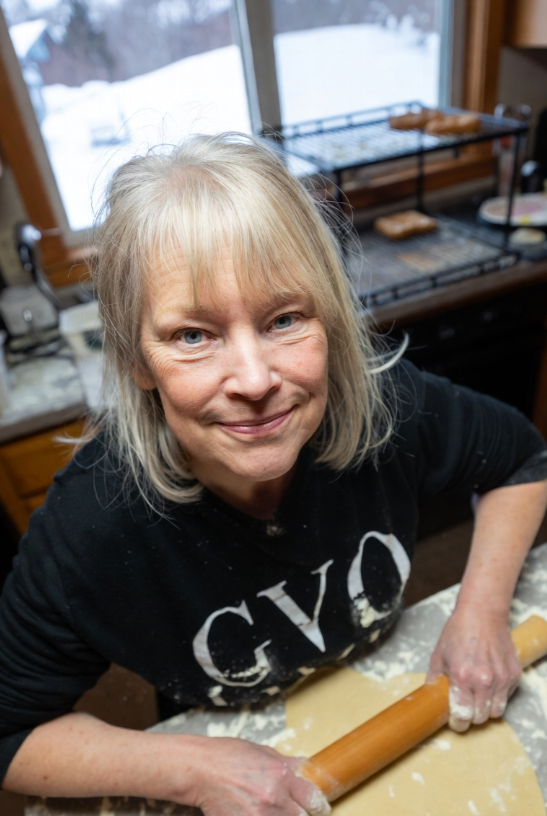
Week 370 of Linda’s 30-year story
· Duluth, Minnesota
Linda is a sixty-three-year-old retired nurse from Duluth, Minnesota, living alone in the house where she raised her children and said goodbye to her husband. She lost Paul to ALS in 2020 after two years of watching the kindest man she'd ever known lose everything but his dignity. She cooks Scandinavian comfort food and Minnesota hotdish and the pot roast Paul loved, and she sets two places at the table out of habit because it makes her feel less alone. Every recipe she writes is a person she's loved.
