
 By
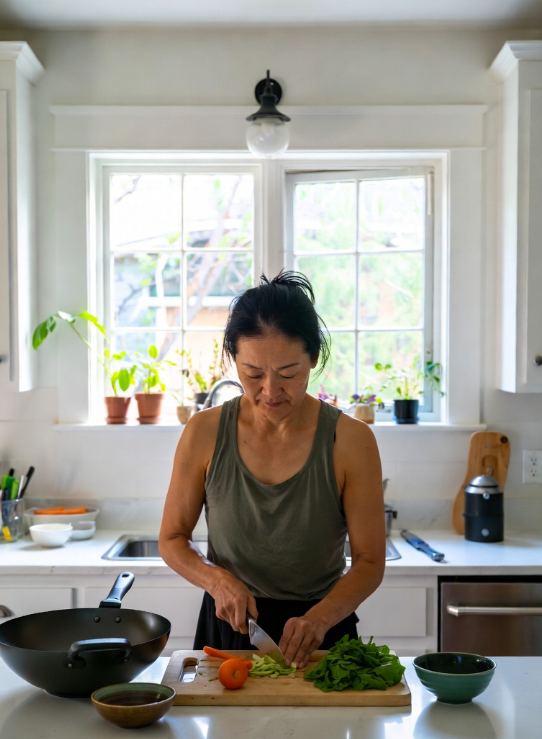
By Late April. I am returning to the second book with renewed energy — the publication of the first book has cleared a space in my mind, the way clearing the counter clears the kitchen. The counter was full of first-book anxiety and now it is empty and the emptiness is ready for new ingredients. The second book — Two Kitchens: On Being Neither and Both — is about Barbara's kitchen and Fumiko's kitchen and the space between them where I learned to cook, where I learned to be, where I learned that neither-and-both is not a deficit but a country.
I made Barbara's meatloaf this week — not Japanese, not from Fumiko, but from my American mother, from the kitchen in Sacramento where Barbara made meatloaf and macaroni and cheese and all the American comfort food that was my other inheritance, the inheritance I don't write about as often because the Japanese inheritance is more dramatic, more photogenic, more "interesting" to readers who associate food writing with the exotic. But Barbara's meatloaf is also an inheritance. Barbara's kitchen is also a kitchen. The meatloaf is also love. The love is also food. The second book is about this: the also. The both. The kitchen that is not Japanese and is not interesting to food magazines and is also mine, also my mother's, also the place where I learned that love comes in casserole form as well as miso form.
Miya tasted the meatloaf and said, "This is different." I said, "This is Grandma Barbara's recipe." She said, "It's good but it's not oishii." The distinction was precise and devastating: good is the English word. Oishii is the Japanese word. The English word applies to Barbara's food. The Japanese word applies to Fumiko's food. Miya has assigned languages to her grandmothers' cooking, and the assignment is both accurate and heartbreaking, because the assignment means the Japanese inheritance is the one that resonates deeper, and the deeper resonance is both a triumph (Fumiko's teaching worked) and a loss (Barbara's teaching is not less, just quieter).
Barbara’s meatloaf never sat alone on the table — there was always bread beside it, the crusty, uncomplicated kind that didn’t have a name or a story attached, that was just there, the way all of Barbara’s American kitchen was just there, reliable and quiet and not requiring explanation. When Miya said “good” instead of “oishii,” I thought about that bread — how it, too, is good, how good is not a lesser word but a different one, how the second book is also about the bread. I’ve been making it this week alongside the meatloaf, practicing what it means to let “also” be enough.
Crusty Bread
Prep Time: 15 min (plus 12–18 hr rise) | Cook Time: 45 min | Total Time: ~14 hr | Servings: 1 loaf (10 slices)
Ingredients
- 3 cups all-purpose flour, plus more for dusting
- 1 1/4 tsp salt
- 1/4 tsp active dry yeast
- 1 1/2 cups warm water (about 100°F)
- 1 tsp sugar
Instructions
- Mix the dough. In a large bowl, whisk together flour, salt, yeast, and sugar. Add warm water and stir with a wooden spoon or spatula until a shaggy, sticky dough forms — about 1 minute. Do not knead.
- First rise. Cover the bowl tightly with plastic wrap or a damp towel. Let the dough rest at room temperature for 12 to 18 hours, until the surface is bubbly and the dough has roughly doubled in size.
- Shape the loaf. Turn the dough out onto a well-floured surface. With floured hands, fold the dough over itself two or three times to form a rough ball. Place seam-side down on a large piece of parchment paper. Cover loosely and let rest 1 to 2 hours, until puffy.
- Preheat the oven. About 30 minutes before baking, place a Dutch oven (with lid) on the center rack. Preheat oven to 450°F (230°C). The Dutch oven must be fully heated before the bread goes in.
- Bake covered. Carefully lift the parchment with the dough and lower it into the hot Dutch oven. Score the top once with a sharp knife or razor. Replace the lid and bake for 30 minutes. The steam trapped inside creates a crackling crust.
- Bake uncovered. Remove the lid and bake an additional 12 to 15 minutes, until the crust is deep golden brown and the loaf sounds hollow when tapped on the bottom.
- Cool before slicing. Lift the bread out using the parchment and transfer to a wire rack. Let cool at least 20 minutes before slicing — the interior finishes setting as it cools.
Nutrition (per serving)
Calories: 138 | Protein: 4g | Fat: 1g | Carbs: 28g | Fiber: 1g | Sodium: 295mg