
 By
By Mid-August. Post-birthday. The summer is in its late phase — the tomatoes at their peak, the basil going to flower, the shiso still producing but beginning to show the signs of late season: the leaves tougher, the flavor slightly bitter, the plant spending its last energy on seeds rather than leaves. The shift is annual and imperceptible unless you cook with the shiso daily, which I do, and the daily cooking is the daily noticing, and the daily noticing is the practice of attention that Fumiko taught without teaching, that I learned without learning, that exists in the space between the cook and the ingredient.
I made tsukudani — small preserved foods simmered in soy sauce and mirin, the kind of thing Fumiko kept in jars in her refrigerator: seaweed tsukudani, mushroom tsukudani, tiny dried fish tsukudani. The tsukudani is preservation food, the kind you make when the season is changing and you want to hold onto the flavor a little longer, the kind of food that says: I know this won't last, but I can make it last a little longer if I simmer it in soy sauce and keep it in the dark.
I visited Ken in Sacramento. Monthly trip, the routine, the road. His garden is producing its late-summer abundance: eggplant, peppers, the last tomatoes. The Parkinson's is — Ken would say "fine." Ken always says "fine." Fine is Ken's word for: manageable, present, not worse, endured. The tremor is there. The word-finding pauses are there. The garden is there. The miso soup is there. All the things are there, the declining things and the enduring things, side by side, the way they always are, the way they are for everyone, the decline and the endurance coexisting in the same body, the same garden, the same kitchen.
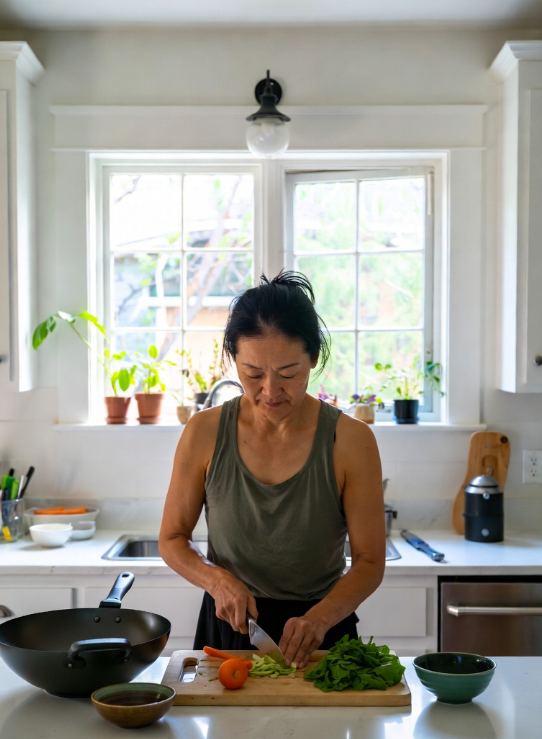
I made Fumiko's tamagoyaki for Ken — the rolled omelet, perfectly layered, the technique now so ingrained that my hands do it without instruction. Ken watched me make it and said: "Your hands look like hers." Your hands look like hers. Five words that split me open. My hands look like Fumiko's hands. The rolling, the tilting, the way the egg folds over itself — the gesture is the same, transmitted through observation and practice and years of repetition. My hands are Fumiko's hands. The hands that make the tamagoyaki are the hands that made the tamagoyaki. The hands are the chain. The chain holds.
I came home from Sacramento with Ken’s words still in me — your hands look like hers — and I found myself standing in the kitchen not quite ready to stop cooking, not quite ready to be still. There were apples on the counter, late-season, starting to soften at the shoulders the way late-season things do, and I knew what to do with them the same way I’d known what to do with the shiso: give them heat, give them sweetness, make them last a little longer. A baked apple is tsukudani logic applied to fruit — you take what’s at its peak, you transform it slowly, and you hold onto it for one more night.
Baked Apple
Prep Time: 10 minutes | Cook Time: 45 minutes | Total Time: 55 minutes | Servings: 4
Ingredients
- 4 large baking apples (Honeycrisp, Fuji, or Granny Smith)
- 4 tablespoons unsalted butter, divided
- 4 tablespoons packed brown sugar
- 1 teaspoon ground cinnamon
- 1/4 teaspoon ground nutmeg
- 1/4 teaspoon ground ginger
- 4 tablespoons old-fashioned rolled oats
- 4 tablespoons raisins or dried cranberries
- 1/2 cup apple cider or water
- Vanilla ice cream or whipped cream, for serving (optional)
Instructions
- Preheat the oven. Heat your oven to 375°F (190°C). Set out a small baking dish or an 8x8-inch pan.
- Core the apples. Using an apple corer or a small melon baller, remove the core from each apple, starting from the top and stopping about 1/2 inch from the bottom so the filling has a well to sit in. Peel the top third of each apple if you prefer a softer exterior.
- Make the filling. In a small bowl, combine the brown sugar, cinnamon, nutmeg, ginger, rolled oats, and raisins or cranberries. Stir until evenly mixed.
- Fill the apples. Place the cored apples upright in the baking dish. Spoon the filling mixture evenly into each cavity, pressing it in gently. Top each apple with 1 tablespoon of butter.
- Add the liquid. Pour the apple cider or water into the bottom of the baking dish. This keeps the apples moist and creates a light pan sauce as they cook.
- Bake, covered. Cover the dish loosely with aluminum foil and bake for 30 minutes.
- Finish uncovered. Remove the foil and bake for an additional 12—15 minutes, until the apples are tender when pierced with a knife and the filling is lightly caramelized. Baste once with the pan juices if you like.
- Rest and serve. Let the apples cool for 5 minutes before serving. Spoon the pan juices over the top and serve warm, with vanilla ice cream or whipped cream if desired.
Nutrition (per serving)
Calories: 225 | Protein: 1g | Fat: 9g | Carbs: 39g | Fiber: 5g | Sodium: 8mg